+91 9990176000
 +91 9999097600
 CALENDAR 2026


 On August 12, 2026, the world will witness a magical moment as the Sun is covered for some time. The stunning scenery will be visible in totality (sun will be fully covered for some time) in some places, while other parts of the Earth will witness it as a partial eclipse. (sun will appear partially covered).
A total solar eclipse will occur on 12th of August, 2026, which will be fully visible in places like Greenland (eastern part), Russia (northern part), and Iceland, and a small area of northeastern Portugal and finally Spain.
A partial eclipse will be visible in places like most of the provinces of Canada, the Northern United States (Alaska to parts of the East Coast), parts of Europe and northwestern Africa. If you want to know all about the total solar eclipse 2026 on 12th August 2026, this guide is for you.
What is a Total Solar Eclipse?
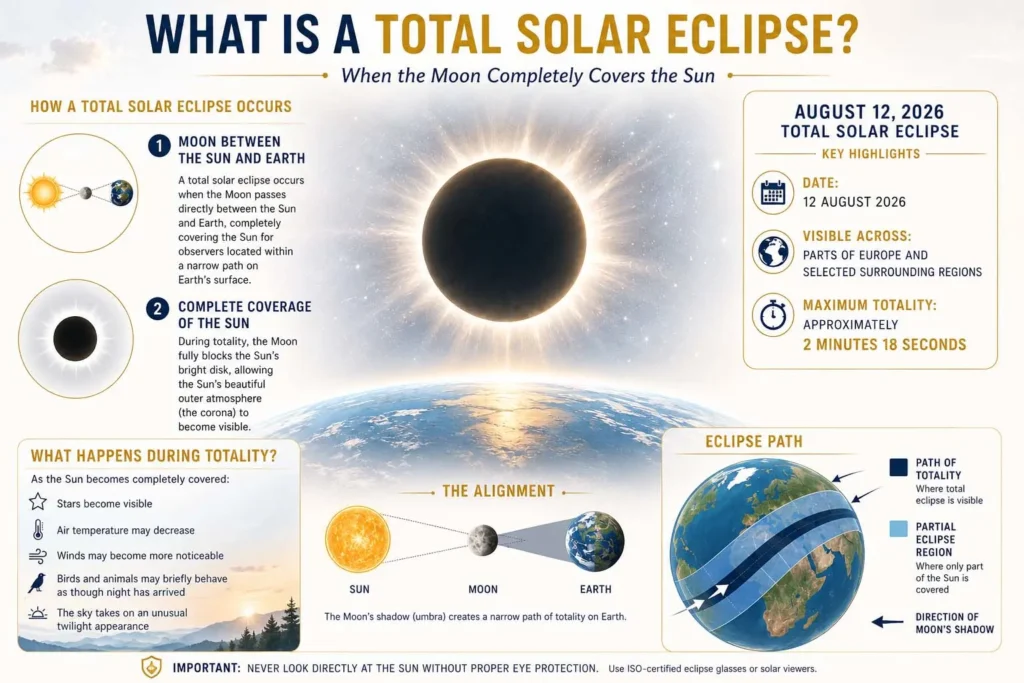 A solar eclipse occurs when the Moon directly passes between the Sun and Earth. As the Moon covers the Sun’s disk, a narrow path across Earth temporarily falls into darkness (where the eclipse is visible).
The complete coverage of the Sun for a particular time frame is called a total solar eclipse, which is visible in a few places on Earth. The solar eclipse of August 12, 2026 will be a total eclipse where the Sun will be fully covered by the Moon.
The eclipse will cross some parts of Europe and other places. The duration of totality, when the Sun will be completely obscured by the Moon, is approximately 2 minutes and 18 seconds.
With the Sun’s dazzling disc covered, the atmosphere will be dark and unique. Stars may become visible, temperatures can drop, winds may change, and birds often begin behaving as though night has arrived.
When is the Total Solar Eclipse in India?
According to the astronomical and astrological data, this solar eclipse on 12th August 2026 will not be visible in India, and sutak will also not be applied. However, the timing according to IST is as follows:- Official date of the eclipse: 12th August.
- Eclipse ending date as per Indian time zone: 13th August.
- Visibility in India: No.
- Maximum duration of the totality: 02 minutes 18 seconds.
- Longest Totality region: North Atlantic region and Greenland
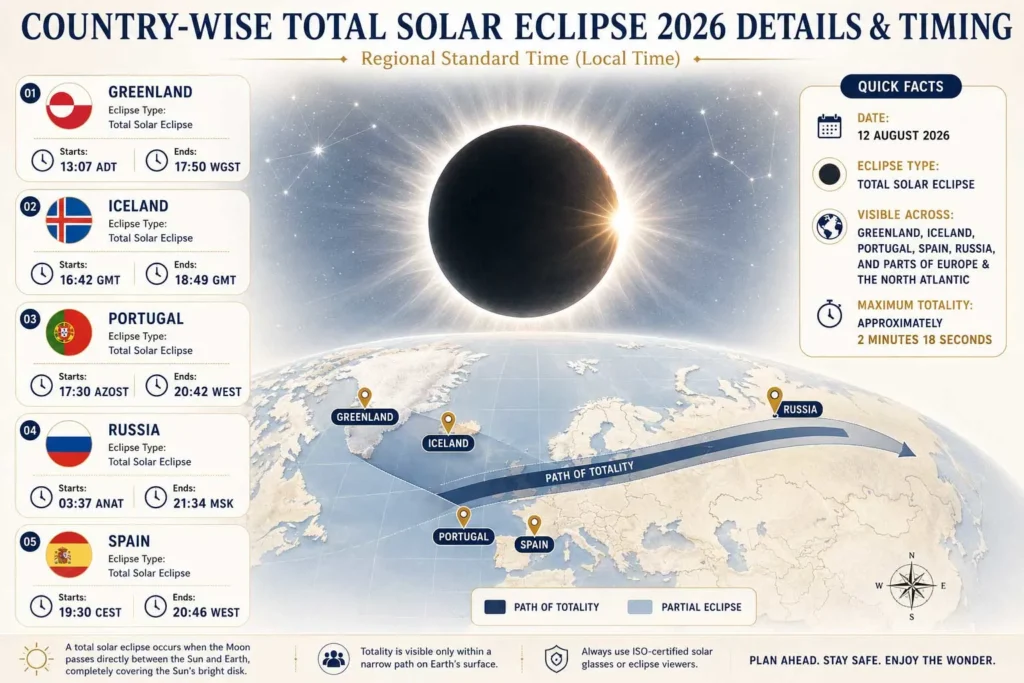
Country-wise Total Solar Eclipse Details and their Timing (as per their regional standard time frame)
|
Country |
Eclipse Type | Start of Eclipse |
End of Eclipse |
|
Greenland |
Total Solar Eclipse | 13:07 ADT | 17:50 WGST |
| Iceland | Total Solar Eclipse | 16:42 GMT |
18:49 GMT |
|
Portugal |
Total Solar Eclipse | 17:30 AZOST | 20:42 WEST |
| Russia | Total Solar Eclipse | 03:37 ANAT |
21:34 MSK |
|
Spain |
Total Solar Eclipse | 19:30 CEST |
20:46 WEST |
Where Can I Watch the Solar Eclipse?
Curious about watching the total eclipse? The good news is that the European Space Agency (ESA) will broadcast the eclipse visuals on 12 August 2026, 19:30 CEST. India Standard Time (IST): 11:00 PM (23:00 IST) on 12 August 2026. You can watch this sitting anywhere in the world. You will be able to watch it on YouTube at the mentioned time.What Can You See During a Total Solar Eclipse?
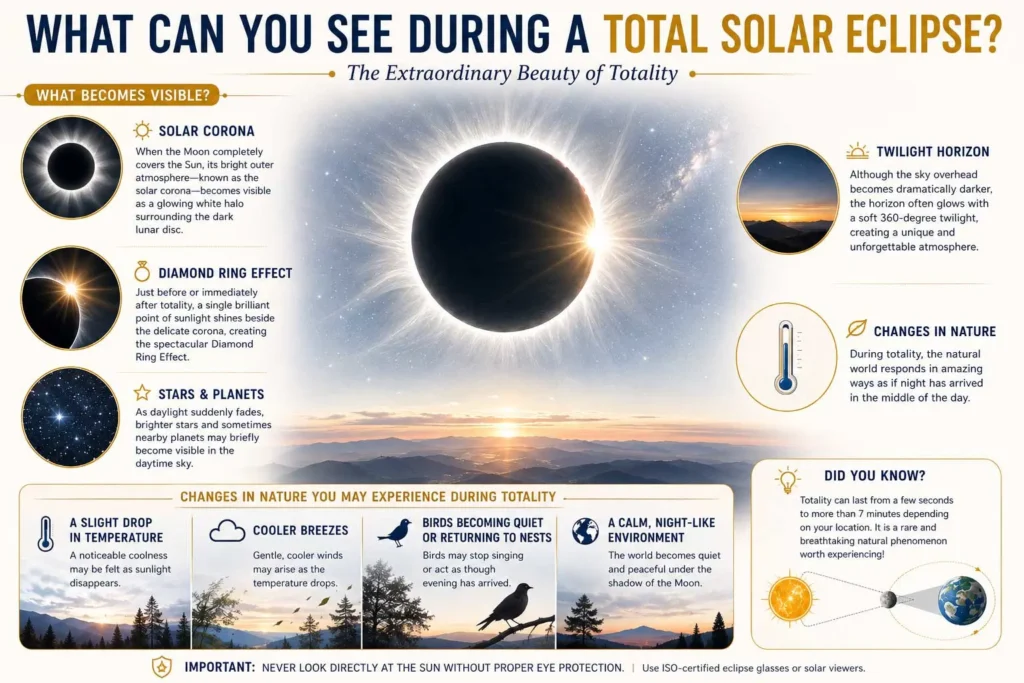 During a total solar eclipse, the Moon completely blocks the Sun, and a bizarre view is encountered when the glowing solar corona appears at the outermost part of the Sun adjacent to the Moon.
A deep, dark phenomenon appears in the sky, making the atmosphere charcoal dark. A single brilliant point of sunlight shines beside the delicate corona, creating the breathtaking appearance of a giant diamond ring.
Why Can’t We Look Directly at a Total Solar Eclipse?
Looking at the dark Sun during a partial or total solar eclipse is risky for our eyes and overall body. As the Sun’s light gets dimmed, the reduced brightness and solar corona create harmful rays that can cause harm to our eyes. If you are so curious to watch the view in real time with your eyes, it is advised to wear an eclipse glass.Astrological Impact of Total Solar Eclipse 2026
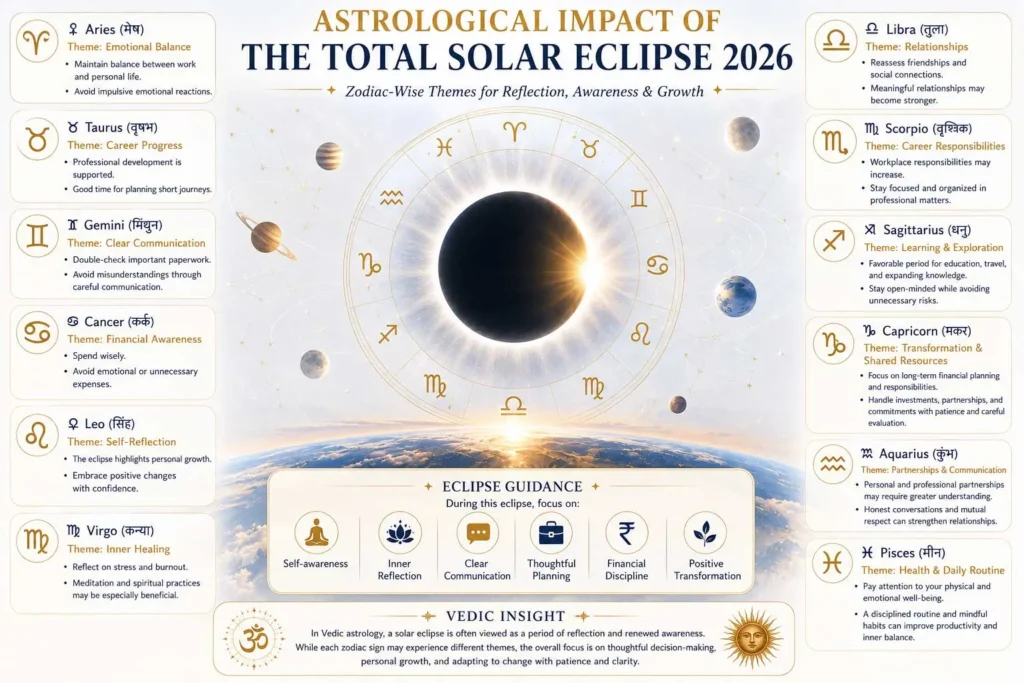 In countries like India, eclipse effects are seen through the lenses of astronomical as well as astrological views, as it is believed that solar or lunar eclipses have a celestial impact on our lives according to our birth zodiac sign (rashi). Here is a brief explanation of the zodiac impact as a result of the Total Solar Eclipse 2026:
- Aries: Emotional imbalance may create distress due to challenges in balancing work and personal life.
- Taurus: It’s a good time for professional development and for planning a short trip.
- Gemini: Handle your responsibilities and paperwork with clarity, as the eclipse seems to create confusion and misunderstanding.
- Cancer: Be aware financially and avoid emotional and unnecessary expenses.
- Leo: As the eclipse will occur in Leo. It’s a time of self-reflection for Leo natives and to accept changes.
- Virgo: Review yourself and overcome your doubts, stress and burnout. It’s the best time for spiritual activities and meditation.
- Libra: It’s a time for review of your friend circle and relationships. Some relationships may naturally fade; others will grow stronger and more meaningful.
- Scorpio: Due to this solar eclipse, your roles and responsibilities at the workplace will increase. You also need to be alert in terms of your profession.
- Sagittarius: A great time for acquiring new knowledge, exploring new things, travel, study and avoiding getting deeper into things.
- Capricorn: The natives of Capricorn need to be careful in matters of loans, investments and other money-related work.
- Aquarius: Aquarius natives will have a reality check about their connections, and they will gain clarity about their expectations from others in personal and professional life.
- Pisces: Pisces people will require more discipline and balance in their daily routine, work and health as the eclipse will affect these areas of life.
Conclusion
A total solar eclipse in 2026 is going to occur on 12th of August, which has its own effects on the world and humans. This totality of the eclipse will pass through a few parts of the world, such as Greenland, Russia, Portugal, Spain, etc. The dark and bizarre moment of the eclipse will be broadcast by the European Space Agency (ESA), where people can also view it on YouTube on the night of August 12. Astrologically, the time is also suitable for self-reflection and engaging in spiritual activities and meditation.You may also find this related article useful: Lunar Eclipse Rituals to Prevent Yourself from Its Effects