+91 9990176000
 +91 9999097600
 CALENDAR 2026


 Dhanteras is the festival of wealth, health and prosperity, with families lighting the first diya in their homes for the 5-day Diwali celebration. The festival is observed as the first day of Diwali, and it is believed that worshipping Mata Lakshmi, lord Kuber and Dhanwantari (often forgotten) on this day brings abundance, wisdom and good health. However, it is very important to understand the correct puja vidhi and rituals that give the complete blessings and merits of Dhanteras.
If you want to observe Dhanteras 2026 correctly, know its right muhurat, worship, story, and learn other important details; follow this guide.
The blog also covered the important Yamadeepam ritual (lighting a diya in the South direction) and its story, which devotees should know before observing Dhanteras 2026 in the evening. It also carries a list of traditional items that one should buy (as per their budget) and information about the key deity of Dhanteras- Dhanvantri, which is known to less number of people.
When is Dhanteras Festival in 2026: Dhanteras Kab Hain?
When the festival of Deepawali approaches (comes near), people begin to search for or ask about the Dhanteras date and time. If you want to know the Dhanteras date and time in 2026 along with the correct Dhanteras Muhurat, keep reading:Dhanteras 2026 Dates and Muhurats
Dhanteras 2026 falls on the 6th of November, 2026, two days before Diwali, on 8th November 2026. The Lakshmi and Kuber puja muhurat (Dhanteras puja muhurat) roughly begins after 6 pm and ends after 8 pm; check a trusted local panchang of your city to confirm the exact muhurat timings.- Dhanteras Puja: November 6, 2026 (Friday)
- Dhanteras Puja Muhurat: 06:02 PM to 07:57 PM (As per New Delhi time zone)
- Duration: 01 Hour 56 Mins
- Yama Deepam: on Friday, November 6, 2026
- Pradosh Kaal: 05:33 PM to 08:09 PM
- Vrishabha Kaal: 06:02 PM to 07:57 PM
- Trayodashi Tithi Begins: 10:30 AM on Nov 06, 2026
- Trayodashi Tithi Ends: 10:47 AM on Nov 07, 2026
Important Note: The Dhanteras worship (Lord Ganesha, Dhanwantari, Lakshmi and Kuber pujan) should be done before the end of Pradosh Kaal or Vrishabha Kaal and should not be extended late into the night. Start the puja in the evening following the actual muhurat and complete it before Pradosh or Vrishabh muhurat ends.
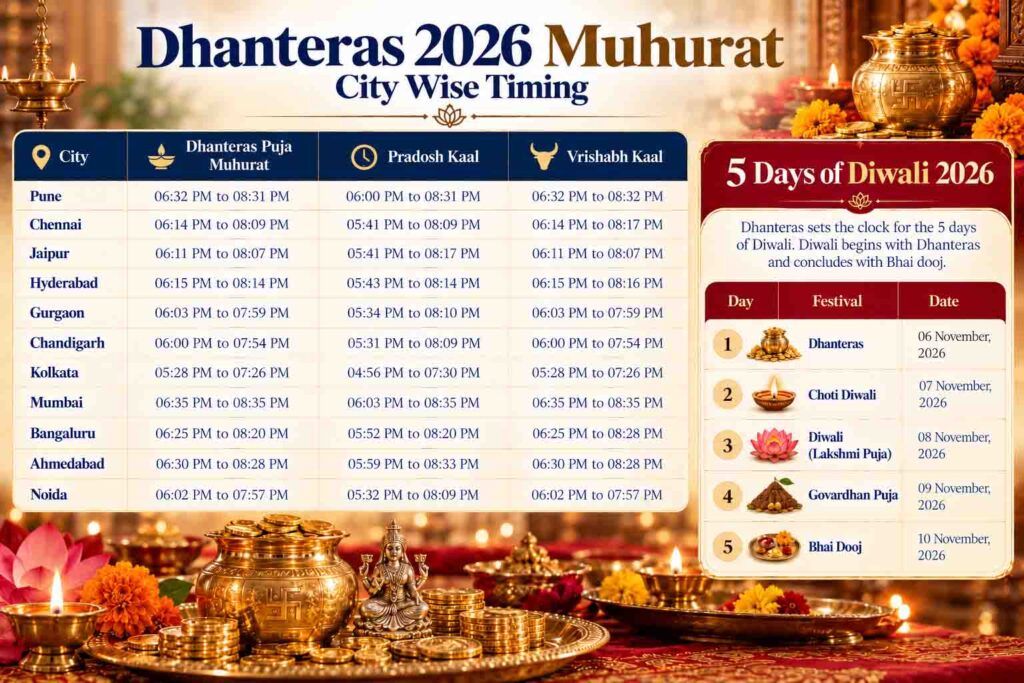
Dhanteras 2026 Muhurat: City-wise Timing
|
City |
Dhanteras Puja Muhurat | Pradosh Kaal |
Vrishabh Kaal |
| Pune | 06:32 PM to 08:31 PM | 06:00 PM to 08:31 PM | 06:32 PM to 08:32 PM |
| Chennai | 06:14 PM to 08:09 PM | 05:41 PM to 08:09 PM | 06:14 PM to 08:17 PM |
| Jaipur | 06:11 PM to 08:07 PM | 05:41 PM to 08:17 PM | 06:11 PM to 08:07 PM |
| Hyderabad | 06:15 PM to 08:14 PM | 05:43 PM to 08:14 PM | 06:15 PM to 08:16 PM |
| Gurgaon | 06:03 PM to 07:59 PM | 05:34 PM to 08:10 PM | 06:03 PM to 07:59 PM |
| Chandigarh | 06:00 PM to 07:54 PM | 05:31 PM to 08:09 PM | 06:00 PM to 07:54 PM |
| Kolkata | 05:28 PM to 07:26 PM | 04:56 PM to 07:30 PM | 05:28 PM to 07:26 PM |
| Mumbai | 06:35 PM to 08:35 PM | 06:03 PM to 08:35 PM | 06:35 PM to 08:35 PM |
| Bengaluru | 06:25 PM to 08:20 PM | 05:52 PM to 08:20 PM | 06:25 PM to 08:28 PM |
| Ahmedabad | 06:30 PM to 08:28 PM | 05:59 PM to 08:33 PM | 06:30 PM to 08:28 PM |
| Noida | 06:02 PM to 07:57 PM | 05:32 PM to 08:09 PM | 06:02 PM to 07:57 PM |
| Day | Festival | Date |
| Day 1 | Dhanteras | 06 November, 2026 |
| Day 2 | Choti Diwali | 07 November, 2026 |
| Day 3 | Diwali (Lakshmi Puja) | 08 November, 2026 |
| Day 4 | Govardhan Puja | 09 November, 2026 |
| Day 5 | Bhai Dooj | 10 November, 2026 |
What is Dhanteras?
Dhanteras is an auspicious Hindu festival, which marks the beginning of the Diwali celebration. The sacred rituals of Dhanteras are observed in the evening of the Trayodashi, on the 13th day of the dark fortnight of Kartik month, and it is also known as Dhantroyadashi. The festival is centred around the custom of bringing something new into the home and the worship of the deities Lakshmi, Kuber and Dhanwantari.What is the meaning of Dhanteras?
Dhanteras combines two words: Dhan, which means wealth, and Teras, which is the 13th tithi. Dhanteras brings together two blessings:The first is wealth and prosperity: In the evening of Dhanteras, we invoke the blessings of Goddess Lakshmi and the deity Kubera by inviting them with sincere devotion, worship and cleanliness. Both deities govern wealth, and we offer them prayers to grant wealth, wisdom and success in our lives.
The second one is often unnoticed, but it marks the root of the celebration. Dhanteras, also known as Dhanvantri Trayodashi, honours the lord Dhanvantri, who is the physician of the gods and the progenitor or creator of Ayurveda. Ideally, he should also be worshipped on Dhantrayodashi along with the deities Ganesh, Lakshmi and Kuber.
Therefore, Dhanteras or Dhantrayodashi worship is associated with wealth along with good health.
History behind Dhanteras
Many people are not aware of why Dhanteras is celebrated. Let’s understand the story behind Dhanteras:Story of Dhanvantari
The history of Dhanteras dates back to the time of Sagar Manthan, which was led by the Gods (Devas) and Asuras (demons). The churning of the deep ocean (samudra manthan) was carried out to extract its hidden treasures.Many eternal and precious items were drawn, and among the last was the Lord Dhanwantari, who appeared carrying the amrit kalash pot. The day of Dhanteras marks this appearance of the deity Dhanwantari. Also, two days later, at the same churning, Mata Lakshmi appeared, and this is why Dhanteras and Diwali sit closely together in the calendar.
Dhanwantari is an incarnation (avtaar) of Lord Vishnu, and he governs the domain of health. Known as the god of medicine, healing and Ayurveda, the lord bestows the blessings of good health and long life. Also, the day of Dhanteras is named after him, and we should not forget to worship him on the same day.
On Dhanteras evening, we should begin the worship by praying to Lord Ganesha first; then we should offer worship to the deity Dhanvantari to seek the blessings of good health for ourselves and for our family. Then we can start the prayer of Mata Lakshmi for wealth/prosperity and Lord Kuber, the treasurer/guardian of wealth, to seek the blessings of regular cash flow and steady money.
Important note: We should not forget to add the worship of Lord Dhanvantari on Dhanteras. The day specially belongs to him, and Diwali specifically belongs to Mata Lakshmi and Lord Kuber.
Legend of King Hima’s Son and Yama
Once there was a young prince (King Hima’s son), who was fated to die after the fourth day of his marriage (on Kartik Krishna Trayodashi). When the God of Death, Yama (Yam), came as a serpent to bite him, he failed to bite the young prince. The clever wife of the prince gathered gold and silver jewellery on the doorway (entrance) and lit diyas all around. This made Yama’s sight blurred and scattered, and he returned.The young prince was awakened by her wife, who sang songs and told him stories. She succeeded in her mission and changed the fate of her husband and did not let Yama enter her house to kill her husband. This incident marks the Yamadeepam ritual (yamadeepdaan), where people later started lighting diyas and placing them at the entrance of the home (threshold) or in the courtyard in the south direction (the direction of Yama).
Yama deep is lit and placed in the south direction with the belief that it will avoid any sudden or untimely death in the family. This is a very significant ritual; it should be performed to turn away any miserable events.
How to do Dhanteras Puja at Home Step by Step
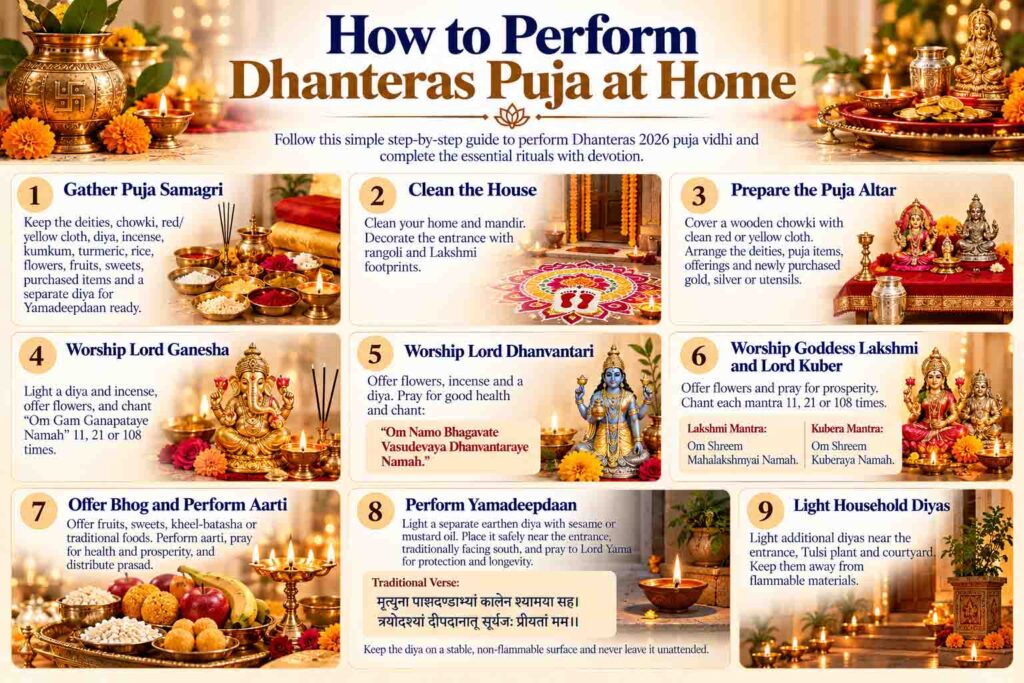 Most people ask and search for how to worship on Dhanteras, as they are not aware of the Dhanteras puja vidhi. Follow these steps for the Dhanteras 2026 puja vidhi to make sure you offer prayers and correctly perform rituals:
Step 1: Prepare the Puja samagri list before the worship begins.
The following is the Dhanteras puja samagri list. Keep the following items ready before beginning the puja:- Idols or pictures of Lord Ganesha, Goddess Lakshmi and Lord Kubera
- A picture or idol of Lord Dhanvantari, if available
- A clean wooden chowki and red or yellow cloth
- A diya, cotton wicks, oil or ghee, and incense sticks
- Roli or kumkum, turmeric, akshat (unbroken rice) and sandalwood paste
- Fresh flowers, a garland and a few leaves, if customarily used
- Fruits, sweets, kheel-batasha or other customary offerings
- A coin or newly purchased gold, silver or metal utensil
- A separate earthen diya for Yamadeepdaan
- A bell, an aarti plate and camphor, if used in your household
Step 2: Cleaning of the house
Clean your house in the afternoon, draw rangoli and the footprint of deity Lakshmi. You can also bring the printed rangoli and footprint from market.Step 3: Prepare the puja altar
Cleaning of worship place or home mandir in your house is very important. Also, it must be done with clean and unused cloth only. After that, do the following:Place a clean red or yellow cloth on a wooden chowki.
Arrange the idols or pictures of Lord Ganesha and Goddess Lakshmi, with Lord Kubera nearby. Keep Lord Dhanvantari’s picture alongside them if you have.
Then,
Place a diya, incense sticks, flowers, kumkum, rice grains, sweets and fruits on the altar (chowki). Keep any newly purchased gold, silver, coins, utensils or whatever you have purchased for Dhanteras 2026 in front of the deities as an offering.Step 4: Begin the puja with Lord Ganesha’s worship
Light incense and rotate near the god (Ganesha), offer flowers, and chant his mantra (Om Ganganpatey Namah) (11, 21 or 108 times).Step 5: Worship Lord Dhanvantari
Lord Dhanvantari is worshipped on Dhanteras in connection with health, healing and Ayurveda. Offer flowers, incense and a lamp before his picture or idol, if available. Pray for good health, strength and well-being for yourself and your family. Many devotees also first worship lord Vishnu, who is himself Dhanvantri (a form). You can chant the below mantras 11, 21 or 108 times.Lord Vishnu (Narayana) and Dhanvantri Mantras
Vishu Mantra: Om Namo Bhagavate Vasudevaya Dhanvantaraye Namah.Dhanvantri Mantra: Om Namo Bhagavate Vasudevaya Dhanvantaraye Amrita-Kalasha-Hastaya Sarva-Amaya-Vinashanaya Trailokya-Nathaya Sri Maha Vishnave Namah
Step 6: Deity Lakshmi and Kuber Dev Worship
Now, continue the puja by invoking Goddess Lakshmi. Chant her mantras; you can also read the Lakshmi chalisa or other path of the deity. Then worship Kuber Dev.Mata Lakshmi Mantra: Om Shreem Mahalakshmyai Namah (11, 21 or 108 times)
Kuber Dev Mantra: Om Shree Kuberai Namah (11, 21 or 108 times).
Step 7: Offer Bhog and Perform Aarti
Offer fruits, sweets, kheel-batasha or other foods traditionally prepared in your household. Whole coriander seeds and jaggery are also used as offerings in some regional customs.Perform the aarti of the deities while ringing a bell. Conclude by folding your hands and praying for health, prosperity, peace and happiness in the household. After the puja, distribute the prasad among family members.
Step 8: Perform Yamadeepdaan (Yama Deepam)
Yamadeepdaan is a distinct Dhanteras ritual in which a lamp is offered to Lord Yama, the deity associated with death. The ritual seeks protection from untimely death and well-being for the family. The practice is traditionally associated with the account of King Hima’s son and is described in connection with the Trayodashi observance in the Skanda Purana.Follow these steps:
Prepare a separate diya: Use an earthen lamp. Some traditions use a four-wicked lamp; many households also use an ordinary oil diya.
Add the oil and wicks: Use sesame oil or mustard oil according to your family’s practice. Both are found in contemporary descriptions of the ritual, so avoid presenting one as universal.
Choose the location: Traditionally, the lamp is placed outside the main entrance of the home, facing south, the direction associated with Lord Yama.
Offer a prayer to Lord Yama: Fold your hands and pray for the health, longevity and protection of family members. You may recite the traditional verse below.
Let the lamp burn safely: Place it on a stable, non-flammable surface, away from curtains, footwear and other combustible materials. Do not leave a flame unattended or in a position where it can be knocked over.
The traditional verse (mantra) associated with Yamadeepdaan is:
Mrityuna Pashadandabhyam Kalen Shyamaya Saha |
Trayodashyam Dipadanat Suryajah Priyatam Mama ||
मृत्युना पाशदण्डाभ्यां कालेन श्यामया सह।
त्रयोदश्यां दीपदानात् सूर्यजः प्रीयतां मम॥
The prayer expresses the wish that Yama, the son of Surya, be pleased by the lamp offered on Trayodashi.
If you live in an apartment or cannot safely place a diya outside the main door, use a secure location near the entrance or in an appropriate outdoor area, while respecting your household tradition and building safety rules.
Step 9: Light other household diyas
After the main puja, families may light additional diyas at the entrance, near the Tulsi plant, in the courtyard and in other suitable places around the house. The number and placement of lamps vary by tradition. Keep the lamps on stable surfaces and away from anything that can catch fire.What to Buy on Dhanteras
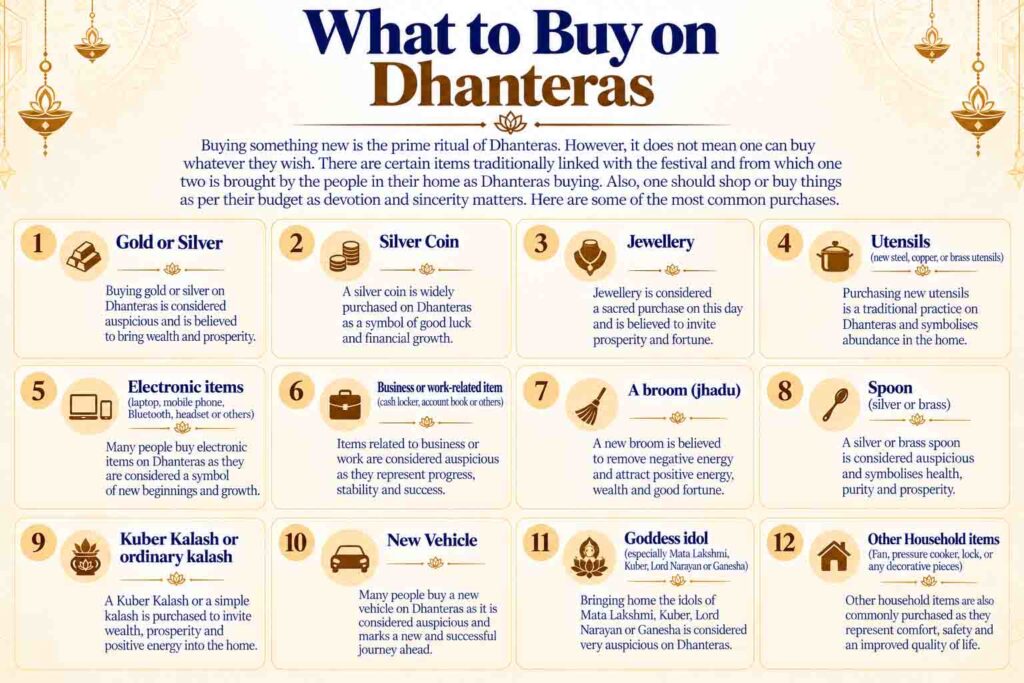 Buying something new is the prime ritual of Dhanteras beyond the worship of deities. However, it does not mean one can buy whatever they wish. There are certain items traditionally linked with the festival. Also, one should shop or buy things as per their budget, as devotion and sincerity matter. Here are some of the most common purchases.
- Gold or Silver
- Silver Coin
- Jewellery
- Utensils (new steel, copper, or brass utensils)
- Electronic items (laptop, mobile phone, Bluetooth, headset or others)
- Business or work-related item (cash locker, account book or others)
- A broom (jhadu):
- Spoon (silver or brass)
- Kuber Kalash or ordinary kalash’
- New Vehicle
- Goddess idol (especially Mata Lakshmi, Kuber, Lord Narayan or Ganesha)
- Other Household items (Fan, pressure cooker, lock, or any decorative pieces)
What not to buy on Dhanteras?
List of items one should not buy on Dhanteras day, as these are considered inauspicious or a sign of bad omen:- Sharp Objects: Knife, scissors, needles, etc.
- Glassware and Ceramic
- Black coloured goods
- Leather objects
- Black or blue coloured dress