+91 9990176000
 +91 9999097600

 CALENDAR 2026


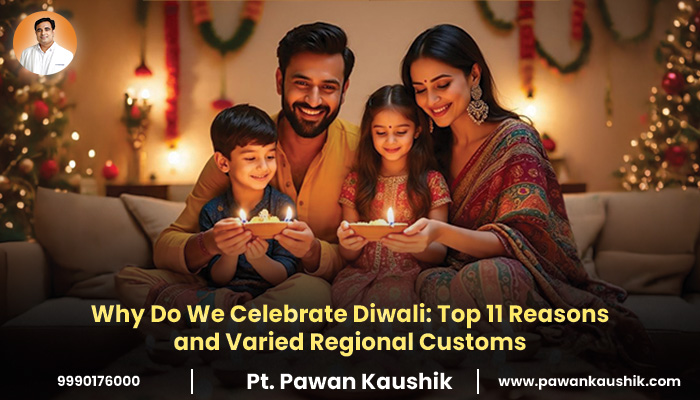 Observing a Hindu festival with the right knowledge and understanding is one of the best ways to celebrate it, as it helps us appreciate its true significance, honour its traditions, and understand the values it teaches us. This blog explains the actual reasons behind the celebration of Deepawali and What are the stories of Diwali festival?
Diwali, or Deepavali, is a major Hindu festival which commemorates the triumph of light over darkness and the triumph of righteousness over evil. Known as the festival of light, people observe Deepawali to seek the blessings of the deity Lakshmi for prosperity, wealth and good fortune.
On the auspicious occasion of Diwali, people decorate their homes, worship the deities Lakshmi and Lord Ganesha, and share gifts with friends and relatives. However, many of us don’t realise that the reasons for celebrating Diwali differ across religions and regions. Let’s understand this:
11 Reasons To Celebrate Diwali
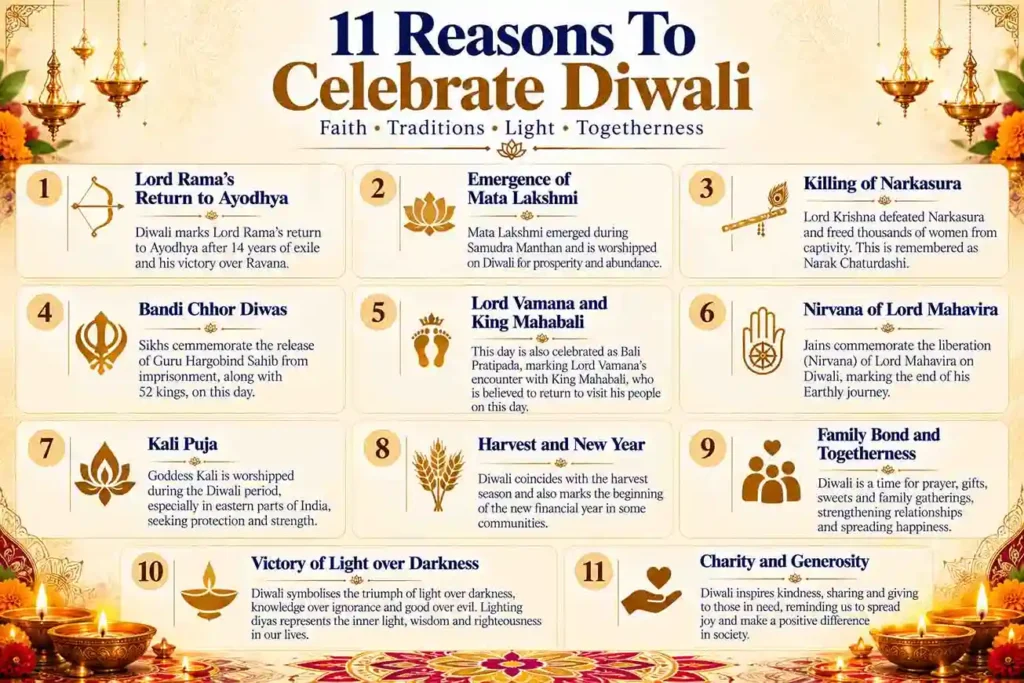
Lord Rama’s Return to Ayodhya
The main reason to celebrate Diwali is that it marks Lord Rama’s return to his home (Ayodhya) after 14 years of exile. In Ramayana Kaal, Lord Ram was held in forest exile, and while he was living in the forest, his wife, Mata Sita, was abducted, and then the great war between Lord Rama and Ravana happened.After killing the ten-headed demon, Ravana, Lord Ram returned to his home along with his brother, Lakshman and his wife, the deity Sita. The people of Ayodhya welcomed him by lighting diyas (eternal lamps) and by decorating the whole city of Ayodhya. Since then, this has become the tradition, and today we celebrate Diwali to honour Ram’s valour and his arrival in Ayodhya after exile.
The story symbolises the victory of righteousness over evil and the return of peace and happiness after a difficult period.
The Story of Samudra Manthan and the Emergence of Mata Lakshmi
According to the Vishnu Purana and Shrimad Bhagavatam Purana, Goddess Lakshmi emerged from the ocean in Sagar Manthan- the churning of the deep sea by the Gods (Devtas) and Demons (Danavas). This marks the celebration of Deepavali, and we worship Goddess Lakshmi- the deity of wealth and prosperity on every Diwali.Shree Ganesha is also worshipped (begin the worship with him) along with the deity Lakshmi, as he is the lord of good fortune and remover of obstacles.
Diwali is dedicated to the worship of the deity of Wealth (Maa Lakshmi). She is worshipped on this occasion to seek her blessings of wealth and fortune.
Killing of Narkasura by Lord Krishna
In various Hindu traditions, Diwali is also associated with the defeat of Narkasura by Lord Krishna and his consort, Satyabhama. According to sacred Hindu texts, Narkasura was a brutal mythical king of the Bhuma Dynasty. He also had received boons from Lord Brahma (the creator), which made him arrogant and ruthless.Narkasura, by misusing his power and boon, created terror in the three worlds (teeno lok) and imprisoned approximately 16,000 women. Lord Krishna then, with the help of Satyabhama, defeated and killed him and restored dharma and justice. The event commemorates the festival of Narak Chaturdashi (Chhoti Diwali), celebrated one day before Diwali.
It is especially significant in the South and Goa region, where many cultures and places also observe this as the main Diwali.
Bandi Chhor Diwas on Diwali
In sikh culture, Bandi Chhor Diwas, also known as the day of liberation and release of prisoners day commemorates the release of the sixth Sikh Guru, Guru Hargobind, from Gwalior Fort in 1619. This event or celebration falls around the same time as Diwali.As per Sikhism, Guru Hargobind Sahib secured the release of 52 Rajput Rajas along with him from Mughal imprisonment by Jahangir. The celebration of Bandi Chhor marks Guru Sahib’s return from prison, which falls in October or November, typically coinciding with the Hindu festival of Deepawali.
On this special occasion, Gurudwaras and homes are lit by Sikhs with diyas and lamps, and people perform kirtans and prayers in Gurudwaras and their homes.
The Tale of Lord Vamana and King Mahabali
Another story in Hindu tradition coincides with the broader festive season of Diwali: the story of Lord Vamana and King Mahabali. However, this tradition of celebration is closely tied to Bali Pratipada, where in North India, people celebrate Diwali to mark the return of Lord Rama from his exile; in the Southern and Western parts, people celebrate to honour King Bali, pressed to the Netherworld and his 1 day of returning to his subjects (janta).According to the Vamana Purana, there lived a righteous and powerful demon (Asur) King, Mahabali. He conquered the three worlds, and this made the Gods (Devas) concerned.
Seeing this, Lord Vishnu took the Incarnation of a dwarf Brahmin as Vamana, who asked for the land of his three paces from King Mahabali.
King Bali agreed to his request, and the deity Vamana took his cosmic form, measuring earth and heaven in his two steps, and for the third one, Mahabali offered his head. Lord Vamana pushed him down to the netherworld (Paathaalam).
Seeing King Bali’s generosity & sacrifice, Vishnu grants him a special boon of immortality and the ability to visit his kingdom and subjects once a year, which marks the celebration of Bali Pratipada, falling on the 4th day of the Diwali festival (this year on 10th of November, 2026).
The day is celebrated with the worship of King Bali and his wife, Vindyavali, drawing rangoli, lighting diyas and lamps, etc.
The Attainment of Nirvana by Lord Mahavira
For Jains, Diwali holds a distinct spiritual meaning. It commemorates the nirvana, or final liberation, of Lord Mahavira, the 24th Tirthankara of Jainism. Jain tradition places this event at Pavapuri, in present-day Bihar.Lord Mahavira’s nirvana represents liberation from the cycle of birth and death. For Jains, Diwali is therefore a time for prayer, reflection, spiritual discipline, and renewed commitment to the principles of non-violence, truth, and self-control.
Jain tradition also associates the lighting of lamps with the light of knowledge following Mahavira’s liberation. Thus, the festival has a spiritual meaning that differs from the Hindu stories commonly associated with Diwali.
Kali Puja and the Tradition of Diwali
Kali Puja is also associated with the festive season of Diwali that falls on the Amavasya Tithi of Kartik month. Kali Puja coincides with Diwali because of the tithi on which the festival falls, and this year it falls on the same day as Diwali on 8th of November, 2026.The deity Kali is worshipped to seek the blessings of protection from evil forces and negativity on the auspicious day of Kali Puja. The festival is primarily observed during the night, with homes and temples are cleaned and decorated, and the deity Kali is worshipped.
Pandals are also set up, and cultural performances and fairs are also held. The festival is prominent in West Bengal. However, it is also observed in some regions of Bihar and states like Assam, Tripura and Odisha.
Diwali as a Harvest Festival and the Beginning of a New Year
Diwali also mark the traditional beginning of the new financial year in some communities in India. Historically, the festival coincided with the end of an agricultural cycle in parts of India, making it a time to express gratitude for the harvest and pray for prosperity in the coming season.For business communities in Northern and Western parts of India, the festival of Deepawali marks the beginning of the New- Financial Year. Gujarati communities celebrate Bestu Varas (Gujarati New Year) just after a day of Diwali, when new commercial account books are opened.
Marwari and Jain communities celebrate the night of Diwali to invoke the blessings of Lakshmi for finance and wealth and the upcoming Samvat Vikram Year. They also close their old financial accounts.
Diwali as a Celebration of Family Bond and Togetherness
Diwali is an auspicious festival that brings families together for worship and celebration. People living or working in different parts of the country or overseas visit their native home to meet their family members, relatives, and close ones. This creates a sense of togetherness and family bond.The worship of Goddess Lakshmi seeks the well-being and prosperity of the family, including those members who occasionally visit their home. Also, those who live outside bring gifts for his/her family members to share their love and affection towards their own. Bhai Dooj (falls after Diwali) also highlights the sacred bond between the siblings, where a brother offers gifts and pledges protection to his sister, who prays for her brother’s long life, good health and well-being.
Victory of Light over Darkness
Lighting Diyas (eternal lamps), candles, lamps, and electric bulbs is the most important ritual of Diwali, which signifies the dispelling of darkness and ignorance. Light symbolises knowledge, positivity, hope, awareness, and Dharma (righteousness), while darkness represents ignorance, fear, negativity, and Adharma (Evil). Thus, the celebration of Diwali represents the triumph of Dharma over Adharma and injustice.Charity and Generous Acts on Diwali
On the occasion of Deepawali, many people also engage in charity and acts of kindness. People serve meals or organise Bhandara (community feast) to help and serve the needy and underprivileged. Many family share sweets and gifts with their neighbours and known ones after the worship. Although charitable giving is not the origin of Diwali itself, it is a meaningful way for people to express the festival’s spirit of goodwill and abundance.Regional Celebration of Diwali in India: How It Is Observed in Different Parts
Lighting diyas, glowing flames, cleaning the house and worshipping the deity Lakshmi are central themes and common rituals associated with Diwali, seen across the nation. Apart from that, the tales and customs for Deepawali vary across regions in India.| Festival | Region | Theme | Rituals and Observance |
| Diwali | North India (U.P., Rajasthan, Delhi, Bihar, and Punjab etc) | Lord Rama’s return to Ayodhya after 14 years of exile. | Cleanliness of home.
Lighting Diyas and Lamps. Worship of Lord Ganesha, Mata Lakshmi and Lord Kuber. In Punjab, the festival also coincides with the Sikh observance of Bandi Chhor Divas. |
| Diwali | South India (Tamil Nadu, Karnataka, Andhra Pradesh, and Telangana) | Victory of Lord Krishna and Satyabhama over Narkasura.
Worship of King Mahabali and his wife Vindyavali |
Narak Chaturdashi is prominent. Bali Pratipada is also observed |
| Diwali | West India (Gujarat, Maharashtra | Bali Pratipada
Gujarati New Year |
Worship of King Mahabali.
Taking Oil Bath (Abhyanga or Thaila Snan). Bestu Varas (Gujarati New Year): New commercial account books are opened. Upcoming Samvat Vikram Year: Marwari and Gujarati seek blessings of Mata Lakshmi for the new year, and they also close their old financial accounts. |
| Diwali | East India, especially West Bengal. Also, Assam and Odisha | Kali Puja along with Lakshmi Puja | Worshipping the deity Kali.
Worshipping of Mata Lakshmi. Jain communities observe Mahavira’s nirvana. |
Summary
Diwali is one of the major Hindu festivals, which is celebrated by lighting diyas (eternal lamps), worshipping the goddess of wealth, Lakshmi and sharing sweets and gifts with relatives and neighbours. The festival marks the return of Lord Rama to Ayodhya, after the completion of 14 years of exile in the forest.However, in many traditions and regions, the rituals of the same festival vary, apart from lighting lamps and prayers. In northern states, Diwali commemorates Ayodhya’s welcoming of Lord Rama, whereas Kali Puja is highly revered in the eastern part and the state of West Bengal.
Likewise, in the South, Narak Chaturdashi is the prime observance, and in the West, Bali Pratipada and Gujarati New Year are prominent. The blog explains the top 11 reasons to celebrate Diwali, which falls on 8th of November this year (2026).