+91 9990176000
 +91 9999097600

 CALENDAR 2026


 Here’s a question I hear from almost every new homeowner. “Pandit ji, who decided the kitchen goes in the south-east?” “How to arrange the rooms according to the direction?” Fair thing to ask. Before you rearrange a room on someone’s say-so or according to your will. You should think and understand where the rules came from. So let’s explore the origin of Vastu Shastra: the Vedic roots, the old texts and the legend of Vastu Purusha.
Let’s talk: Vastu Shastra is rooted from ancient Hindu texts such as Vedas and believed to be over 5,000 years ago. It is used for directional alignment of the building. Vastu Purusha works as a foundation of the Vastu Shastra. It explains the logic and gives answers of “Why”.
Origin of Vastu Shastra: Where the Idea Began
In simple terms, Vastu Shastra is a written principle that laid the foundation for the architectural designing of the buildings, home layout and interiors. Its origin is believed to be over 5,000 years ago. Yet, the timeline is still in debate. It is linked with ancient traditional hindu texts such as Brihat Samhita, Mayamata and Samarangana Sutradhara.A broader knowledge of hindu system of architecture. It describes the principles of designing, layouts, measurement, space arrangement for rooms, geometrical patterns and its directional alignment. It is used for designing hindu temples and layouts for homes, gardens, cities and many more. Now, it has evolved with the time in respect to diverse regions and architectural needs.
Vastu Shastra aligns the spaces with the flow of energies i.e. 45 and keeps it balanced for harmony, mental well being, physical health and spiritual peace. It talks about the five elements i.e. air, fire, water, Earth and space (Panchamahabhuta) which work with the arrangement of the spaces to balance it out to ensure the positive flow of energies.
Scholar Vibhuti Chakrabarti holds that Vastu Vidya is as old as the Vedic period and linked to ritual architecture. Vastu Vidya was first revealed by Brahma, passed to Vishvakarma the divine architect and then to Vishnu.
The History of Vastu Shastra Through Its Texts
Every arrangement of spaces revolves around the five elements and balances it with nature for a positive flow of energies and harmony. The knowledge of Vastu is found in ancient hindu texts including Brihat Samhita, Mayamata, Matsya Purana, Vishnu Purana, Manasara and many more.| Text | Rough period | Known for |
| Brihat Samhita (Varahamihira) | About 6th century CE | Chapters on houses, cities and temples |
| Mayamata | 5th–7th century to 10th century (estimates differ) | South Indian design and construction |
| Manasara | Estimates differ; surviving version later | Architecture and sculpture |
| Isanasivagurudeva Paddhati | 9th century | Building in south and central India |
| Samarangana Sutradhara (King Bhoja) | 11th century | Classical architecture and engineering |
The six most studied texts are Mayamata, Manasara, Samarangana Sutradhara, Rajavallabha, Vishvakarmaprakasha and Aparajitaprccha. Regional texts exist too. In Rajasthan, Sutradhara Mandana’s Prasadamandana covers temple planning and has chapters on building towns.
Today, these are neglected and this is the reason for the main suffering of the people nowadays. If there is a balance between nature’s five elements with the principles of Vastu then all the cosmic powers work with your action.
The Vastu Purusha Legend
For any new construction or make changes or building layouts of homes or offices, Vastu Shastra is the rightful knowledge for the implementation. But the spirit of the house is Vastu Purusha. He is the cosmic being which is present in each and every small or big layout. Ignoring it may bring displeasure.Now let’s talk about the origin of the Vastu purusha mentioned in Matsya Purana. Once Lord Shiva fought with the demon Andhaka and defeated him. After the fight, Lord Shiva began to sweat and a drop of sweat fell to earth and took a form of furious being. He was hungry and started doing penance to please Lord Shiva. Lord Shiva, impressed by his penance and granted him a boon states that he can devour all three worlds. He started to devour all the three worlds starting from bhooloka (terrestrial world), then celestial world of Gods and last demon world.
To control him, the 45 deities rushed, held him and pinned him face-down, fixed his body to the ground and stationed themselves on his body.
So, before any new construction on Earth, the person needs to worship Vastu Purusha first along with the gods on his body. That’s the idea behind a Vastu puja before building.
His body is drawn as a grid, the Vastu Purusha Mandala. A graphical representation of his body. It’s a square of 8 × 8 (64) or 9 × 9 (81) smaller squares, with his head towards the north-east. The Rajavallabha prescribes 64 squares for ordinary houses and 81, the Paramasayika, for temples and palaces. The centre stays open as the Brahmasthan. Some put his head to the north and count Brahma among 45 gods.
It helps the architects and Vastu consultants to design the layouts that align with the cosmic energies to ensure the harmony and spiritual well being.
Directions and Guardians: How Legend Maps Out
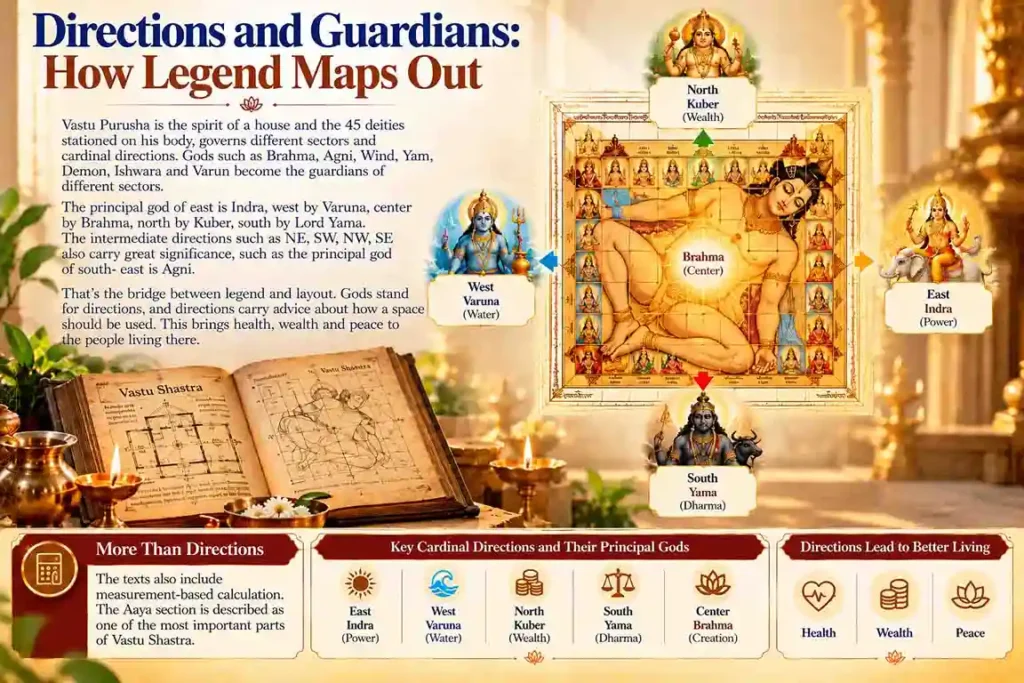 Vastu Purusha is the spirit of house and the 45 deities stationed on his body, governs different sectors and cardinal directions. Gods such as Brahma, Agni, Wind, Yama, Demon, Ishwara, Varun become the guardians of different sectors. The principal god of east is Indra, west by Varuna, center by Brahma, north by Kuber, south by Lord Yama. The intermediate directions such as NE, SW, NW, SE also carry great significance such as the principal god of south- east is Agni.
That’s the bridge between legend and layout. Gods stand for directions, and directions carry advice about how a space should be used. This brings health, wealth and peace to the people living there.
The texts also include measurement-based calculation. The Aaya section is described as one of the most important parts of Vastu Shastra. So Vastu isn’t only a list of directions. It’s a method with its own mathematics.
How This Origin Shows Up in Homes Today
Usually, people use the spaces in homes in whatever they see fit. Take a house in Gurgaon where the pooja space is in the south-west direction. But Mandala based direction guidelines say the place for pooja should be in the north-east direction, the head of the purusha. The right direction leads to positive inflow of energies.Or a Noida couple who wants to renovate a kitchen. With the confusion in mind, they call Vastu astrologer for consultation. By observing and analysing the facts, he explains the directions, the light and the logic and leaves them to decide. With this, the person gets guidance for the next step to be taken. Either move the stove or move the weight in that direction. Some do, some don’t. Both are fine.
Other types of pattern can also be seen like a business owner wants a layout for his narrow shop according to the texts. But the classical texts speak of towns, temples and homes. It is not a type of rigid rule that is applicable for every corner. So, layouts that work on paper can still fail in a narrow shop.
These are typical situations, not verified case studies, and none comes with a guaranteed result. But it is true and verified that if the various activities of people at home, offices, shops or sites are according to the principles of Vastu and channelise with the directions, it began to draw the positive power from nature in a natural way.
For the Vastu consultation, Pt. Pawan Kaushik, with 30+ years in astrology, Vastu and gemstone consultation can review for your home or plot, you can book a Vastu consultation in Gurgaon. He has consulted lakhs of clients and studies tons of different types of patterns which make him more worthwhile to consult.
Myth, Method or Both?
I read the tradition in three layers. Ancient texts give the framework. Legend, the Vastu Purusha story, gives the picture and centuries of building practice give the method that applied worldwide. The mandala grid is best as a religious story and for the logical explanation which connects it with nature’s elements. It channels the energies with the proper position of the things in the homes, offices or other places. So, treat it as a myth or read for its spatial logic.Does the myth prove that every rule works? No. Vastu Shastra is a traditional guidelines, principles that educate you about the nature’s elements and how to become one with nature. If we provide a proper place to the elements at our building, then you can become one with nature and all the negativity will go away. Vastu Shastra can remove the defects in the structure. A good consultation can weigh traditional and practical sense together.