+91 9990176000
 +91 9999097600
 CALENDAR 2026


 For those wondering about Rakhi 2026, Raksha Bandhan will be celebrated on Friday, 28th of August 2026. The festival symbolises the sacred bond between sisters and brothers that dates back to the Mahabharata. Every year, people have confusion about the Rakshabandhan date and the correct muhurat for tying the sacred thread (Rakhi).
Many even worry about the Bhadra kaal (prohibited muhurat for rakhi). If you want to know when Raksha Bandhan is in 2026, its exact muhurat, important details and interesting facts about this sacred festival, this guide is for you.
Raksha Bandhan 2026 Date
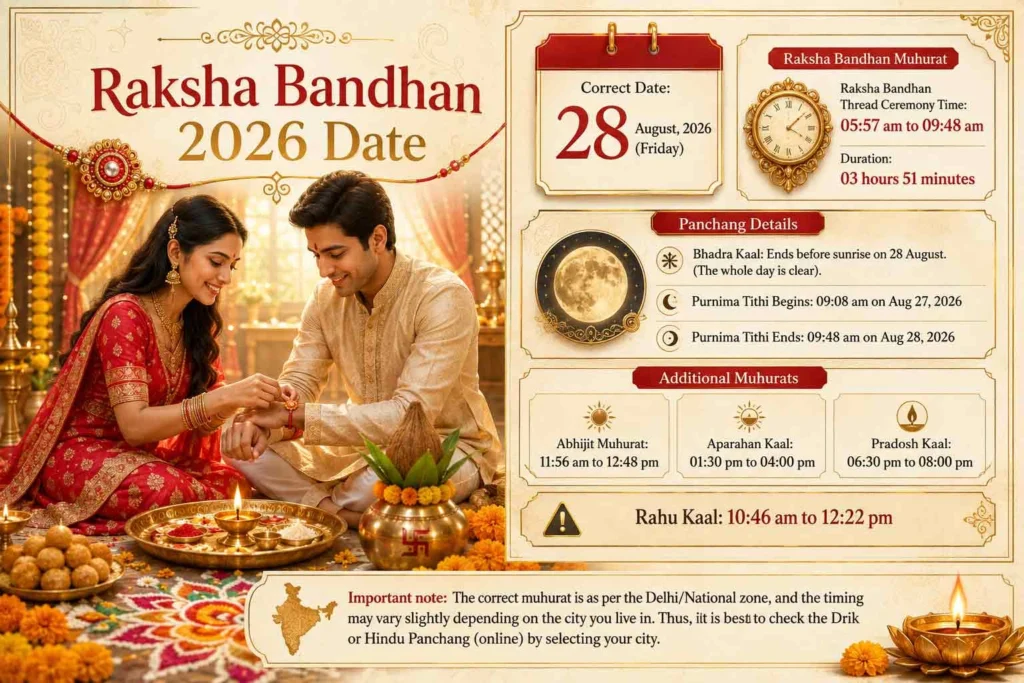
- Correct Date: 28 August, 2026 (Friday).
- Muhurat: Raksha Bandhan Thread Ceremony Time: 05:57am to 09:48 am.
- Duration: 03 hours 51 minutes.
- Bhadra Kaal: Ends before sunrise on 28 August. (The whole day is clear).
- Purnima Tithi Begins: 09:08 am on Aug 27, 2026
- Purnima Tithi Ends: 09:48 am on Aug 28, 2026.
- Aparahan Kaal: 01: 30 pm to 04: 00 pm.
- Pradosh Kaal: 06: 30 pm to 08:00 pm.
- Rahu Kaal: 11:17 am to 01:01 pm.
Subh Muhurat for Raksha Bandhan 2026
Raksha Bandhan Muhurat timing is the main concern for everyone. Obviously, it is crucial as every brother and sister wants this special day to be celebrated on auspicious timing, where the thread tied by the sister protects her brother from every negative force and the brother’s vow towards their sister protection becomes strong and supported by the Universe’s energy.In 2026, the special (subh) muhurat for tying the thread (rakhi) is from 05: 57 am to 09: 48 am (according to the Hindu panchang). It is the best time to perform Raksha Bandhan rituals in 2026.
Important Note: Avoid the rituals of Raksha Bandhan during Rahu Kaal (mentioned above) and late at night.
Worried About Bhadra kaal, This Rakhi? All You Need to Know About It in 2026.
Luckily, Bhadra kaal on Raksha Bandhan 2026 ends before sunrise on 28th of August. Thus, it does not apply to the Raksha Bandhan 2026 festival. However, the Rakhi tying ceremony must be held during the specified muhurat (mentioned in the date section).Bhadra kaal is considered an unfavourable time for tying Rakhi, and the rituals of Rakshabandhan must be avoided during Bhadra kaal, as it is believed to cause harm in the life of the brother whose sister ties the thread during that time. According to legends, Bhadra is the sister of Lord Shani (Saturn).
Raksha Bandhan Celebration 2026 from Abroad
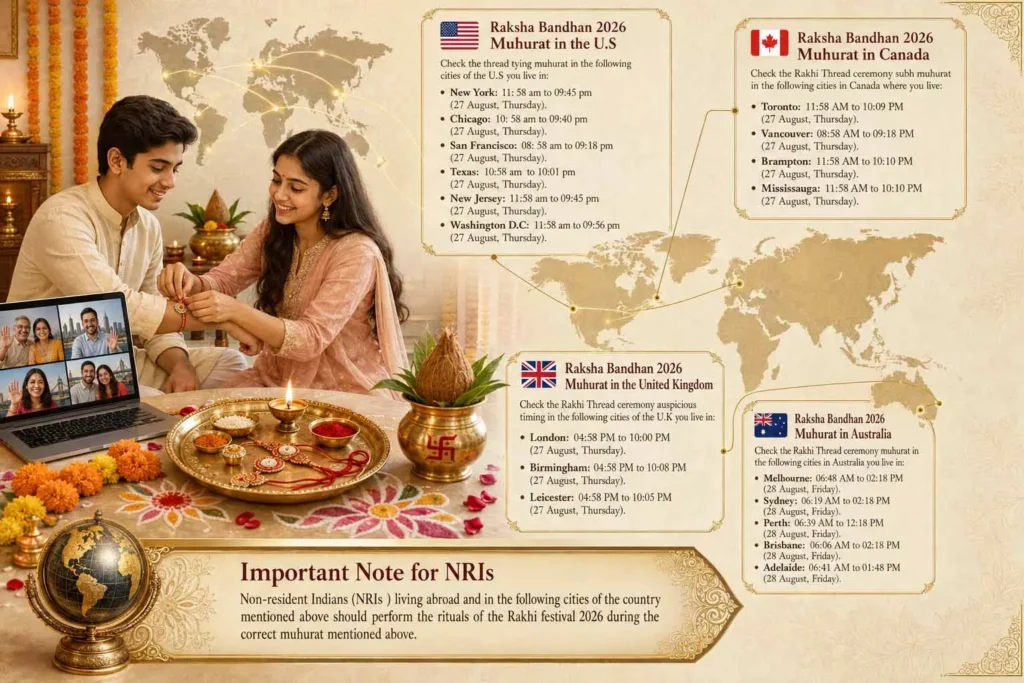 The shubh muhurat for Raksha Bandhan varies from city to city across India and abroad. If you are living outside India, you can check the following country-by-country Raksha Bandhan muhurat timings to see muhurats for cities you live in abroad.
Raksha Bandhan 2026 Muhurat in the U.S
Check the thread tying muhurat in the following cities of the U.S you live in:- New York: 11: 58 am to 09:45 pm (27 August, Thursday).
- Chicago: 10: 58 am to 09:40 pm (27 August, Thursday).
- San Francisco: 08: 58 am to 09:18 pm (27 August, Thursday).
- Texas: 10:58 am to 10:01 pm (27 August, Thursday).
- New Jersey: 11:58 am to 09:45 pm (27 August, Thursday).
- Washington D.C: 11:58 am to 09:56 pm (27 August, Thursday).
Raksha Bandhan 2026 Muhurat in Canada
Check the Rakhi Thread ceremony subh muhurat in the following cities in Canada where you live:- Toronto: 11:58 AM to 10:09 PM (27 August, Thursday).
- Vancouver: 08:58 AM to 09:18 PM (27 August, Thursday).
- Brampton: 11:58 AM to 10:10 PM (27 August, Thursday).
- Mississauga: 11:58 AM to 10:10 PM (27 August, Thursday).
Raksha Bandhan 2026 Muhurat in the United Kingdom
Check the Rakhi Thread ceremony auspicious timing in the following cities of the U.K you live in:- London: 04:58 PM to 10:00 PM (27 August, Thursday).
- Birmingham: 04:58 PM to 10:08 PM (27 August, Thursday).
- Leicester: 04:58 PM to 10:05 PM (27 August, Thursday).
Raksha Bandhan 2026 Muhurat in Australia
Check the Rakhi Thread ceremony muhurat in the following cities in Australia you live in:- Melbourne: 06:48 AM to 02:18 PM (28 August, Friday).
- Sydney: 06:19 AM to 02:18 PM (28 August, Friday).
- Perth: 06:39 AM to 12:18 PM (28 August, Friday).
- Brisbane: 06:06 AM to 02:18 PM (28 August, Friday).
- Adelaide: 06:41 AM to 01:48 PM (28 August, Friday).
Why Do We Celebrate Raksha Bandhan?
Raksha Bandhan is the festival of siblings, where sisters tie Rakhi (sacred thread) around the wrists of their brothers, believing that it will protect and safeguard them from any mishap or unfortunate situation. The festival is a symbol of pure love, affection and care between siblings. This word, Raksha, means protection, and Bandhan refers to bond or relationship. Thus, the celebration of Raksha Bandhan represents the protective bond between a brother and sister and siblings.Every year, the festival falls on the Purnima Tithi of the Hindu lunar calendar in the Shravan Month, which usually occurs from mid-August to the end of August or sometimes the initial week of September. As the festival is celebrated on Purnima (full moon day), it is also known as Rakhi Purnima.
What is the Meaning of Rakhi?
Rakhi means a sacred thread (dhaga) which is tied to the brother’s wrist by a sister on every Raksha Bandhan. It’s a symbol of unconventional love and a pure relationship between siblings, and according to the scriptures, it is a shield that is tied to ensure protection, good health, and long life.Today, it comes in fancy ribbon or lace form that every sister ties on the wrist of their brother, and in return, a brother (or sibling) gives money or a gift to his sister. The custom of Rakhi and Rakshabandhan is centuries old, and it is even linked to the mythological era.
The Legend of Raksha Bandhan
There is much evidence of the festival, which dates back from the medieval era of Rajput kingdoms and the invasion of the Mughals to the mythological era of the Mahabharat and the Vishnu Purana. Each piece of evidence highlights the significance and a particular Raksha Bandhan Story.Raksha Bandhan Story and Roots from Bhagavat Puran
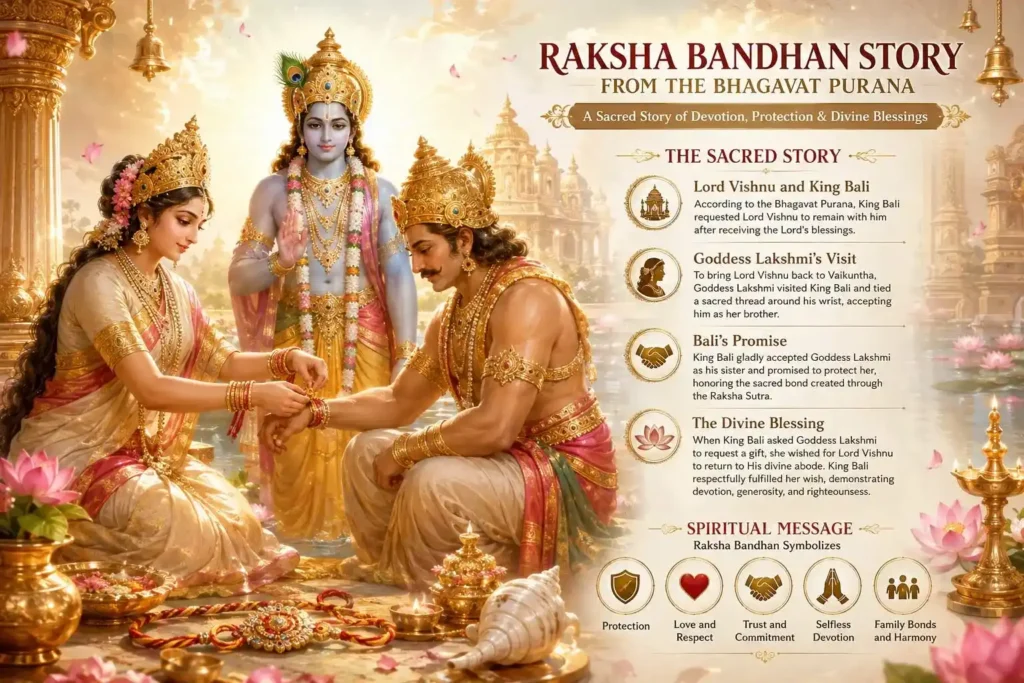 In the Bhagavat Purana, it is mentioned that the famous King Bali requested Lord Vishnu to let him reside on his lotus feet, as the Demon King had failed to defeat the Almighty God, Vishnu. Seeing this agreement of the Lord, Mata Lakshmi was upset as she was not happy with the decision that a demon sit on the Lord’s lotus feet.
The deity tied the holy thread around the wrist of Bali and made a wish that he protect her as her sister. Bali gladly accepted the deity Lakshmi as her sister and asked her to wish for pin anything that she wanted. The deity demanded that Bali return to his abode. This story of Raksha Bandhan is mentioned in the sacred Vedic texts.
Raksha Bandhan Story and Roots from Mahabharata
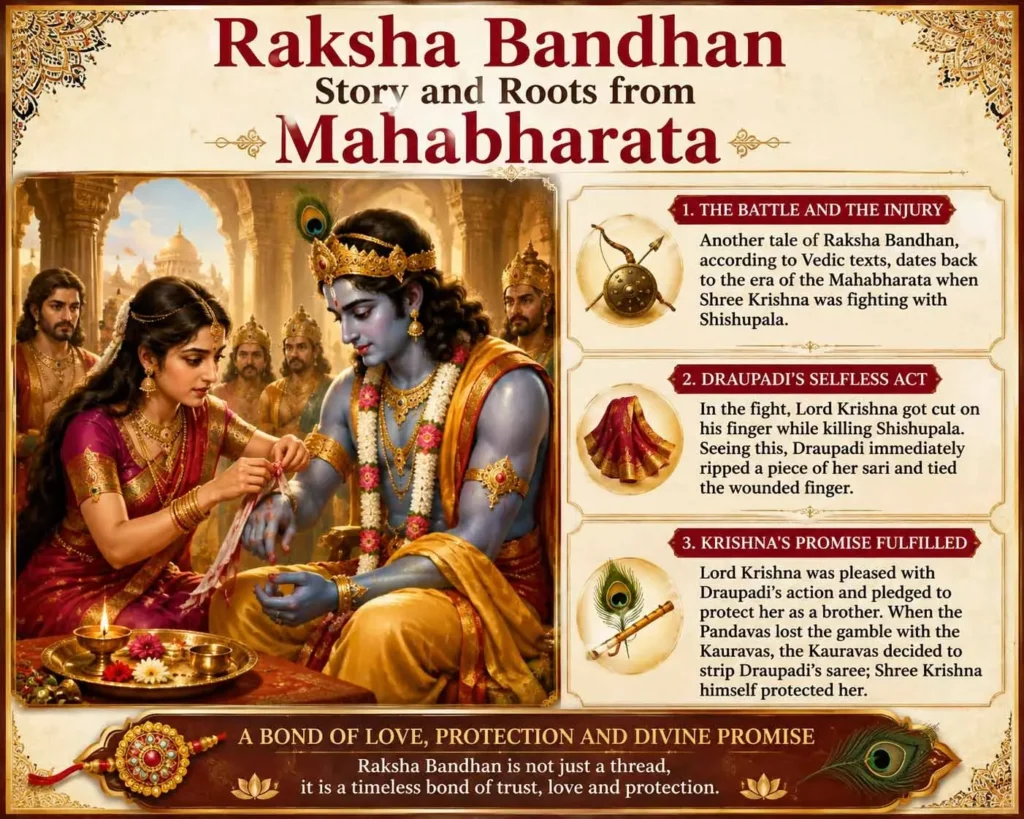 Another tale of Raksha Bandhan, according to Vedic texts, dates back to the era of the Mahabharata when Shree Krishna was fighting with Shishupala. In the fight, Lord Krishna got cut on his finger while killing Shishupala. Seeing this, Draupadi immediately ripped a piece of her sari and tied the wounded finger.
Lord Krishna was pleased with Draupadi’s action and pledged to protect her as a brother. When the Pandavas lost the gamble with the Kauravas, the Kauravas decided to strip Draupadi’s saree; Shree Krishna himself protected her.
History of Raksha Bandhan from the Medieval Era
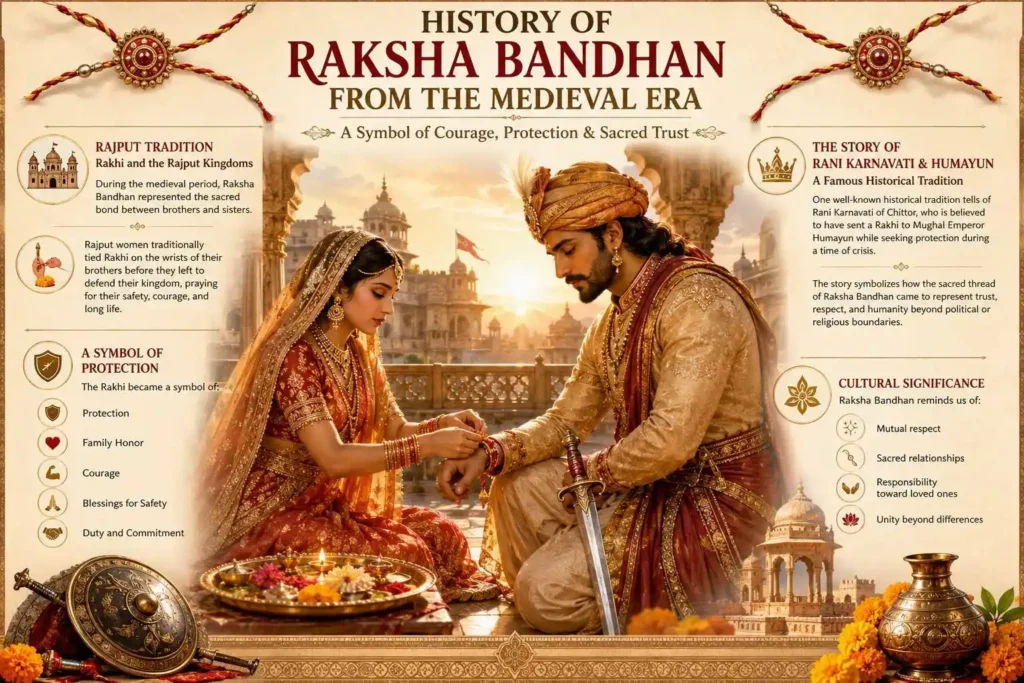 The custom of Raksha Bandhan is also evident in the Rajput kingdom period. Rakhi was the sacred binding between brothers and sisters, as the protection of sisters was foremost. During the invasion of the Mughals, Rajputs used to fight with them, and their sisters used to tie rakhi to their wrists to seek blessings of long life and protection.
There is a famous tale that describes how this sacred rakhi ritual broke religious barriers when the widow queen of Chittor, Karnawati, was helpless to stop the invasion of Bahadurshah; she sent a rakhi to Mughal Emperor Humayun. This act pleased the emperor so much that he immediately ordered a stay.
How to Celebrate Raksha Bandhan? Here is the Step-by-Step Guide to Perform the Rituals of Raksha Bandhan
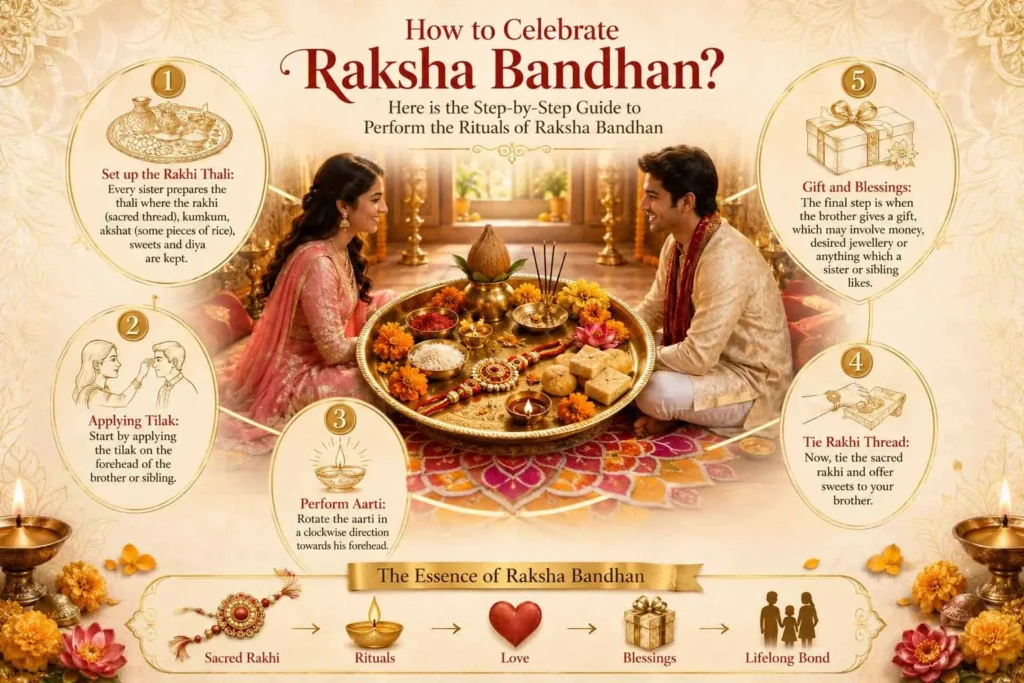 Although the custom of celebration may vary from region to region, the following rituals of Raksha Bandhan are commonly followed.
- Set up the Rakhi Thali: Every sister prepares the thali where the rakhi (sacred thread), kumkum, akshat (some pieces of rice), sweets and diya are kept.
- Applying Tilak: Start by applying the tilak on the forehead of the brother or sibling.
- Perform Aarti: Rotate the aarti in a clockwise direction towards his forehead.
- Tie Rakhi Thread: Now, tie the sacred rakhi and offer sweets to your brother.
- Gift and Blessings: The final step is when the brother gives a gift, which may involve money, desired jewellery or anything which a sister or sibling likes.
Raksha Bandhan Mantra
Today, many people don’t know the significance of the Rakhi mantra. In Hindu culture, mantras have greater significance, and by chanting a mantra, we foster spiritual energy. While tying rakhi, there is a special mantra which should be chanted. The mantra is- “येन बद्धो बलि राजा, दानवेन्द्रो महाबलः। तेन त्वाम् प्रतिबद्धनामि, रक्षे मा चल मा चलः॥” A sister should chant this while tying a Rakhi around her brother’s wrist.Meaning of the Rakhi Mantra
The mantra means: “With the same sacred thread that was used to bind the mighty demon king Bali, I now tie this sacred thread around your wrist.”On Which Hand a Rakhi Should be Tied
A rakhi should be tied on the right wrist of the right hand as the hand is considered auspicious in hindu culture and many of the sacred works are done with this hand. It also represents purity, strength and righteousness.The Regional Celebration of Raksha Bandhan in Different Parts of India
In India where there is cultural diversity, festival of rakhi is celebrated in different style and their regional names also varies.Rakhi Celebration as Narali Purnima
While tying the rakhi by a sister into the wrist of her brother is common for Indians living in any part of the country and overseas, the celebration reaches another level of joy when it is done in more unique ways:In the coastal area of Maharashtra and Daman & Diu, the fisherfolk (Machhuwara) community celebrate the festival of Raksha Bandhan as the “Narali Poornima.” The celebration is done by throwing the Coconut into the sea. The coconut is considered an auspicious fruit in Hinduism, and it is used in most of the spiritual activities. According to the fisher folk community in Maharashtra region, the ritual pacifies the intense wave of the sea and gives blessing of Varun Devta. This is also done to welcome the onset of the fishing season after the completion of the Shravan month.
Rakhi Celebration as Kajari Purnima
Kajari Purnima belongs to specific areas of Madhya Pradesh, Chhattisgarh, Uttar Pradesh and Bihar, and it is celebrated among the farming communities. The day marks the onset of the sowing season for the farmers. On the particular day, women bring wheat from the field in a leaf cup and keep it in an area of the house which is deprived of sunlight. This is done seven days before Kajari Purnima, on the Shravan Shukla Navami. The floor (where the cup is placed) is cleaned using mud and dung and decorated with rice rangoli and traditional designs until the day of Kajari Purnima, and then it is immersed in the nearby lake or water body.Rakhi Celebration as Avani Avittam
While in North India, people celebrate Raksha Bandhan by tying rakhi, giving gifts and making vows for protection towards their sister. In South India, especially in Brahmin communities, on the day of Rakhi, Avani Avittam is celebrated, where the Brahmin males wear a new thread as a janeu removing the old one, as they believe it as a new beginning and getting rid from their old sins.Memorable Raksha Bandhan 2026 Celebration Ideas
This year, make your Raksha Bandhan a memorable Rakhi celebration with the following ideas:A Short Family Trip
Take your siblings and family members on a trip to heritage sites in Jaipur or visit any nearby hill station. Choose either a self-drive road trip or pick one- or two-day itineraries from a travel expert.Gaming Session
Play an exciting game with your family in the living room after the completion of Rakhi rituals. You can organise the game on a Rakhi-theme-based or any other theme which is mesmerising.DIY (Do It Yourself) Kit:
Making handmade Rakhi and decorative items with your younger siblings can be a creative idea to strengthen your emotional bonding.Virtual Rakhi Ceremony
Schedule a Google Meet or Virtual call session (if you or your sister is living abroad) at the muhurat time and celebrate the festival of Raksha Bandhan in an online mode.Unique Gift Idea
Gifting is the best way to impress your sibling and strengthen your bond with her. Pricing doesn’t matter; you can also offer something in a budget-friendly range, like giving her a favourite novel, wristwatches, travel tumblers or skincare essentials.Think of Eco- Friendly Raksha Bandhan in 2026
This year, adopt an eco-friendly style of celebration where gifts and sweets should be packed with reusable substances and not with plastics. Also, use a biodegradable rakhi made with bamboo or cotton.Significance of Raksha Bandhan
Rakhi is not just a simple thread; according to cultural belief, it is a powerful shield that protects every brother from negative influence and bad luck. The sacred thread carries the prayers of a sister and divine blessings that protect the wearer from difficulties. The rituals of Raksha Bandhan are unique, and it symbolises purity, focus and blessings.Spiritual Significance
The spiritual significance of Raksha Bandhan lies in its simplicity, as the simple piece of thread is believed to create a protective shield around a brother and aid in his upliftment.The festival falls during the Shravan month, which is dedicated to Lord Shiva. Shravan is the holiest time according to the Hindu calendar, as it is the period of a full month when devotees take fasts, engage in spiritual realms and seek blessings from the Lord of lords- Mahadeva.
Every year, the ceremonies of Rakhi are performed in Sharavan Maas (Month) when the spiritual activities like chanting mantras, fasting and meditation on the Gods attract cosmic blessings more than any time of the year.