+91 9990176000
 +91 9999097600

 CALENDAR 2026


 Chhath is known for its distinct yet graceful rituals. Imagine worshipping the red Sunbeam after dusk and waking up early in the morning, heading to the Ghat (riverbank), witnessing the first rays of the rising Sun, and seeing people all around worshipping, interacting, and gathering in one place. All these are the beauty of Chhath- a sacred Hindu festival; we will cover it in the blog.
As Diwali draws near, people (especially from Bihar and U.P.) also begin preparing for Chhath Puja. However, many are confused about the exact dates and rituals, as the festival runs for 4 days.
In 2026, Chhath Parva falls from 13th November to 16th November, while the main ritual (worship at the ghat) is on 15th (Sandhya Arghya) and 16th (Usha or Morning Arghya). Understanding Chhath Puja is a unique experience that connects us with our traditions, devotion, and cultural roots. Now let’s discuss all the important facets of the festival, including the 2026 Chhath Puja date, 4-day rituals, Chhath Puja story and its significance.
When is Chhath Puja in 2026? Chhath Puja Kab Hai?
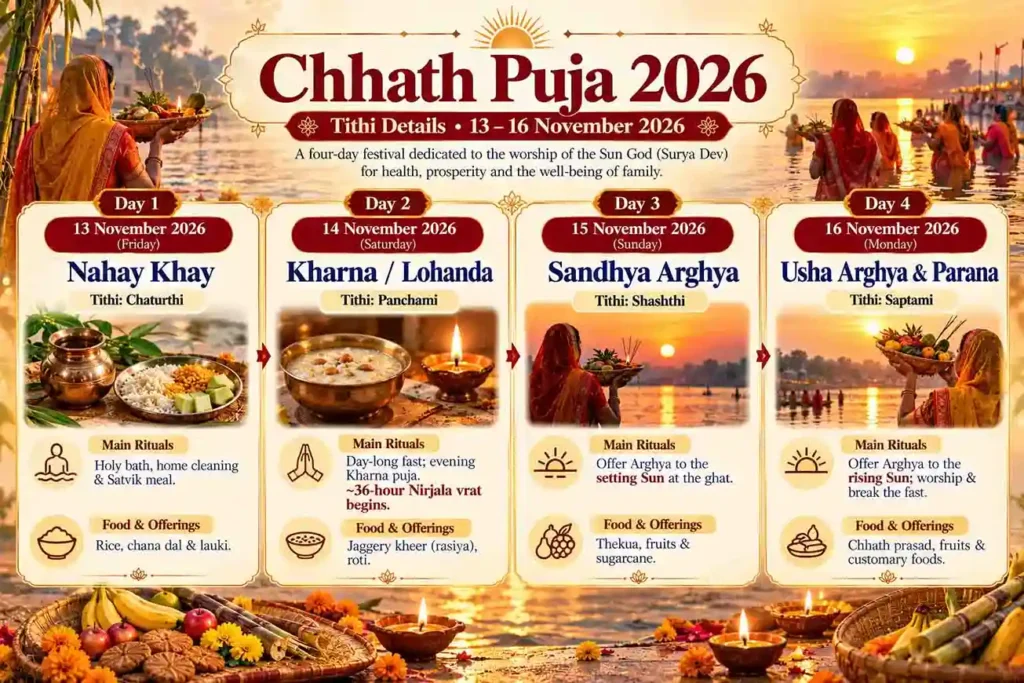
Chhath Puja is observed over four days, beginning on Kartik Shukla Chaturthi and ending on Kartik Shukla Saptami tithi. Below are the highlights of Chhath Puja days, tithis, and rituals.Chhath Puja 2026 Tithi Details
| Chhath Puja Days | Date | Event | Tithi | Main Rituals | Traditional food and offerings |
| First Day of Chhath Puja | 13-Nov-2026 (Friday) | Nahay Khay | Chaturthi | Chhath Puja begins: Holy Bath, Cleaning of the House and kitchen, and a Satvik Meal is eaten by the devotee (Vratti) and her family. | Rice, chana dal, and bottle gourd (lauki), prepared according to family tradition. |
| Second Day of Chhath Puja | 14-Nov-2026 (Saturday) | Kharna or Lohanda | Panchami | Fast throughout the day; kheer (made with Jaggery), also called rasiya, and Chapatis are prepared and offered first to the deity, and then eaten by the family members and devotees after evening worship. After the Kharna prasad is eaten in the evening, the approximately 36-hour nirjala vrat begins. | Jaggery-based kheer (rasiya), roti, and other customary offerings. |
| Third Day of Chhath Puja | 15-Nov-2026 (Sunday) | Sandhya Arghya | Shashthi | Thekua, seasonal fruits, sugarcane, and other items are arranged in the soop and daura. Arghya (Water) is offered to the Setting Sun (Glory of the festival) at the riverbank or at the river ghats. | Thekua, seasonal fruits, sugarcane, and other items are arranged in the soop and daura. |
| Fourth Day of Chhath Puja | 16-Nov-2026 (Monday) | Usha Arghya & Parana | Saptami | Arghya (Usha Arghya) is offered again at the ghat, but this time to the rising Sun. Chhathi Maiya is worshipped, and kathas are recited. The fast is broken after worship in the morning. | The remaining Chhath prasad, fruits, and customary foods are shared after the morning ritual. |
The 4-Day Chhath Puja Rituals Along with Kharna and Parna Rules:
Before we understand all four days of the Chhath festival, it is important to understand that the term devotee, vratti, vratin or parvaiti refers to the women who observe the Nirjala Vrat (36 hours) of the festival.Day 1: Nahay Khay (13th of November, 2026)
Chhath Puja begins with Nahay Khay, which means bathe and eat. On this day, devotees or vratti observing the fast take a sacred bath using pond or well water or normal (clean) water. The cleaning of the house begins, especially from the kitchen and then outwards.Satvik Meal is prepared in the house, where the food menu consists of Arwa (unpolished) rice, chana dal and a lauki sabzi made without onion and garlic. The food may also vary depending on the region (place) and one’s family tradition. The same food is eaten by family members and, in the end, the vrati (who observe fast) too.
Nahay Khay is basically a sankalp (vow) taken for the next three-day festival.
Day 2: Kharna or Lohanda (14th of November, 2026)
The vratin fasts during the day and eats the Kharna prasad in the evening. After this meal, the strict nirjala fast begins and continues until after Usha Arghya. Meanwhile, during the daytime, kheer is made with jaggery as prasadam (offering) along with roti and puri. Seasonal fruits, including bananas, are also taken. The prasadam or prasad is offered to Chhathi Maiya and Surya Dev at home. The Kharna prasadam is first eaten by the vratti, and then it is shared with family and neighbours. Alongside this, the main 36 hours nirjala fast begins, which is concluded on the last day of Chhath in the morning with parana.Day 3: Sandhya Arghya (15th of November, 2026)
Day 3 commences the main ritual of Chhath and is also called the Sandhya Arghya. On this day, Thekua (a special prasadam of Chhath made with jaggery and wheat flour) is prepared. Thekua, sugarcane pieces, sweets, and fruits like apple, banana, orange or mosambi are arranged and taken into soop or daura or dala (bamboo basket). This is why the festival of Chhath (particularly days 3 and 4 ) is also called Dala Chhath because of this ritual.In late afternoon on Day 3, or Sandhya Arghya, the family carries the soops or dauras (on the head) to the ghat where they perform the rituals of Chhath. Now, the evening ritual is performed by the parvaiti, where she stands in the river water facing west and offers arghya to the setting Sun (doobte hue surya ko Arghya). The arghya contains water with akshat and roli and sometimes milk poured from a lota. The dala and daura carrying prashad are also shown to the setting Sun.
After prayers (of the Sun and Chhathi Mata), people return from the ghat to their homes, taking all daura, soop and other containers.
Day 4: Usha Arghya and Parana (16th of November, 2026)
Day 4, or Parana, is the last day of Chhath. Families again reach the ghat with the dauras and dallas, carrying prasadam before dawn (from approximately 3 am and onwards). The devotee or vratti stands in river water facing east, waiting for the Sun to rise.Once the Sun rises, the vratin this time offers Arghya to the rising Sun, and then the parana worship begins. People all over the ghat bow their heads towards the rising Sun. The Sun is worshipped along with the deity Usha. The elder women on the ghat recite the story of the deity Chhathi (Chhathi Maiya), and devotees seek blessings of good health and long life for their children and family.
After this, the fast is broken with water, a little prasadam and fruits and then after that with the meal.
What Family and Devotees Should Avoid During the 4 days of Chhath?
- Devotees or vraitin should not consume food and water during the strict 36-hour nirjala fast.
- Families should also avoid tamasic food and non-veg from Nahay Khay till Parana.
- Maintain strict cleanliness when preparing prasad and handling puja utensils.
- Avoid tasting food or using contaminated utensils while preparing offerings (prashad) intended for the vrat.
- Avoid throwing plastic, food waste, or other rubbish into rivers, ponds, and ghats.
- Do not ignore serious weakness, dizziness, confusion, or signs of dehydration. A strict fast can be risky for some people, particularly those with medical conditions. Religious observance should not come at the expense of safety. Seek medical help in case of health issues. Also, consider your overall health before taking the sankalp of the vrat.
Who Should Not Observe the Vrat
- A person undergoing medical treatment or illness.
- Someone with low immunity who cannot bear hunger or thirst.
- Someone who cannot bear the days-long fast with proper discipline and faith.
- A woman who is pregnant, breastfeeding, elderly, or diabetic.
Chhath Puja 2026: City-Wise Kharna, Sandhya Arghya and Usha Arghya Timings:
Sandhya Arghya on Chhath is offered during the sunset (following the sunset timing), while the Usha Arghya is offered following the sunrise time.| City | Kharna Sunset, 14 November, 2026 | Sandhya Arghya Sunset, 15 November, 2026 | Usha Arghya Sunrise, 16 November, 2026 |
| Patna | 05:01 pm | 05:01 pm | 06:07 am |
| Madhubani | 04: 56 pm | 04: 56 pm | 06:05 am |
| Gaya | 05:03 pm | 05:03 pm | 06:07 am |
| Muzaffarpur | 05:00 pm | 04: 59 pm | 06:07 am |
| Bhagalpur | 04: 55 pm | 04: 54 pm | 06:00 am |
| Ranchi | 05: 04 pm | 05: 04 pm | 06:03 am |
| Varanasi | 05: 10 pm | 05: 10 pm | 06:16 am |
| Lucknow | 05: 16 pm | 05: 16 pm | 06: 26 am |
| New- Delhi | 05: 28 pm | 05: 28 pm | 06: 44 am |
| Gurgaon | 05: 29 pm | 05: 29 pm | 06: 45 am |
| Kolkata | 04: 53 pm | 04: 53 pm | 05: 50 am |
| Mumbai | 06: 00 pm | 06: 00 pm | 06: 46 am |
| Bengaluru | 05: 50 pm | 05: 50 pm | 06: 19 am |
Significance of Chhath Puja
Chhath Puja is about thanksgiving to the lord Sun, who is the central source of light, energy and life. The festival pays gratitude to the Sun for sustaining life on Earth. Chhath Puja signifies the worship of the visible god- the Sun, who gives light to Earth and is known for its strict discipline and rules.The grand festival also gratifies nature’s blessings on humans and pays gratitude to the Sun for light, warmth, food, harvests and the water cycle. The Mahaparva worship the ordinary (for many people), which is the very essence of life.
Worshipping the Setting Sun- The Epic Chhath Puja Ritual
People worship the rising Sun; however, the Chhath festival first pays tribute to the setting Sun (doobta Surya), expressing gratitude to the Almighty who has shaped the course of the day. The setting sun reminds us of the value of decline, completion and ending. We pray for success, but Chhath remind us that even when the light is fading, the gratitude is endless. The one who is fading has given us light all day.Strict and Rigorous Fasting Ritual
Chhath is probably the most difficult and physically demanding vrat or fast, involving a waterless fast for 3 continuous days (36 hours), standing in the river’s cold water at dawn, and cleaning the house from every corner. The tradition also involves offering Arghya to both the setting and rising sun (paying tribute to the Sun in both its phases). This shows the importance of discipline and penance in life, rather than always being easy and ordinary.Worship of Chhathi Mata
Chhathi Maiya is the central deity of Chhath Puja, worshipped along with the Sun during the 4-day festival. She is also known as the Shashthi Devi, who is basically worshipped on the sixth day of childbirth, apart from the festival of Chhath.Chhathi deity is mentioned in some Puranic texts, including the Brahma Vaivarta Purana, where she is described as the sixth (Shashthi) maternal manifestation of Prakriti Devi (Mother Nature). Devotees worship her during Chhath for the blessings of good health, long life and overall well-being of their children.
Chhath Puja is named after Chhathi Maiya, and chhathi means the sixth tithi. Also, the main offering is made on Shashthi, the sixth tithi of Kartik Shukla Paksha, and this is one reason the festival is also known as Surya Shashthi.
Worshipping the First Ray (Usha) of the Sun
On day 4 and Parana, devotees stand in the river water and wait for the Sun to offer Arghya. This is also known as the Usha Arghya, which is the first rays of the Sun, and from both spiritual and scientific perspectives, its falling on the body has immense significance.According to certain Hindu traditions associated with Chhath Puja, Usha and Pratyusha are regarded as consorts of Lord Surya, symbolising the rising and setting sun, respectively.”
Chhath Puja Story:
Chhath is associated with several folk tales and epic traditions, including Karna’s worship of Surya, the prayer of Draupadi and the Pandavas, and regional traditions associated with Lord Ram and Mata Sita and the popular folk tale of King Priyavrata and the Queen Malini.Chhath Puja and the Legend of Ramayana
Lord Ram, along with his wife, Mata Sita and brother Lakshman, returned to Ayodhya after killing Ravana and completing 14 years of exile. After that, Devi Sita observes the Kartik Shukla Shashthi vrat or upvas and worships the Shashthi deity and lord Sun.On the next day, on Saptami tithi (7th lunar day), in the morning, she again offers Arghya to the rising Sun and seeks the blessing that peace, happiness, and prosperity always prevail in their kingdom. As per Hindu mythology, this marks the beginning of today’s Chhath Puja rituals.
Chhath Puja and the Legend of Mahabharata
References to Chhath also date back to the time of Mahabharata, when Karna was the great devotee and worshipper of Lord Sun. He used to stand waist-deep in water for hours, offering Arghya to the Sun God. Seeing his devotion, Lord Sun blessed him with immense power and valour. As per the tale, the worship of the Sun by Karna became a tradition, followed to this day and observed as Chhath Puja.There is another episode associated with the Pandavas, when they lost their kingdom and everything; Draupadi decided to observe the rigorous fast of Chhathi Maiya and offer Arghya to Lord Sun. Seeing her devotion, Lord Sun granted her the boon that whatever she had lost would be regained. Since then, it is believed that observing the Chhath fast fulfills devotees’ wishes and brings happiness, prosperity, and the blessing of children to their families.
Chhath Puja and the Legend of King Priyavrata and the Queen Malini
In ancient times, there lived a King Priyavrata and his wife Queen Malini. The king and queen had everything except an offspring (child). Upon the Maharishi Kashyapa advice they performed Putrakameshti Yag (yajna) and let queen eat the Kheer (sweet rice) prepared as part of the yajna (yag).After this, the Queen gave birth to a child, who was stillborn (lifeless child). Seeing this, the King was in deep grief, and he went to the cremation ground for the last rite of his child. At the same moment, Goddess Devsena (the mind-born daughter of Lord Brahma) appeared from the sky. She spoke from the sky that she is the Shashthi deity who preserves and takes care of the child. The goddess asked the king to worship her and tell everyone about this.
The king worshipped the Shashthi deity following proper rituals on the Kartik Shukla Shashthi, and he was blessed with a healthy and living child. The king spread the glory of the Goddess throughout his kingdom, and thus began the tradition of the festival we know today as Chhath Puja.
Where is Chhath Puja Celebrated? Chhath Puja is celebrated in which state
Chhath Puja is especially associated with Bihar, Jharkhand, Uttar Pradesh, and the Nepal Terai. It is also observed in other Indian states and overseas by communities that maintain these traditions.While it is performed mainly in the above-listed states, today it has worldwide recognition. People from the Bihar and Jharkhand region living in West Bengal, Delhi, Haryana, Punjab, southern, western and eastern states observe Chhath Puja like in their own state.
They dig a small pond, create and decorate ghat by themselves, and many also visit the prominent water bodies in the cities where the Bihari community celebrates Chhath Puja.
Women observe the nirjala fast, beginning from the Kharna (in the evening) and breaking it on Parana’s morning (after Usha Arghya), in the same way as Women in Bihar and Jharkhand do.
The widespread popularity and faith in the sacred tradition of the festival have led to its observance across the country by people beyond Jharkhand, Bihar and Uttar Pradesh. There have been many instances where the Chhath Puja rituals have been performed overseas also.
Chhath Puja Vidhi at Home: A Guide for Devotees Who Live in Apartments or Urban Areas without a Ghat or River
Chhath Puja or festival is primarily observed near ghats- banks of the river, ponds or other water bodies. However, devotees living in cities and apartment complexes may not have convenient access to a public ghat. They can plan a respectful home observance according to their family traditions, while preserving the central rituals as far as practicable.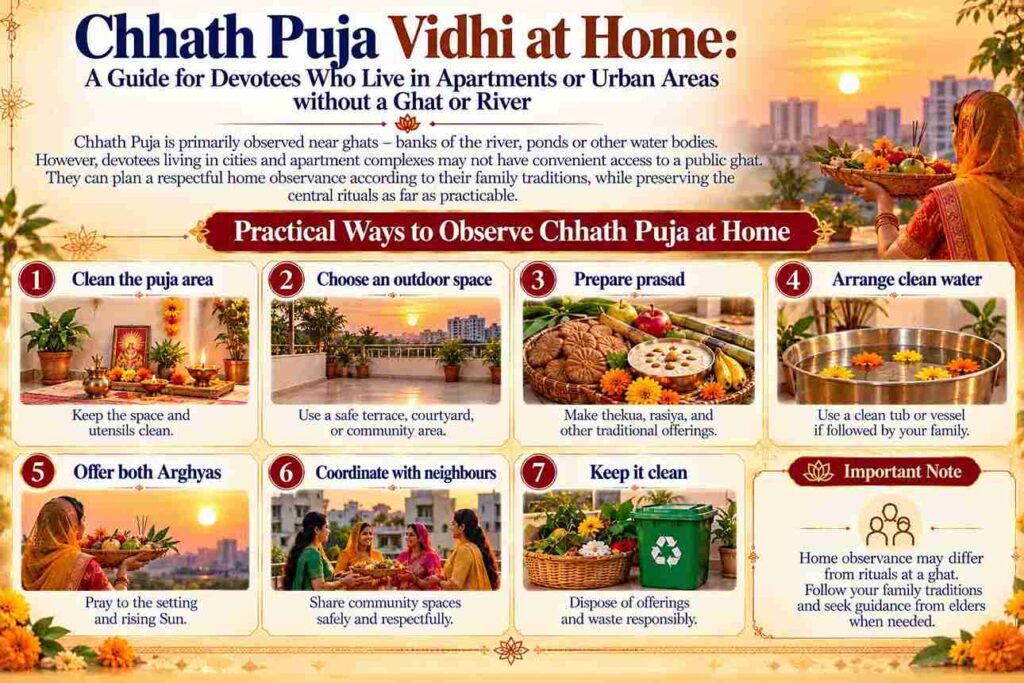
Practical ways to observe Chhath Puja in an apartment
- Prepare a clean puja area: Clean the space and keep the utensils and offerings separate from everyday cooking items.
- Arrange a suitable outdoor space: A terrace, courtyard, or designated community area can be used if it is safe and permitted.
- Prepare the traditional prasad: Make thekua, rasiya, and other customary offerings according to the family’s practices.
- Arrange a clean water vessel: If a river or pond is unavailable, some families may use a clean tub or vessel for a symbolic water-based offering, according to their tradition.
- Observe both Arghya rituals: Offer prayers to the setting Sun on the third evening and the rising Sun on the fourth morning, where visibility and the available space permit.
- Coordinate with neighbours: A shared apartment courtyard or community arrangement can provide a suitable space without blocking access or creating safety hazards.
- Keep the surroundings clean: Dispose of flowers, food waste, and other materials responsibly instead of releasing rubbish into drains or water bodies.
Chhath Puja Samagri List
| Samagri (Items) | Purpose |
| Soop or daura or dauri or dala (bamboo baskets) | Used to hold offerings (Prasadam) and raised during Arghya so that the prashad carries the blessings of Surya Dev and Chhathi Maiya. Many families also use the same object made with pittal and steel. |
| Thekua | The Signature Chhath Prasad offered to Chhath deities. |
| Kasaar, sweet rice flour laddoos, called as Bhusva in Bihar | Another popular offering or prasad of the Chhath festival |
| Sugarcane (ganna) with leaves and chopped sugarcane | The whole sugarcane or ganna is used in decorating the ghat, and for the Kosi canopy on the third night, where the ethernal lamps, candles are placed. The chopped one is kept in a dala as offerings along with sweets and fruits. |
| Jaggery Kheer (rice pudding) also known as Rasiya or Rasiao Kheer | Used as Naivedyam and an offering on Kharna. |
| Aluwa (sweet potato) and Suthni (a traditional edible tuber root vegetable) | Used as offerings and kept in a dala with other prasadam |
| Seasonal Fruits – banana- often a whole bunch, apple, mosambi, orange, water chestnut (singhara), coconut, sweet lime, fresh turmeric with its leaves, custard apple, guava, etc | Used as offerings |
| Panchbhog (5 different sweets) | Used as offerings |
| Diyas, candles, and wicks | Used on ghat and Home Mandir |
| Kalash, lota and thali | Lota is used for pouring water or milk during Arghya, while thali is used to carry the offerings. Kalash is used in puja. |
| Sindoor and suhaag items | Married woman applies sindoor to her hair parting to the nose (as tradition); she wears bangles and other suhag items at the ghat |
| Dhoop, incense stick (agarbatti) and camphor | Used in puja at ghat and home mandir |
| Other samagri like: Akshat, paan, milk, supari, honey, ghee, and new clothes for the Vratti, traditionally unstitched | Used for the arghya and during puja |
Chaiti Chhath vs Kartik Chhath
Chhath Puja is observed during two periods of the Hindu lunar year: Chaitra and Kartik. Both are dedicated to Sun worship and share the central rituals of Nahay Khay, Kharna, Sandhya Arghya, and Usha Arghya. Kartik Chhath is the more widely known and commonly observed celebration.| Comparison | Chaiti Chhath | Kartik Chhath |
| Month | Hindu lunar month of Chaitra (March- April) | Hindu lunar month of Kartik (October- November) |
| Celebration | Celebrated in a simple and solemn way | Celebrated on a massive, grand scale where the entire village or society gathers at ghats, ponds, and public water bodies |
| Who Celebrates | Selected families or individuals, fulfilling a vow or mannat. Also, those who have been observing the festival for generations. | People from Bihar, Jharkhand, Nepal, and Uttar Pradesh living in their own states or outside |
| Main worship | Surya Dev and Chhathi Maiya | Surya Dev and Chhathi Maiya |
| Core rituals | Four-day observance | Four-day observance |
Chhath Puja and Astrology: Significance of Surya Dev
In Vedic astrology, Surya (the Sun) is traditionally associated with vitality, confidence, leadership, authority, self-expression, and one’s sense of purpose. Chhath Puja’s focus on the Sun gives the festival an important place in traditions that connect solar worship with discipline, well-being, and gratitude.- Strengthens the Sun’s influence in birth chart: Offering Arghya to Surya Dev strengthens the position of the Sun in kundli and reduces affliction or debilitation effects in life.
- Supports career and leadership: The Sun is associated with status, recognition, and government-related matters in Vedic astrology. Worshipping the Sun is believed to support career progress, professional respect, and success in leadership roles.
- Promotes vitality and well-being: The Sun is linked with vitality and life force in traditional astrology. Offering Arghya to the Sun is a devotional practice through which people seek blessings for good health and strength.
- Seeks family happiness and children’s well-being: Devotees worship Chhathi Maiya for family welfare, protection, and the well-being of children, according to traditional beliefs.
- Encourages discipline and mental strength: The strict fasting routine, early-morning rituals, and regular prayers can help devotees practise patience, self-control, and dedication.