+91 9990176000
 +91 9999097600

 CALENDAR 2026


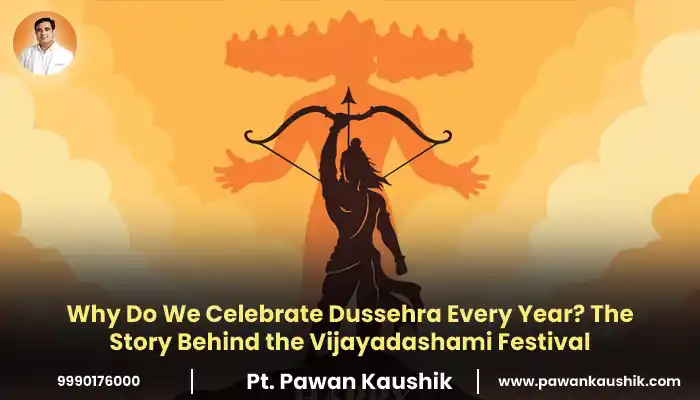 Dussehra is a major and significant Hindu festival that marks the victory of Lord Ram over the 10-headed demon Ravana. The festival is celebrated to recall the victory of righteousness over unrighteousness and good over evil.
The festival is celebrated across the nation and in some parts of neighbouring countries like Nepal & Sri Lanka, marking the ancient mythological demise (killing) of Ravana by Lord Ram.
Dussehra, also known as Vijayadashami, is celebrated on the Dashami Tithi, the tenth day of the bright phase of the Ashwin month in the Hindu lunar calendar. We celebrate Dussehra every year, and it is a major Hindu festival in India.
Dussehra, or Vijayadashmi, is celebrated every year on the dashmi tithi of the Ashwin month as per the Hindu lunar calendar. On this sacred day, the statue or idol of Ravana is burnt, which reflects the burning of ego and immortality.
Processions, fairs and Ramleela plays are very common observations on the day of Dussehra. People enjoy the day with wholeheartedness; they view cultural programs and visit the famous sights of Dussehra with their children and family. Let’s now understand in detail why we celebrate and how it is celebrated in different parts of the country.
What Does Dussehra Mean?
The term Dussehra comes from Sanskrit, where dasha means ten and hara means defeat or removal. Thus, the word Dussehra refers to the killing of ten-headed Ravana by Lord Shree Ram. Likewise, in Vijayadasmi, vijay means victory, and dashmi refers to the tenth day of the lunar fortnight in the Hindu calendar.Dussehra and Vijaya Dashmi are similar terms that represent the victory over evil and are celebrated across India. It signifies the triumph of God and marks the completion of the Navratri festival.
Why Do We Celebrate Dussehra?
Dussehra is not celebrated for a particular reason. It is a festival of triumph over evil powers. Like other important festivals, it also falls every year. Dussehra marks the culmination of the 9 days of Navratri, where each day is dedicated to a particular form of Goddess Navdurga. According to the sacred Hindu scripture, Dussehra is linked to the defeat of Ravana by Lord Maryada Prusottam- Ram and the killing of Mahisasur by the almighty and the goddess of Shakti- Durga.Dussehra and The Tale of Lord Rama Defeating Ravana
People often ask why do we celebrate Dussehra. The actual reason behind the celebration of the festival of Dussehra is to honour and remember the mythological killing of Ravana by Lord Ram in the Ramayana. Lord Rama, an avatar of Vishnu, defeated the ten-headed demon king Ravana, who abducted the deity Sita. We celebrate Dussehra in memory of Lord Ram’s victory over Ravana.This victory teaches us that ego and arrogance (symbolised by Ravana) always fall before truth and righteousness (symbolised by Rama). Before Dussehra, Ram Leela is performed across India during Navratri. These performances show the story of Lord Rama defeating Ravana, celebrating the victory of good over evil.
Victory of Goddess Durga over Mahishasura
Another reason behind celebrating the festival of Dussehra is the killing of the demon Mahishasura by goddess Durga. It also represents the victory of divine force over evil energy (victory of gods over the demons).There was a time when the mighty demon terrified the gods and all three worlds (teen lok). He decided to conquer divinity and establish the kingdom or realm of demons (Asuras). Seeing Mahisasur’s terror, Maa Durga took a battle with the demon, destroyed him, and established peace and the rule of the gods in the realm. The festival of Dussehra is celebrated to honour the killing of Mahisasur by the deity Durga (Bhagwati).
Dussehra symbolises the destruction of negativity and the rise of divine energy. The festival teaches us that inner strength and purity always win against evil thoughts and actions.
Spiritual Significance of Dussehra Festival
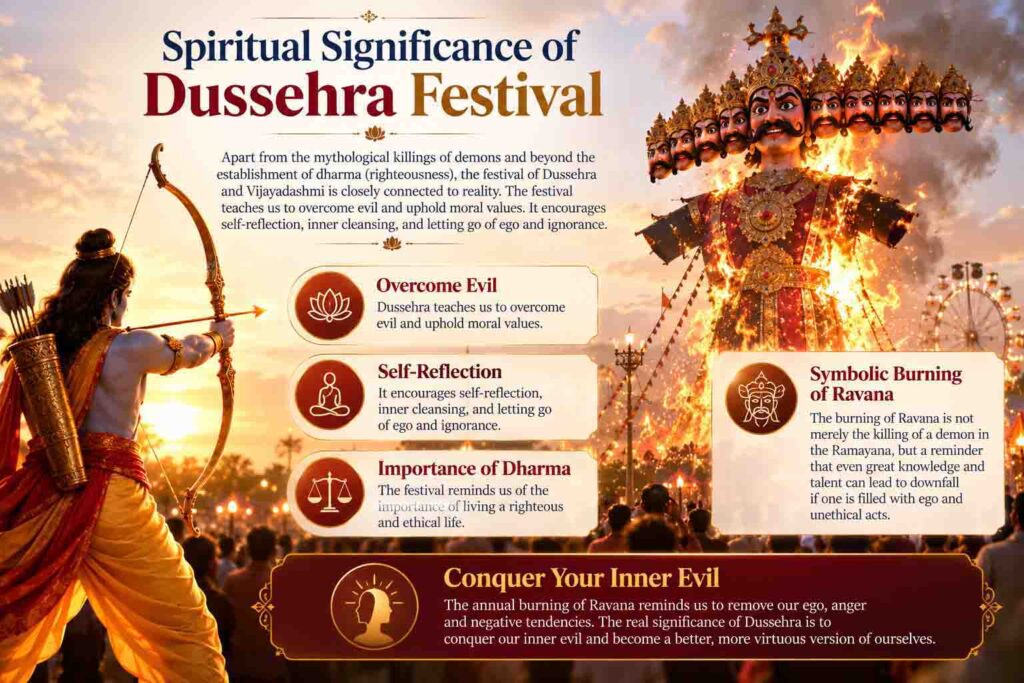 Apart from the mythological killings of demons and beyond the establishment of dharma (righteousness), the festival of Dussehra and Vijayadashmi is closely connected to reality. The festival teaches us to overcome evil and uphold moral values. It encourages self-reflection, inner cleansing, and letting go of ego and ignorance.
The primary ritual of Dussehra and Vijayadashmi is the burning of Ravana. It is not merely the killing of the demons that happens in the Ramayana; rather, it is observed every year to remind us that, no matter how knowledgeable or scholarly someone is, their ego and sins can lead to their destruction.
The portrayal of Ravana’s burning that is organised every year during the festival of Vijayadasmi reminds us to remove our ego, anger, and unethical acts. The real significance of the celebration of the festival is to conquer our inner evil.
What is Ravana Dahan: What Does His Effigy Burning Symbolise?
Ravana Dahan is a significant ritual in Hinduism, which involves the burning of the giant human-made effigy of Ravana, which is filled with firecrackers. It is the most vital and impactful part of the Dussehra celebration.Ravana Dahan and the burning of his statue symbolise the end of unrighteousness and immorality. It also reminds us to burn our own inner demons. Every head of Ravana represents a vice: ego, lust, greed, pride, jealousy, and more. By watching him burn, we are reminded to purify our own thoughts.
What Ravana’s Ten Heads Symbolise?
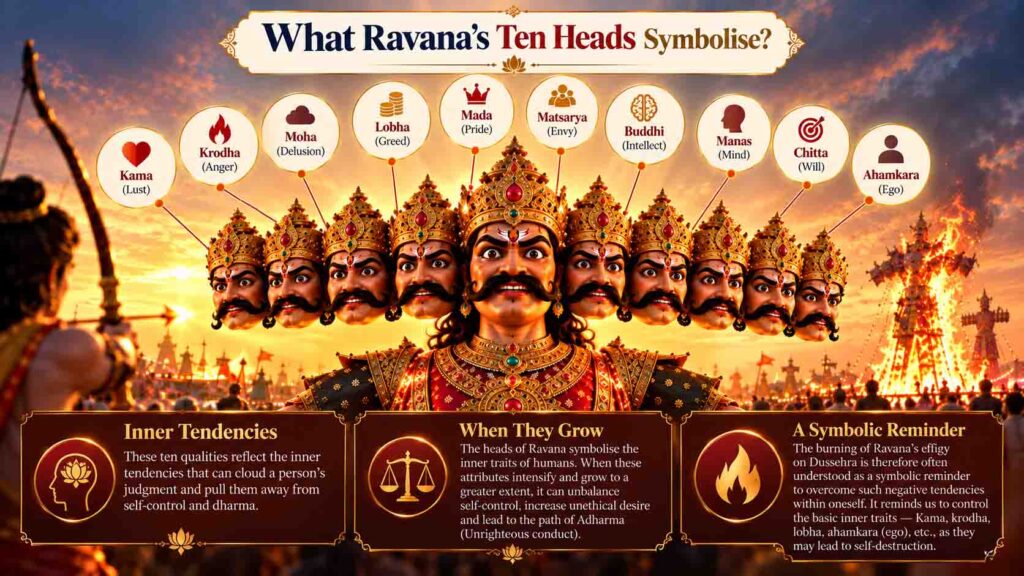 The ten heads of Ravana symbolise the following:
- Kama (lust)
- Krodha (anger)
- Moha (delusion)
- Lobha (greed)
- Mada (pride)
- Matsarya (envy)
- Buddhi (intellect)
- Manas (mind)
- Chitta (will)
- Ahamkara (ego)
The heads of Ravana symbolise the inner traits of humans which are listed above. When these attributes intensify and grow to a greater extent, it can unbalance self-control, increase unethical desire and lead to the path of Adharma (Unrighteous conduct).
The burning of the Ravana effigy on the day of Dussehra reminds us to control the basic inner traits: Kama, krodha, lobha, ahamkara (ego), etc., as they may lead to self-destruction.
Ayudha Puja & Shastra Puja and Its Relevance to Dussehra and Weapons
The festival is widely observed in southern states like Tamil Nadu (as Ayudha Pujai), Karnataka (as Ayudha Puja), Kerala, Andhra Pradesh, and Telangana. In other regions like Maharashtra and Odisha, it is celebrated as Khande Navami or Shastra Puja.Ayudh Puja, also known as Shastra Puja, is a religious celebration observed on the Navmi tithi of Navratra or on the day of Vijayadasmi. It is commonly observed in the southern part of India, especially in the states of Tamil Nadu, Karnataka, Kerala, Andhra Pradesh, and Telangana.
During the Ayudha or Shastra Puja, people worship the tools, instruments, and weapons they use for their livelihood or keep in their houses. The word Ayudha refers to a tool or weapon, and Shastra is a Sanskrit word that also means weapon. Thus, collectively, both mean the festival of weapons or tools.
People used to clean machinery items, books, musical instruments, vehicles, and weapons. They also apply sandalwood paste, vermilion (tilak), and offer flowers to them. Students and working professionals worship books, pens, pencils, laptops, and computers they use for their study and earning. Defence personnel, policemen or security guards also offer prayers to their firearms and weapons.
Dussehra Celebration in Different States of India
Dussehra is celebrated with different flavours across India: Here are the Region-wise Dussehra / Vijayadashami celebration details:|
State / Region |
Major City/Area | Common Name |
Observation & Specific Rituals |
| Delhi & much of North India | Delhi, Uttar Pradesh, Haryana, Punjab | Dussehra / Vijayadashami | Ramlila (the story of the Ramayana is played) and Ravana Dahana ceremonies are commonly held at designated sites. Fairs (melas) and processions (jhanki) are commonly observed across the city, where families and individuals pay a visit. |
| Ayodhya & eastern Uttar Pradesh | Ayodhya, Varanasi, Ramnagar | Dussehra / Vijayadashami | Strong influence of the sacred epic- the Ramayana. Ramleela and the Ravana Dahan are held across the cities. People used to visit temples to worship and view Ramleela performances. Large gatherings are seen at designated temples, including the Ram Mandir. Ramleela play is extended to 10-12 days from the day of Dussehra. |
| Rajasthan | Kota, Jaipur, Sikar and other areas | Dussehra / Vijayadashami | Dussehra fairs and Ravan Dahan events are common across Rajasthan. Month-long Vijayadashmi kota mela, Rajput sword worship, and shooting of the grand arrow at Ravana’s effigy make the festival unique & special. |
| Himachal Pradesh | Kullu | Kullu Dussehra | Apart from the Ravana- Dahan celebration, the week-long carnival attracts the eye of tourists across the world. Lord Raghunath’s chariot procession leads the celebration, with hundreds of village deities arriving in decorated palanquins. It becomes a week-long religious and cultural gathering. |
| Gujarat | Ahmedabad and across the state | Navratri / Dussehra / Vijayadashami | Across Gujarat and the capital, Ahmedabad, the tradition of Garba and Dandiya Raas is commonly observed during the nights of Navratri and on Dussehra and beyond. |
| West Bengal | Kolkata and across Bengal | Vijaya Dashami / Bijoya Dashami | Across the West Bengal region, including Kolkata, Dussehra is celebrated as Vijayadashmi. The killing of the demon Mahishasura is the central theme after the culmination of the festival Durga Puja. The immersion of Mata Durga’s idol is led by the people’s march, and the procession adds another level of charm to Vijayadashmi. |
| Odisha | Cuttack, Bhubaneswar, Puri | Dussehra / Durga Puja / Dashami | Elaborate Durga Puja pandals, processions and Goddess worship. Cuttack is especially known for elaborate |
| Jharkhand | Ranchi and other areas | Dussehra / Vijayadashami / Durga Puja | Dussehra / Vijayadashami / Durga Puja |
| Bihar | Patna and other areas | Dussehra / Vijayadashami | The eastern Gangetic region shares considerable Durga Puja influence with Jharkhand, Bengal and eastern Uttar Pradesh. Ramleela performance, Burning of Ravana effigies and immersion of the deity Durga’s idol are common across the state of Bihar. Jhijhiya competition and dance in the Mithila and Magadh region is a distinct celebration observed in Bihar. |
| Assam & Tripura | Guwahati, Agartala and surrounding areas | Durga Puja / Vijayadashami | Celebration includes the worship of the goddess. Pandals, public gatherings, and immersion of Maa Durga’s idol are common rituals. The Ministry of Tourism identifies Assam and Tripura among the regions where this Durga Puja/Vijayadashami tradition is particularly established. |
| Karnataka | Mysuru | Mysuru Dasara / Dasara / Nadahabba | A very distinct celebration of Dussehra is held. Unlike other regions of India, the killing of the demon Mahishasura by Mata Chamundeshwari and her victory is celebrated with all pomp and show. Every ritual is organised. On the day of Dussehra, a Jumbo (or Jamboo) Savari ride is held, where the grand elephants carry the deity Chamundeshwari’s idol inside the golden howdah (a seat), and then the parade starts, and later the idols are immersed. Mysore Dussehra is also a tourist attraction across India and beyond. |
| Karnataka – other regions | Mangaluru, Madikeri, Srirangapatna | Dasara | Regional variations include Sharada Devi processions in Mangaluru, elaborate illuminated mantapas in Madikeri, temple and riverside celebrations in Srirangapatna, and traditions such as Ayudha Puja and Bombe Habba. |
| Tamil Nadu | Chennai and across Tamil Nadu | Navaratri / Ayudha Puja / Vijayadashami | The celebration of Navratri and Dussehra is also peculiar in the state of Tamil Nadu. Families set up the traditional Golu/Kolu, featuring the steps where small idols of gods and goddesses are on the top, then saints in the middle and humans in the last row. Ayudh Puja is also a special ritual observed in the region, where books, tools, musical instruments, machinery and vehicles are worshipped. Vijayadashami is associated with new beginnings and initiation into learning. |
| Kerala | Kottayam, Malappuram, Thiruvananthapuram and elsewhere | Vijayadashami | The festival has a strong Saraswati and education-related tradition. Books and learning materials are kept for worship during Navaratri, followed by Vidyarambham/Ezhuthiniruthu on Vijayadashami, when children are ceremonially introduced to learning. |
| Andhra Pradesh | Vijayawada | Vijayadashami / Dussehra | The major focus is Goddess Kanaka Durga at the Kanaka Durga Temple. The Goddess receives different alankarams during Navaratri, with Vijayadashami featuring special pujas, processions and, traditionally, Teppotsavam on the Krishna River. |
| Andhra Pradesh | Proddatur | Proddatur Dussehra / Vijayadashami | Temple-centred celebration with elaborate Goddess adornments throughout Navaratri. Vijayadashami culminates in a large fair and Thotti Meravani, a procession in which the Goddess is taken through the town along with deities from other temples. |
| Andhra Pradesh | Devaraguttu, Kurnool | Devaraguttu Dussehra / Banni Festival | A highly distinctive local tradition centred on Mala Malleswara Swamy and Goddess Parvathi. Vijayadashami night features the traditional Banni Utsavam, including a ritual stick-fighting event. |
| Telangana | Hyderabad and across Telangana | Vijayadashami / Dussehra / Navaratri | Vijayadashami is widely celebrated as Dussehra. The festival exists alongside the state’s distinctive Bathukamma celebrations, which culminate shortly before Dussehra. |
| Maharashtra | Mumbai, Pune and across the state | Dussehra / Vijayadashami | Shastra Puja, worship of tools and weapons, is important. People also worship agricultural implements and exchange Apta/Shami leaves, traditionally regarded as symbolic of gold. Some areas observe Simollanghan, a ritual associated with crossing traditional boundaries. |
| Chhattisgarh | Bastar / Jagdalpur | Bastar Dussehra | Perhaps the most important exception to the conventional Dussehra narrative: Ravana is not burned. The long festival centres on Maa Danteshwari, local deities, tribal traditions and elaborate chariot rituals. It begins with Pat Jatra and continues for roughly 75 days. |
| Chhattisgarh | Sarangarh | Sarangarh Dussehra | On Vijayadashami, a symbolic mud fort is constructed, and participants compete to climb it in the traditional Garh Vichhedan/Garh Chadhai ritual. |
How Dussehra is Celebrated Beyond India
Beyond India, Dussehra and Vijayadashami are celebrated in different ways, shaped by local customs and the traditions of Hindu communities around the world. Check how the celebration is done in other nation:|
Country / Region |
What it is Commonly Called | How it is Celebrated |
Distinctive Traditions / Features |
| Nepal | Dashain / Bijaya Dashami / Vijaya Dashami | Dashain is Nepal’s major Hindu festival and is celebrated over an extended period, with worship of Goddess Durga, family reunions, temple visits and elaborate pujas. The tenth day, Vijaya Dashami, is the central day for receiving blessings from elders. | Dashain |
| Sri Lanka | Vijayadashami / Dussehra | Hindu communities in Sri Lanka observe Navaratri with worship of Durga, Lakshmi and Saraswati. Vijayadashami marks the victory of Lord Rama over Ravana and is observed as the concluding day of the festival. | No Distinction; celebrated as Vijadashmi by the Hindu communities |
| United Kingdom | Dussehra / Vijayadashami | Hindu communities observe the festival through temple programmes, Ramlila performances, prayers, cultural gatherings and, where permitted, Ravana effigy burning. The form varies according to the regional traditions of different Hindu communities. | In the UK, celebrations are generally community- and temple-based. Some temples organise smaller-scale Ravana Dahan, while communities with Bengali, Gujarati, Tamil, Nepali and other backgrounds may observe their own regional traditions around the same Navratri period. |
| United States | Dussehra / Vijayadashami | Indian and Hindu diaspora communities celebrate through Ramlila, Ravana Dahan, temple prayers and community gatherings. Other regional traditions-including Durga Puja, Ayudha Puja, Golu and Garba-also take place during the wider Navratri period. | Celebrations are often organised by Hindu temples, cultural associations and community groups. In some communities, children and young people participate in performances and cultural programmes, making Dussehra both a religious and community event. |
How Dussehra Connects to Navratri
Dussehra, also known as Vijayadashami, is observed on the 10th day of the Hindu month of Ashwin, right after the nine days of Navratri. During Navratri, people worship nine forms of Goddess Durga. Dussehra celebrates her final victory over Mahishasura.So, the festival brings together two divine stories-Rama’s and Durga’s-making it one of the most spiritually charged days in Hinduism.