+91 9990176000
 +91 9999097600
 CALENDAR 2026


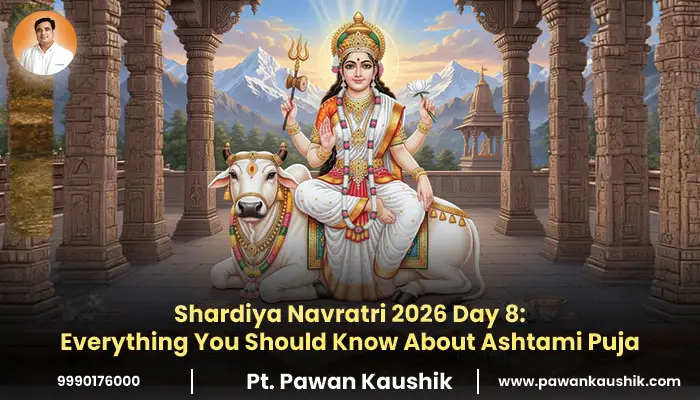 Day 8th of Navratri is dedicated to Goddess Mahagauri, where devotees worship her with full devotion. Maa Mahagauri is the 8th incarnation of deity Durga among her 9 forms. After the intense penance in order to please Lord Shiva, deity Parvati turns dark. Seeing her austerity, Lord Shiva graces her with the return of her radiant beauty, and this form of the deity came to be known as Goddess Mahagauri.
Devotees worship Mata Mahagauri on Navratri day 8. She appears to have a fair complexion and blesses her devotees and worshippers with purity, peace and mental calmness. In 2026, the 8th day of Navratri, Durga Ashtami, falls on 19th of October 2026. The Maha Ashtami tithi is from 08:27 AM on October 18, 2026, to 10:51 AM on October 19, 2026.
If you are looking for all the correct details of Ashtami puja and everything about Mahagauri Mata, including the 8th day of Navratri bhog, colour, mantra, story, etc., this guide is for you.
When is Shardiya Navratri Ashtami Poojan in 2026?
Below is the Shardiya Navratri Maha Ashtami 2026 date and time.- In 2026, day 8 of Navratri falls on the 18th and 19th of October.
- Asthami tithi timing 2026 is from 08:27 AM on October 18, 2026, to 10:51 AM on October 19, 2026.
- Durga Ashtami Puja will be held in the morning on October 19, 2026.
About the 8th Day of Navratri Goddess: Who is Mata Mahagauri?
Maa Mahagauri is a revered divine goddess whom people worship, especially on the Ashtami tithi of Navratri. The word Maha means extraordinary, and Gauri means- White or light; together, Mahagauri represents extreme radiance and beauty. She represents peace, purity and tranquillity and blesses her devotees with good fortune and a blissful life.Worshipping the 8th manifestation of the deity Durga, Mahagauri is also believed to clear sins and purify the soul of her followers & devotees. Families also seek her blessings on Durga Ashtami or Maha Ashtami for a peaceful and happy married life and for a harmonious household atmosphere.
Mahagauri Mata is also the remover of obstacles, and she blesses her devotees with serenity, a good life and wisdom.
Appearance of Maa Mahagauri
Mahagauri Mata is depicted with a fair, white and radiant complexion, symbolising complete purity, dharma and divinity. The goddess sits on a white bull (Nandi) that symbolises sacredness, steadfastness and spiritual purity.The deity is also shown wearing complete white attire. He is also depicted with four hands, where on the right side, the upper hand holds a trident (treeshool), and the bottom appears in abhaya mudra (gesture of protection).
Likewise, on the left side, the upper hand holds a Dambru (small drum), and the lower one appears in varaha mudra (blessing gesture). Her trident (trisool) symbolises the destruction of negativity and evil power, while the damru represents the cosmic rhythm.
Significance of the 8th Day of Navratri
The significance of Navratri day 8, or Durga Ashtami, lies in Navratri’s peak energy. The Ashtami tithi represents the aftermath of the triumph over evil and the establishment of virtue and goodness. On the spiritual occasion of Maha Ashtami, devotees worship Devi MahaGauri to seek her blessings. The deity helps their devotees fulfil their desires and overcome life obstacles.Ashtami tithi is very popular for Kanya Puja, where families and individuals organise this ritual to accumulate good karma. This includes feeding younger girls and offering them sweets, money as dakshina, and clothes. Kanya Pujan is a very sacred ritual of Navratri, which is mostly observed on Ashtami tithi.
Astrological Significance of Durga Ashtami
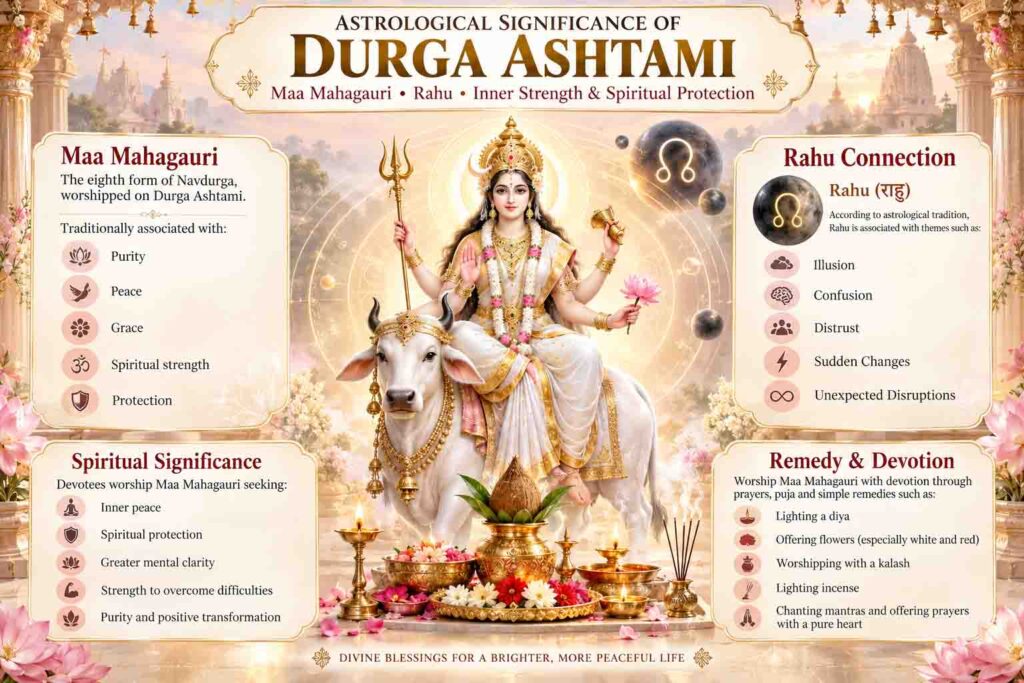 Each form of the Navratri deity is associated with a planet, and Mata Mahagauri governs the planet “Rahu.” The planet creates illusion, distrust, sudden loss, mental issues and unexpected disruption. As per astrological belief, worshipping the eight forms of Goddess Durga-Mahagauri also helps devotees overcome the malefic effects of Mahagauri’s ruling planet, Rahu, in the birth chart and gain the positive traits of the planet.
Maa Mahagauri Katha: 8th Day of Navratri Story
Maa Mahagauri story is a beautiful tale of devotion, sacrifice, pure intention, austerity and divine grace. The story of the deity explains the determination of Goddess Parvati when she dreamed of marrying Lord Shiva.She undergoes intense penance that continues for thousands of years.
During her austerity, she gave up all comforts and meditated in the dense forest around the mountain. Her body turned fragile and dark. Her appearance gradually became vulnerable, yet she stuck to her wish and did not let her resolve waver.
Seeing the unshaken determination and unmatched devotion, Lord Shiva agreed to fulfil her wish. Lord Shiva appeared at the place of the deity and saw her pale appearance. Then he bathed her with the Ganga water matted in his hair (jata). Deity Mahagauri’s darkness and dirt were washed away, and she appeared glowing and extremely radiant.
Her skin emerged extremely fair and like a white flower, and she came to be known as Mahagauri. Due to her glow and fair complexion, she is also known as “Shwetambardhara.”
The story of Maha Ashtami and the deity Mahagauri symbolises how firm determination and devotion meet the desired goal. Her journey of penance and dark appearance, and later the glowing appearance, represents her pure devotion that sustains the fires of hardship and then receives blessings in the aftermath of life.
On the 8th day of Navratri, people listen to the katha of Ashtami that recalls that no matter how difficult the journey of life is, sincere devotion and willpower bring divine grace that leads to success and fulfilment.
8th Day of Navratri Colour 2026
For Shardiya Navratri 2026, the day 8 Navratri colour is purple (18th of October). However, the Ashtami tithi is on 19th October 2026; the colour will be peacock green, according to the Hindu panchang. To make it clearer, 18th of October is associated with the colour purple, while on 19th of October (where asthami tithi continues), the colour will be Peacock Green. The colour signifies grace, renewal, and a blissful life after the period of difficulties and austerity.What to Wear on Durga Ashtami 2026?
Although there is no compulsion for a particular dress code, each day of Navratri has a specific colour, and wearing that colour is believed to be auspicious to harness the blessings of that day’s deity. On Ashtami tithi 2026, dark green or peacock green cloth will be considered spiritually beneficial for devotees. If green is not possible, one can also wear a white or silver-coloured dress, which signifies the fair and radiant form of Goddess Mahagauri.8th day of Navratri bhog: Mahagauri Prasadam on Asthami Tithi
Like each day of Navratri, there is also a special 8th day of Navratri bhog that is offered to the goddess Mahagauri. The traditional bhog, or offering, for Goddess Mahagauri is coconut, and devotees offer the same and sweets made with coconut to the deity on every Maha Asthami. Other fruits and sweets, including panchamrit, are also offered along with the coconut.In 2026, devotees can offer a whole piece of coconut or sweets like coconut barfi, nariyal laddoo, or kheer to the eighth incarnation of the deity Durga and invoke her blessings. Coconut symbolises inner dedication and softness, even though it is harsh from outside. It is an ego-less offering to the divine mother, Maa Mahagauri.
Mahagauri Mata Mantra
The following is the list of Navratri Ashtami and Mahagauri Mata Mantras a devotee should chant or hear on Ashtami tithi:Mahagauri Mata In- General Mantra
ॐ देवी महागौर्यै नमः॥Om Devi Mahagauryai Namah॥ (chant 108 times)
Goddess Mahagauri Beej Mantra
The primary beeja (seed) mantra for Mata Mahagauri is “श्री क्लीं ह्रीं वरदायै नम:”Shri Kleen Hreem Varadayai Namah. (Chant 108 times).
Prarthana
श्वेते वृषेसमारूढा श्वेताम्बरधरा शुचिः।महागौरी शुभं दद्यान्महादेव प्रमोददा॥
Shwete Vrishesamarudha Shwetambaradhara Shuchih।
Mahagauri Shubham Dadyanmahadeva Pramodada॥
Stuti
या देवी सर्वभूतेषु माँ महागौरी रूपेण संस्थिता।नमस्तस्यै नमस्तस्यै नमस्तस्यै नमो नमः॥
Ya Devi Sarvabhuteshu Maa Mahagauri Rupena Samsthita।
Namastasyai Namastasyai Namastasyai Namo Namah॥
Dhyanam
वन्दे वाञ्छित कामार्थे चन्द्रार्धकृतशेखराम्।सिंहारूढा चतुर्भुजा महागौरी यशस्विनीम्॥
पूर्णन्दु निभाम् गौरी सोमचक्रस्थिताम् अष्टमम् महागौरी त्रिनेत्राम्।
वराभीतिकरां त्रिशूल डमरूधरां महागौरी भजेम्॥
पटाम्बर परिधानां मृदुहास्या नानालङ्कार भूषिताम्।
मञ्जीर, हार, केयूर, किङ्किणि, रत्नकुण्डल मण्डिताम्॥
प्रफुल्ल वन्दना पल्लवाधरां कान्त कपोलाम् त्रैलोक्य मोहनम्।
कमनीयां लावण्यां मृणालां चन्दन गन्धलिप्ताम्॥
Vande Vanchhita Kamarthe Chandrardhakritashekharam।
Simharudha Chaturbhuja Mahagauri Yashasvinim॥
Purnandu Nibham Gauri Somachakrasthitam Ashtamam Mahagauri Trinetram।
Varabhitikaram Trishula Damarudharam Mahagauri Bhajem॥
Patambara Paridhanam Mriduhasya Nanalankara Bhushitam।
Manjira, Hara, Keyura, Kinkini, Ratnakundala Manditam॥
Praphulla Vandana Pallavadharam Kanta Kapolam Trailokya Mohanam।
Kamaniyam Lavanyam Mrinalam Chandana Gandhaliptam॥
Stotra
सर्वसङ्कट हन्त्री त्वंहि धन ऐश्वर्य प्रदायनीम्।ज्ञानदा चतुर्वेदमयी महागौरी प्रणमाम्यहम्॥
सुख शान्तिदात्री धन धान्य प्रदायनीम्।
डमरूवाद्य प्रिया अद्या महागौरी प्रणमाम्यहम्॥
त्रैलोक्यमङ्गल त्वंहि तापत्रय हारिणीम्।
वददम् चैतन्यमयी महागौरी प्रणमाम्यहम्॥
Sarvasankata Hantri Tvamhi Dhana Aishwarya Pradayanim।
Jnanada Chaturvedamayi Mahagauri Pranamamyaham॥
Sukha Shantidatri Dhana Dhanya Pradayanim।
Damaruvadya Priya Adya Mahagauri Pranamamyaham॥
Trailokyamangala Tvamhi Tapatraya Harinim।
Vadadam Chaitanyamayi Mahagauri Pranamamyaham॥
Kavacha
ॐकारः पातु शीर्षो माँ, हीं बीजम् माँ, हृदयो।क्लीं बीजम् सदापातु नभो गृहो च पादयो॥
ललाटम् कर्णो हुं बीजम् पातु महागौरी माँ नेत्रम् घ्राणो।
कपोत चिबुको फट् पातु स्वाहा माँ सर्ववदनो॥
Omkarah Patu Shirsho Maa, Him Bijam Maa, Hridayo।
Klim Bijam Sadapatu Nabho Griho Cha Padayo॥
Lalatam Karno Hum Bijam Patu Mahagauri Maa Netram Ghrano।
Kapota Chibuko Phat Patu Swaha Maa Sarvavadano॥
Aarti
जय महागौरी जगत की माया। जय उमा भवानी जय महामाया॥हरिद्वार कनखल के पासा। महागौरी तेरा वहा निवासा॥
चन्द्रकली और ममता अम्बे। जय शक्ति जय जय माँ जगदम्बे॥
भीमा देवी विमला माता। कौशिक देवी जग विख्यता॥
हिमाचल के घर गौरी रूप तेरा। महाकाली दुर्गा है स्वरूप तेरा॥
सती (सत) हवन कुण्ड में था जलाया। उसी धुयें ने रूप काली बनाया॥
बना धर्म सिंह जो सवारी में आया। तो शंकर ने त्रिशूल अपना दिखाया॥
तभी माँ ने महागौरी नाम पाया। शरण आने वाले का संकट मिटाया॥
शनिवार को तेरी पूजा जो करता। माँ बिगड़ा हुआ काम उसका सुधरता॥
भक्त बोलो तो सोच तुम क्या रहे हो। महागौरी माँ तेरी हरदम ही जय हो॥
Jai Mahagauri Jagat Ki Maya।
Jai Uma Bhavani Jai Mahamaya॥
Haridwar Kankhal Ke Paasa।
Mahagauri Tera Vahan Nivasa॥
Chandrakali Aur Mamta Ambe।
Jai Shakti Jai Jai Maa Jagdambe॥
Bhima Devi Vimala Mata।
Kaushik Devi Jag Vikhyata॥
Himachal Ke Ghar Gauri Roop Tera।
Mahakali Durga Hai Swaroop Tera॥
Sati (Sat) Havan Kund Mein Tha Jalaya।
Usi Dhuyen Ne Roop Kali Banaya॥
Bana Dharm Singh Jo Sawari Mein Aaya।
To Shankar Ne Trishul Apna Dikhaya॥
Tabhi Maa Ne Mahagauri Naam Paya।
Sharan Aane Wale Ka Sankat Mitaya॥
Shanivar Ko Teri Puja Jo Karta।
Maa Bigda Hua Kaam Uska Sudharta॥
Bhakt Bolo To Soch Tum Kya Rahe Ho।
Mahagauri Maa Teri Hardam Hi Jai Ho॥
The above details consist of all the important mantras, stotra, kavachh, dhayanam, aarti and Mahagauri stuti. Chanting these spiritual hymns protects devotees from obstacles and offers the blessings of the deity Mahagauri.
8th Day Navratri Puja Vidhi Step by Step
Devotees can follow this Mahagauri puja vidhi step by step to worship Maa Mahagauri on the eighth day of Navratri with devotion and proper preparation. Before beginning the puja, it is important to keep the worship area clean and arrange all the required items so that the rituals can be performed peacefully without interruption.Navratri Day 8 Puja Samagri List
Before we move to the Navratri Day 8 puja samagri list, it is important to understand that you do not need to arrange every item in a large quantity. The essential items can be kept ready according to your family tradition and the type of puja you normally perform.The main puja samagri for worshipping Maa Mahagauri includes:
Puja Samagri List |
||
|---|---|---|
|
Idol or picture of Maa Mahagauri |
A clean chowki or puja platform | Clean white or red cloth for the chowki |
|
Kalash |
Water for the Kalash |
Mango leaves |
| Coconut for the Kalash | Gangajal |
Roli and kumkum |
|
Haldi |
Chandan or sandalwood paste | Akshat (unbroken rice) |
| Fresh white flowers, especially jasmine or mogra | Flower garland |
Dhoop or incense sticks |
|
Ghee diya |
Ghee or oil for the lamp | Camphor for Aarti |
| Panchamrit made with milk, curd, honey, ghee and sugar | Fruits, including coconut |
Sweets or homemade prasad |
|
Halwa |
Puri | Black gram (kala chana), especially if Kanya Puja is being performed |
| Betel leaves and betel nuts | Cloves and cardamom, if used in your family puja |
Moli or Kalava |
|
A bell |
Shankh, if available |
Chunri or cloth to offer to the Goddess |
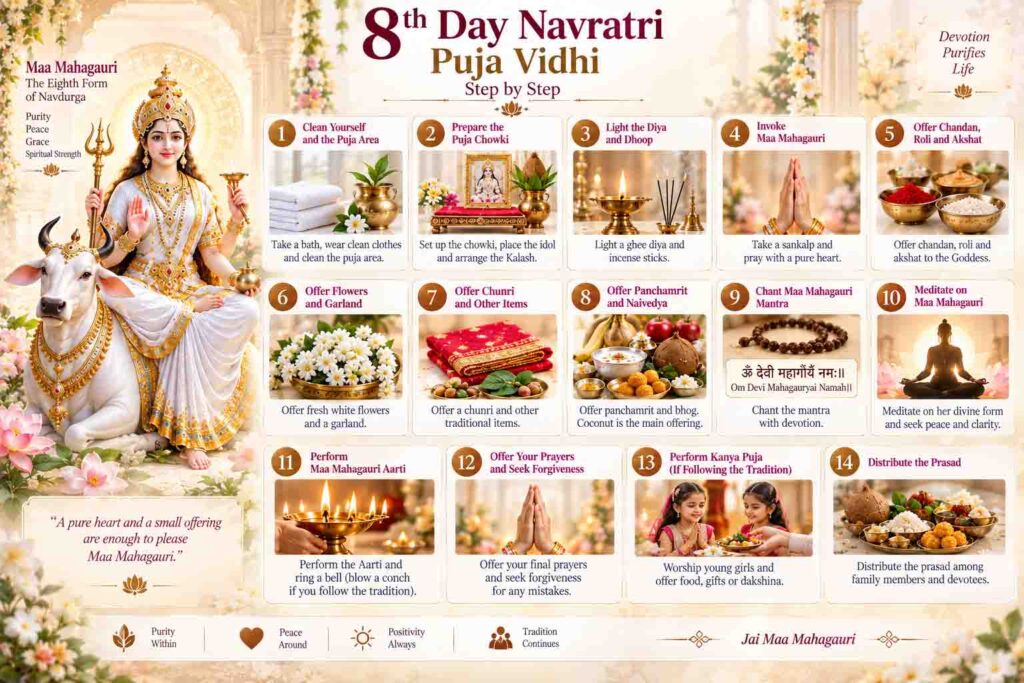
Step 1. Clean Yourself and the Puja Area
Begin the day by taking a bath and wearing clean clothes. You may choose white or another clean, comfortable colour according to your family tradition. Clean the place where you will perform the puja and remove unnecessary items from the area.You can sprinkle a little Gangajal around the puja space as part of the purification process. Keep the chowki ready and place a clean cloth over it.
Step 2. Prepare the Puja Chowki
Place the idol or picture of Maa Mahagauri on the prepared chowki. Arrange the Kalash near the Goddess and fill it with clean water. Place mango leaves around its opening and a coconut on top if this is part of your family’s usual Kalash setup.Decorate the area with fresh flowers and keep all the puja samagri within easy reach.
Step 3. Light the Diya and Dhoop
Light a ghee diya in front of Maa Mahagauri. You can then light dhoop or incense sticks to begin the worship in a calm and devotional atmosphere.The lamp is kept as an important part of the puja, while incense is traditionally offered as part of the worship.
Step 4. Invoke Maa Mahagauri
Sit comfortably in front of the Goddess, fold your hands and take a moment to focus your mind. Remember Maa Mahagauri and begin the puja with a sincere prayer.You may mentally state your sankalp, expressing your intention to perform the puja with devotion and seek the Goddess’s blessings.
Step 5. Offer Chandan, Roli and Akshat
Offer sandalwood paste, roli or kumkum and akshat to Maa Mahagauri according to your family tradition. These offerings form part of the customary worship of the Goddess.If you are worshipping an idol, apply the offerings gently and respectfully. For a picture, offer them symbolically without damaging the image.
Step 6. Offer Flowers and Garland
Offer fresh flowers to Maa Mahagauri. White flowers such as jasmine or mogra are commonly associated with her worship because they complement her white and peaceful form. You may also offer a flower garland.While offering the flowers, pray with devotion and remember the serene form of Maa Mahagauri.
Step 7. Offer Chunri and Other Items
If you have brought a chunri or clean cloth for the Goddess, offer it respectfully. You may also offer other traditional items such as betel leaves, betel nuts, cloves and cardamom according to your family’s puja tradition.There is no need to make the offering elaborate if these items are not part of your usual worship.
Step 8. Offer Panchamrit and Naivedya
If your puja tradition includes Panchamrit, prepare it using milk, curd, honey, ghee and sugar and offer it to the Goddess.Next, arrange the bhog. The principal bhog associated with Maa Mahagauri is coconut (nariyal). Devotees also commonly offer halwa, puri, chana, kheer and other sattvik sweets during Ashtami worship. Coconut is particularly associated with Mahagauri’s puja and can be offered as a whole coconut or as part of a suitable coconut-based preparation.Place coconut, fruits, sweets and other prepared sattvik food before Maa Mahagauri. Coconut is the principal bhog traditionally associated with her, while halwa, puri, chana and kheer are also commonly offered during Ashtami.
Step 9. Chant Maa Mahagauri Mantra
After making the offerings, sit quietly before the Goddess and chant her mantra with devotion.A commonly recited mantra is:
ॐ देवी महागौर्यै नमः॥
Om Devi Mahagauryai Namah॥
You may also recite the Mahagauri dhyan mantra, stotra, kavach, stuti or other prayers traditionally included in her worship. The purpose is to maintain a focused and devotional state during the puja.
Step 10. Meditate on Maa Mahagauri
After chanting the mantra, sit quietly for a few moments and meditate on Maa Mahagauri’s form. Visualise her radiant white appearance, peaceful expression and her form seated on the white bull.You can use this time to offer your personal prayers and seek peace, purity, strength and clarity in life.
Step 11. Perform Maa Mahagauri Aarti
Now perform the Aarti of Maa Mahagauri. Light camphor or use the ghee diya and move the flame gently in clockwise circles before the Goddess.Sing Maa Mahagauri’s Aarti while ringing a bell. If your family tradition includes blowing a conch during Aarti, it may also be performed at this stage.
Step 12. Offer Your Prayers and Seek Forgiveness
After the Aarti, fold your hands and offer your final prayers to Maa Mahagauri. You can sincerely ask for her blessings for peace, prosperity, harmony and spiritual well-being.Also seek forgiveness for any mistakes or omissions that may have occurred during the puja, whether intentional or unintentional.
Step 13. Perform Kanya Puja, If Following the Tradition
Kanya Puja or Kumari Puja is an important Ashtami practice in many Hindu households and regions. Young girls are respectfully worshipped as manifestations of the Goddess and are offered food, gifts or dakshina accordingto family and regional customs.
If you perform Kanya Puja, prepare the food and seating area beforehand and conduct the ritual respectfully.
Step 14. Distribute the Prasad
Once the puja is complete, allow the offerings to be accepted as prasad according to your household tradition. Distribute the coconut, halwa, puri, chana, fruits and other offered food among family members and devotees.Conclude the worship by remembering Maa Mahagauri with devotion and gratitude.