+91 9990176000
 +91 9999097600
 CALENDAR 2026


 Shardiya Navratri 2026 is set to begin on the 11th of October and will conclude on the 20th of October. Across India, Navratri is celebrated with utmost devotion, where people participate in puja and do rituals associated with the 9 forms of Deities. However, many devotees do not have ideas about the sacred bhog that is offered on each day of Navratri. According to India’s trusted astrologer, Pt. Pawan Kaushik, while worshipping the nine forms of Maa Durga during Navratri, it is important to follow the correct rituals to receive the blessings of all the deities. Through this blog, we will discuss all the special bhog for 9 days during Navratri, through which you can get the blessings of all the deities of Navratri (all forms of Maa Bhagwati). You can check the Navratri bhog list that makes your pujan complete.
Navratri 9 Days and the Deities Worshipped Each Day
Shardiya Navratri is not just a festival — it is a structured spiritual journey that unfolds over nine sacred days. Each day is dedicated to a different form of Maa Durga, collectively known as the Navadurga. These divine forms represent different aspects of strength, wisdom, protection, purity and spiritual upliftment. Worshipping each form on her respective day helps devotees align with specific energies that support both material balance and inner growth.Understanding which Goddess is worshipped on each day helps bring clarity to your rituals. Every offering made during these nine days is not random — it is symbolically connected with the nature of the deity being worshipped.
Below is the day-wise sequence of Maa Durga’s forms worshipped during Navratri:
Day 1 – Maa Shailputri
The festival begins with the worship of Maa Shailputri, the daughter of the Himalayas. She represents stability and grounding energy.
Day 2 – Maa Brahmacharini
On the second day, Maa Brahmacharini is worshipped, symbolising discipline, devotion and inner strength.
Day 3 – Maa Chandraghanta
Maa Chandraghanta represents courage and protection. Her worship is associated with removing fear and negativity.
Day 4 – Maa Kushmanda
The fourth day is dedicated to Maa Kushmanda, the creator of the universe’s cosmic energy and vitality.
Day 5 – Maa Skandamata
Maa Skandamata symbolises nurturing energy and motherly protection.
Day 6 – Maa Katyayani
Maa Katyayani represents determination and righteous action.
Day 7 – Maa Kalaratri
The seventh day is devoted to Maa Kalaratri, who removes darkness and protects devotees from negative forces.
Day 8 – Maa Mahagauri
Maa Mahagauri symbolises purity, peace and new beginnings.
Day 9 – Maa Siddhidatri
The final day honours Maa Siddhidatri, who grants spiritual fulfilment and divine blessings.
Each of these nine days has a specific spiritual significance, and offering the appropriate Navratri bhog for 9 days helps establish a deeper connection with these divine energies.
Navratri Bhog for 9 Days 2026 List: Day-wise Guide
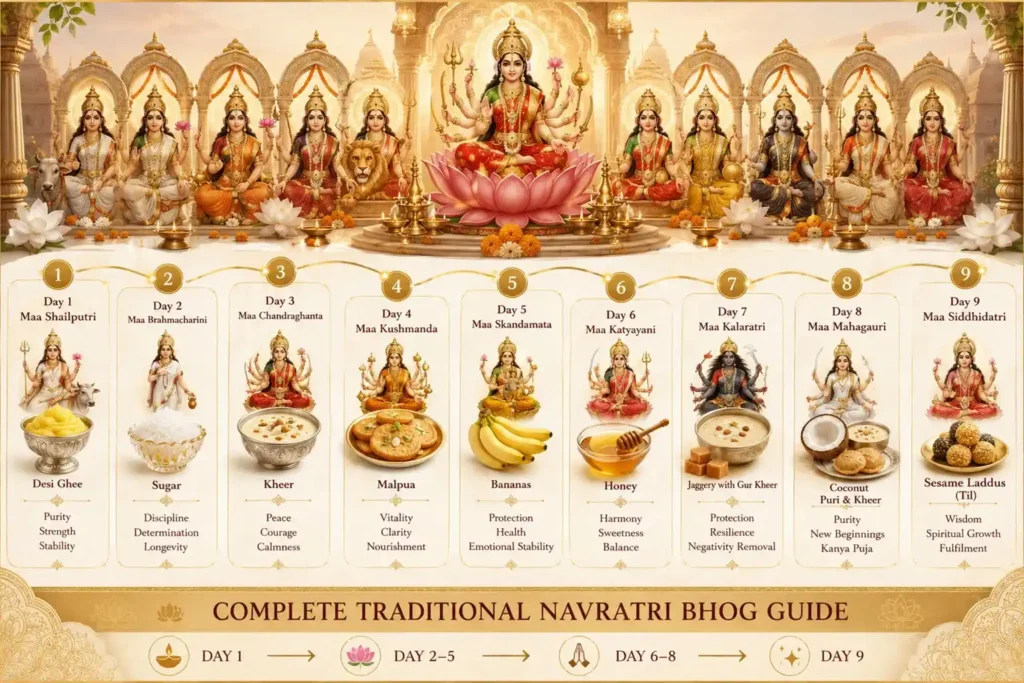 Offering the right Navratri bhog to each form of Maa Durga is an important part of daily worship during these nine days. Each offering is symbolic and is traditionally believed to align with the energy of the deity worshipped on that particular day. Below is the complete bhog (offerings list based on traditional practice and verified references.
1st Day of Navratri Bhog – Maa Shailputri
On the first day, pure desi ghee is offered to Maa Shailputri. This offering is believed to support physical well-being and promote stability in life. Devotees place ghee at the feet of the Goddess as a symbol of purity and strength.2nd Day of Navratri Bhog – Maa Brahmacharini
On the second day, sugar is offered to Maa Brahmacharini. This simple offering reflects her ascetic and disciplined nature. It is believed that this bhog brings longevity and strengthens inner determination.3rd Day of Navratri Bhog – Maa Chandraghanta
Milk-based preparations, especially kheer, are offered on this day. This Navratri offering is associated with peace and courage. Offering kheer is believed to remove fear and bring calmness to the mind.4th Day of Navratri Bhog – Maa Kushmanda
Malpua is offered to Maa Kushmanda on the fourth day. This sweet preparation symbolises vitality and nourishment. It is believed to support clarity of thought and balanced decision-making.5th Day of Navratri Bhog – Maa Skandamata
Bananas are offered as bhog on this day. This offering represents nourishment and protection. Devotees believe that offering bananas promotes health and emotional stability.6th Day of Navratri Bhog – Maa Katyayani
Honey is offered to Maa Katyayani. This offering symbolises sweetness in speech and relationships. It is believed that this supports harmony and emotional balance.7th Day of Navratri Bhog – Maa Kalaratri
Jaggery (gud) is offered on this day. This offering is traditionally associated with protection from negativity and strengthening inner resilience. People also offer sweets and rice pudding (kheer) made with jaggery (gur).8th Day of Navratri Bhog – Maa Mahagauri
Coconut is offered as bhog on the eighth day. It symbolises purity and new beginnings. Devotees also offer sweets made with coconut. Many devotees also perform Kanya Puja on this day, along with offering this puri, kheer, fruits, etc.9th Day of Navratri Bhog – Maa Siddhidatri
Sesame seeds (til) or preparations made from them are offered on the final day. This offering is believed to support spiritual growth and fulfillment.This completes the traditional Navratri Bhog list followed during Shardiya Navratri. Offering the correct one for 9 on the particular day with devotion is considered an important way to seek blessings from each form of Maa Durga during the sacred period.