+91 9990176000
 +91 9999097600
 CALENDAR 2026


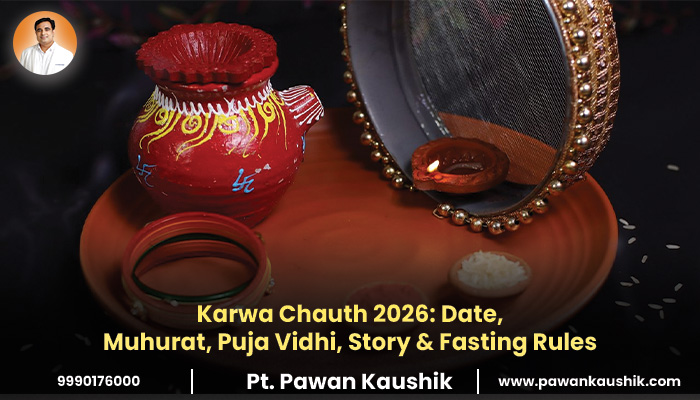 Karwa Chauth is a sacred Hindu festival that shares the holy bond between spouses. It falls on the Chaturthi tithi of the Krishna Paksha in the month of Kartik as per the Hindu lunar calendar.
On the auspicious occasion of Karwa Chauth festival, wives keeps fast from sunrise until moonrise for the long life, good health and success of their husbands. The key rituals involve wives sighting the moon through sieves and then viewing their husbands. The festival includes several rituals performed by women.
If you are looking for all the important details about Karwa Chauth in 2026, this guide is for. Here we cover everything about Karwa Chauth 2026, including its dates, muhurats, puja vidhi, story, and the step-by-step ritual associated with the Moon (Chandra).
When is Karwa Chauth in 2026?
The following are the Karwa Chauth 2026 dates and muhurat details. Following the sacred rituals as per the muhurat provides the full benefits of Karwa Chauth observance:- Karwa Chauth 2026 date: This year, Karwa Chauth falls on 29 October 2026 (Thursday).
- Karwa Chauth Puja Muhurat: 05:38 PM to 06:56 PM
- Karwa Chauth Upavasa Time: 06:31 AM to 08:17 PM
Karwa Chauth 2026 Puja time Muhurat & Moonrise Time
- Moonrise on Karwa Chauth 2026 – 08:17 PM
- Chaturthi Tithi Begins – 01:06 AM on Oct 29, 2026
- Chaturthi Tithi Ends – 10:09 PM on Oct 29, 2026
Karwa Chauth 2026 Puja Muhurat & Moonrise Time Across Cities in India
Karwa Chauth 2026 Muhurats and Moonrise Timing slightly vary from region to region. Indian festivals sit on tithi, not on date, and tithi and moonrise decide the day, not the sunrise. Also, the moonrise at night is different from observance as per the regions. In the eastern part of India, it is observed roughly half an hour earlier than in the northern part. Conversely, the southern part observes it a few moments later. To confirm the exact minute for the Karwa Chauth muhurats in your city, follow the table below:Karwa Chauth 2026 Puja Muhurat and Moon Sighting Time for Different Cities in India:
|
Cities |
Karwa Chauth Puja Muhurat | Karwa Chauth Upvasa Time |
Moonrise Timing |
|
New Delhi |
05:38 PM to 06:56 PM |
06:31 AM to 08:17 PM |
08:17 PM |
| Lucknow |
05:26 PM to 06:43 PM |
06:14 AM to 08:06 PM |
08:06 PM |
|
Mumbai |
06:07 PM to 07:22 PM |
06:37 AM to 09:00 PM |
09:00 PM |
| Jaipur |
05:46 PM to 07:03 PM |
06:34 AM to 08:28 PM |
08:28 PM |
|
Bhopal |
05:44 PM to 07:00 PM |
06:24 AM to 08:31 PM |
08:31 PM |
| Ahmadabad |
06:04 PM to 07:20 PM |
06:43 AM to 08:52 PM |
08:52 PM |
|
Amaravati |
05:45 PM to 07:01 PM |
06:20 AM to 08:35 PM |
08:35 PM |
| Itanagar |
04:35 PM to 05:52 PM |
05:23 AM to 07:13 PM |
07:13 PM |
|
Dispur |
04:43 PM to 06:00 PM |
05:29 AM to 07:23 PM |
07:23 PM |
| Patna |
05:10 PM to 06:27 PM |
05:56 AM to 07:52 PM |
07:52 PM |
|
Raipur |
05:33 PM to 06:51 PM |
06:29 AM to 08:08 PM |
08:08 PM |
| Panaji |
06:07 PM to 07:21 PM |
06:30 AM to 09:05 PM |
09:05 PM |
|
Gandhinagar |
06:03 PM to 07:19 PM |
06:43 AM to 08:51 PM |
08:51 PM |
| Chandigarh | 05:38 PM to 06:55 PM | 06:35 AM to 08:12 PM |
08:12 PM |
|
Shimla |
05:36 PM to 06:54 PM | 06:34 AM to 08:10 PM | 08:10 PM |
| Dharamshala | 05:38 PM to 06:56 PM | 06:39 AM to 08:10 PM |
08:10 PM |
|
Ranchi |
05:12 PM to 06:28 PM | 05:52 AM to 07:58 PM | 07:58 PM |
| Bengaluru | 05:54 PM to 07:08 PM | 06:12 AM to 08:55 PM |
08:55 PM |
|
Thiruvananthapuram |
06:01 PM to 07:14 PM | 06:11 AM to 09:08 PM | 09:08 PM |
| Imphal | 04:37 PM to 05:53 PM | 05:19 AM to 07:18 PM |
07:18 PM |
|
Shillong |
04:43 PM to 06:00 PM | 05:28 AM to 07:24 PM | 07:24 PM |
| Aizawl | 04:42 PM to 05:58 PM | 05:23 AM to 07:26 PM |
07:26 PM |
|
Kohima |
04:34 PM to 05:51 PM | 05:20 AM to 07:15 PM | 07:15 PM |
| Bhubaneswar | 05:14 PM to 06:29 PM | 05:47 AM to 08:03 PM |
08:03 PM |
|
Gangtok |
04:55 PM to 06:11 PM | 05:44 AM to 07:33 PM | 07:33 PM |
| Chennai | 05:43 PM to 06:57 PM | 06:02 AM to 08:44 PM |
08:44 PM |
|
Hyderabad |
05:46 PM to 07:01 PM | 06:13 AM to 08:41 PM | 08:41 PM |
| Agartala | 04:48 PM to 06:04 PM | 05:29 AM to 07:31 PM |
07:31 PM |
|
Kolkata |
05:01 PM to 06:17 PM | 05:39 AM to 07:47 PM |
07:47 PM |
Karwa Chauth in Other Countries: Muhurat and Moon Rise Timing
Karwa Chauth is also observed with great enthusiasm among Indian communities living abroad. If you are living outside India, follow these Karwa Chauth 2026 puja and moon sighting muhurat to perform its rituals according to the correct local lunar time:Karwa Chauth in the U.S. (United States of America)
If you are living in the U.S., follow these Karwa Chauth muhurats for puja, moon sighting and upvasa. The list of cities is chosen based on where Indian citizens primarily live or visit the United States:|
Cities |
Karwa Chauth Puja Muhurat | Karwa Chauth Upvasa Time |
Moonrise Timing |
|
New- York |
05:57 PM to 07:18 PM (28 Oct, 2026) | 07:22 AM to 07:35 PM (28 Oct, 2026) | 07:35 PM (28 Oct, 2026) |
| Chicago | 05:50 PM to 07:11 PM (28 Oct, 2026) | 07:18 AM to 07:27 PM (28 Oct, 2026) |
07:27 PM (28 Oct, 2026) |
|
San Francisco |
06:15 PM to 07:35 PM (28 Oct, 2026 | 07:31 AM to 08:08 PM (28 Oct, 2026) | 08:08 PM (28 Oct, 2026) |
| Houston | 06:38 PM to 07:55 PM (28 Oct, 2026) | 07:32 AM to 08:41 PM (28 Oct, 2026) |
08:41 PM (28 Oct, 2026) |
|
Dallas |
06:40 PM to 07:58 PM (28 Oct, 2026) | 07:42 AM to 08:38 PM (28 Oct, 2026) | 08:38 PM (28 Oct, 2026) |
| Los Angeles | 06:04 PM to 07:22 PM (28 Oct, 2026) | 07:09 AM to 08:04 PM (28 Oct, 2026) |
08:04 PM (28 Oct, 2026) |
|
Washington D.C |
06:12 PM to 07:32 PM (28 Oct, 2026) | 07:31 AM to 07:55 PM (28 Oct, 2026) |
07:55 PM (28 Oct, 2026) |
Karwa Chauth in the U.K. (United Kingdom)
If you are living in the U.K., (United Kingdom) follow these Karwa Chauth muhurats for puja, moon sighting and upvasa. The list of cities is chosen based on where Indian citizens primarily live or visit the United Kingdom:|
Cities |
Karwa Chauth Puja Muhurat | Karwa Chauth Upvasa Time |
Moonrise Timing |
|
London |
04:39 PM to 06:04 PM (29th October) | 06:48 AM to 06:31 PM (29th October) | 06:31 PM (29th October) |
| Leicester | 04:40 PM to 06:06 PM (29th October) | 06:55 AM to 06:27 PM (29th October) |
06:27 PM (29th October) |
|
Birmingham |
04:44 PM to 06:09 PM (29th October) | 06:58 AM to 06:31 PM (29th October) | 06:31 PM (29th October) |
| Edinburgh | 04:39 PM to 06:07 PM (29th October) | 07:13 AM to 06:06 PM (29th October) |
06:06 PM (29th October) |
|
Glasgow |
04:43 PM to 06:11 PM (29th October) | 07:17 AM to 06:11 PM (29th October) |
06:11 PM (29th October) |
Karwa Chauth in the Canada
If you are living in the Canada, follow these Karwa Chauth muhurats for puja, moon sighting and upvasa. The list of cities is chosen based on where Indian citizens primarily live or visit the nation of Canada:|
Cities |
Karwa Chauth Puja Muhurat | Karwa Chauth Upvasa Time |
Moonrise Timing |
|
Ontario |
06:14 PM to 07:35 PM (28 Oct, 2026) | 07:48 AM to 07:45 PM (28 Oct, 2026) | 07:45 PM (28 Oct, 2026) |
| Langley (British Columbia) | 05:56 PM to 07:19 PM (28 Oct, 2026) | 07:52 AM to 07:17 PM (28 Oct, 2026) |
07:17 PM (28 Oct, 2026) |
|
North Vancouver |
05:57 PM to 07:21 PM (28 Oct, 2026) | 07:54 AM to 07:17 PM (28 Oct, 2026) | 07:17 PM (28 Oct, 2026) |
| Prince Albert | 05:39 PM to 07:04 PM (28 Oct, 2026) | 07:54 AM to 06:39 PM (28 Oct, 2026) |
06:39 PM (28 Oct, 2026) |
|
Vancouver |
05:57 PM to 07:21 PM (28 Oct, 2026) | 07:54 AM to 07:18 PM (28 Oct, 2026) | 07:18 PM (28 Oct, 2026) |
| Edmonton | 06:09 PM to 07:34 PM (28 Oct, 2026) | 08:26 AM to 07:09 PM (28 Oct, 2026) |
07:09 PM (28 Oct, 2026) |
|
Montreal |
05:47 PM to 07:09 PM (28 Oct, 2026) | 07:28 AM to 07:13 PM (28 Oct, 2026) | 07:13 PM (28 Oct, 2026) |
| Winnipeg | 06:12 PM to 07:36 PM (28 Oct, 2026) | 08:12 AM to 07:26 PM (28 Oct, 2026) |
07:26 PM (28 Oct, 2026) |
|
Ottawa |
05:56 PM to 07:18 PM (28 Oct, 2026) | 07:37 AM to 07:22 PM (28 Oct, 2026) | 07:22 PM (28 Oct, 2026) |
| Quebec | 05:35 PM to 06:58 PM (28 Oct, 2026) | 05:35 PM to 06:58 PM (28 Oct, 2026) |
06:56 PM (28 Oct, 2026) |
Karwa Chauth in the Australia
If you are living in Australia, follow these Karwa Chauth muhurats for puja, moon sighting and upvasa. The list of cities is chosen based on where Indian citizens primarily live or visit the nation of Australia:|
Cities |
Karwa Chauth Puja Muhurat | Karwa Chauth Upvasa Time |
Moonrise Timing |
|
Melbourne |
07:51 PM to 08:54 PM (29th October) | 06:17 AM to 11:55 PM (29th October) | 11:55 PM (29th October) |
| Sydney | 07:20 PM to 08:24 PM (29th October) | 05:58 AM to 11:14 PM (29th October) |
11:14 PM (29th October) |
|
Brisbane |
06:04 PM to 07:10 PM (29th October) | 04:59 AM to 09:46 PM (29th October) | 09:46 PM (29th October) |
| Adelaide | 07:42 PM to 08:46 PM (29th October) | 06:17 AM to 11:41 PM (29th October) |
11:41 PM (29th October) |
|
Perth |
06:39 PM to 07:43 PM (29th October) | 05:22 AM to 10:36 PM (29th October) | 10:36 PM (29th October) |
| Canberra | 07:31 PM to 08:34 PM (29th October) | 06:04 AM to 11:28 PM (29th October) |
11:28 PM (29th October) |
Karwa Chauth in Nepal
If you are living in Nepal, follow these Karwa Chauth muhurats for puja, moon sighting and upvasa. The list of cities is chosen based on where Indian citizens primarily live or visit the nation of Nepal:|
Cities |
Karwa Chauth Puja Muhurat | Karwa Chauth Upvasa Time |
Moonrise Timing |
|
Janakpur |
05:21 PM to 06:38 PM (29th October) | 06:09 AM to 08:01 PM (29th October) | 08:01 PM (29th October) |
| Kathmandu | 05:22 PM to 06:39 PM (29th October) | 06:12 AM to 08:01 PM (29th October) |
08:01 PM (29th October) |
|
Biratnagar |
05:16 PM to 06:33 PM (29th October) | 06:03 AM to 07:56 PM (29th October) | 07:56 PM (29th October) |
| Birgunj | 05:25 PM to 06:42 PM (29th October) | 06:13 AM to 08:04 PM (29th October) |
08:04 PM (29th October) |
|
Nepalgunj |
05:37 PM to 06:54 PM (29th October) | 06:27 AM to 08:15 PM (29th October) | 08:15 PM (29th October) |
| Biratnagar | 05:16 PM to 06:33 PM (29th October) | 06:03 AM to 07:56 PM (29th October) |
07:56 PM (29th October) |
|
Siddharthanagar |
05:30 PM to 06:47 PM (29th October) | 06:19 AM to 08:09 PM (29th October) |
08:09 PM (29th October) |
Karwa Chauth in Fiji
If you are living in Fiji, follow these Karwa Chauth muhurats for puja, moon sighting and upvasa. The list of cities is chosen based on where Indian citizens primarily live or visit the nation of Fiji:|
Cities |
Karwa Chauth Puja Muhurat | Karwa Chauth Upvasa Time |
Moonrise Timing |
|
Suva |
06:12 PM to 07:19 PM (29th October) | 05:29 AM to 09:34 PM (29th October) | 09:34 PM (29th October) |
| Nadi | 06:15 PM to 07:23 PM (29th October) | 05:33 AM to 09:38 PM (29th October) |
09:38 PM (29th October) |
|
Lautoka |
06:15 PM to 07:23 PM (29th October) | 05:33 AM to 09:37 PM (29th October) | 09:37 PM (29th October) |
| Labasa | 06:06 PM to 07:14 PM | 05:27 AM to 09:26 PM |
09:26 PM |
Karwa Chauth Meaning & Significance- Why Is It Celebrated?
Karwa Chauth is celebrated to seek protection, long life and well-being of a husband by his wife. Wives keep a day-long fast (vrat) and break it after sighting and praying to the moon and seeing their husband’s face through a sieve in front of the moon (chanradev).The festival holds special significance for spouses in India and overseas (Indian community living or working in different nations). The word karwa refers to the earthen pot (made of clay) used to give argha (water) to the Moon, and Chauth means the Chaturthi tithi (fourth lunar day). Therefore, together, the term Karwa Chauth means offering the sacred argh to Moon on the fourth lunar tithi of Kartik Chaturthi.
The Karwa Chauth rituals begin with the setting up of the Sargi- a meal offered by the elder woman to the younger one, which is taken before sunrise on the same day by the woman who observes the vrat of Karwa Chauth.
After the sargi meal on Karwa Chauth, a woman keeps fast for the whole day and gathers in the evening with other women in the evening for puja and then moon rituals. The Karwa Chauth festival and vrat conclude with moon sighting and the husband offering the first bite of food to his wife.
Also, the Karwa Chauth celebration is a modern version of Karak Chaturthi (which has its roots in ancient times), primarily celebrated in the northern region of India and, over time, it has spread across India.
The festival especially belongs to married couples, where wives keep nirjala vast (vrat without the intake of water and food all day) and in many households, husbands also keep a fast in solidarity. Although keeping the nirjala upvas on Karwa Chauth is not mandatory, a woman can also observe the vrat with falahaar (taking fruits and water during the fast).
Karwa Chauth History: How It Began?
The festival of Karwa Chauth in its present form is not described in the Puranas. However, one traditional account links the vrat to Draupadi, who, during the Mahabharata kaal, is said to have observed a similar vrat for Arjuna on the advice of Lord Krishna. This account is rooted in traditional folklore and oral traditions rather than being a direct reference to Karwa Chauth in the Mahabharata. Now, the question is: how did the customs and rituals of Karwa Chauth come into existence? The festival has ancient roots in traditional Hindu vrat practices and mythological traditions, while its present-day customs and rituals developed over time.As per one tradition, the Karwa Chauth vrat is passed down by the women of the north-western plains, whose husbands serve in the military, and when they left for long campaigns, their wives used to fast and pray to the Moon for their safe return.
Other traditional account holds that, the vrat comes from the Karakavrata on Kartik Krishna Chaturthi mentioned in the Narada Purana, on Kartik Krishna Chaturthi. It describes women observing the vrata, worshipping the deity Ganesha, and offering arghya to the moon when it rises.
Karwa Chauth Story (Vrat Katha)
There are a few legends associated with the festival, also known as Karwa Chauth Vrat Kathas. On the auspicious day of Karwa Chauth, elder women used to recite the specific katha aloud. Also, if a woman was living far from their native home, she also used to read or hear the same.Karwa Chauth and Story of Veervati
There was a time when a queen named Veervati decided to take a nirjala fast on Kartik Chaturthi with the women in her parental home. She had 7 brothers who were very loved and respected his sister deeply. Upon fasting, she became faint and pale as she was delicate and sensitive.Seeing her condition, Veervati’s brothers became worried, and they climbed the peepal tree near their home and tied something as light that appeared like the moon. Veervati was convinced that the moon had risen in the sky. Following that, Veervati broke her fast, offering argha to the fake moon and obeyed all the rituals.
While she was performing the rituals, she sneezed also. Just moments later, she heard the news of her husband dying. Veervati wept in her grief and went to her in-laws’ home. On the way, she met Indrani, the wife of Indra, and learned why this happened to her. Indrani suggested that she should observe the Kartik Chaturthi vrat with full devotion and in the correct way, and her husband will return to life.
Following Indrani’s advice, Veervati started observing the fast on the tithi of Kartikik chaturthi (karak chaturthi) during the fourth day of the waning moon (Krishna Paksha) in Kartik mas (month). She was observing the ritual with full faith and offering the argh to the Moon (Chandra). A miracle happened, and his husband came back to life.
The Moral of the story teaches about the vrat (fast). An incomplete observance or fast is not considered complete, and the worship should be done only for the true moon. It also signifies that patience and faith matter more than comfort. Therefore, if you are well and take the vow of any observance like Karwa Chauth, it should be done in a proper and fair manner.
Another Legend of Karwa Chauth: Karwa and the Crocodile
In another story, there was a woman named Karwa who was a devoted wife. One day her husband was caught by crocodile while bathing. When this news reached Karwa, she left to trace her husband and chase Yama, the god of death. Before that, she also tried to bind the crocodile with thread.While meeting Yama, Karwa insisted to free his husband and sending the crocodile to hell (nark). Seeing her utmost devotion and bravery, Yama did the same. As per many tales, this marks the observance of Karak Chaturthi, which later developed as Karwa Chauth in modern times.
What is Sargi in Karwa Chauth
Sargi is a traditional thali that consists of the pre-meal of Karwa Chauth, more popular in the region of Haryana, Punjab and Delhi and the custom is also followed in other parts of northern states like Uttar Pradesh and Rajasthan, where the same custom of a meal is followed without the word Sargi.In general, the mother-in-law prepares the sargi food for women living in their in-law’s home, and those who live outside manage it themselves. The food consists of fruits, a light meal and other items. It is taken to have energy during the intense fast, which is a day-long. Sargi is not taken after sunrise on the Karwa Chauth day.
At What Time Sargi is Eaten on Karwa Chauth Day?
There is no exact second or minute muhurat for the Sargi ritual, and the food of the Sargi thali can be taken from the Brahma Muhurat to stretch before dawn. Those who observe the Karwa Chauth fast can check the local Sunrise time where they live and eat the meal from the Sargi ki thali before that. However, it should not extend beyond sunrise.What Does Sargi Thali Contain: Sargi Thali Items
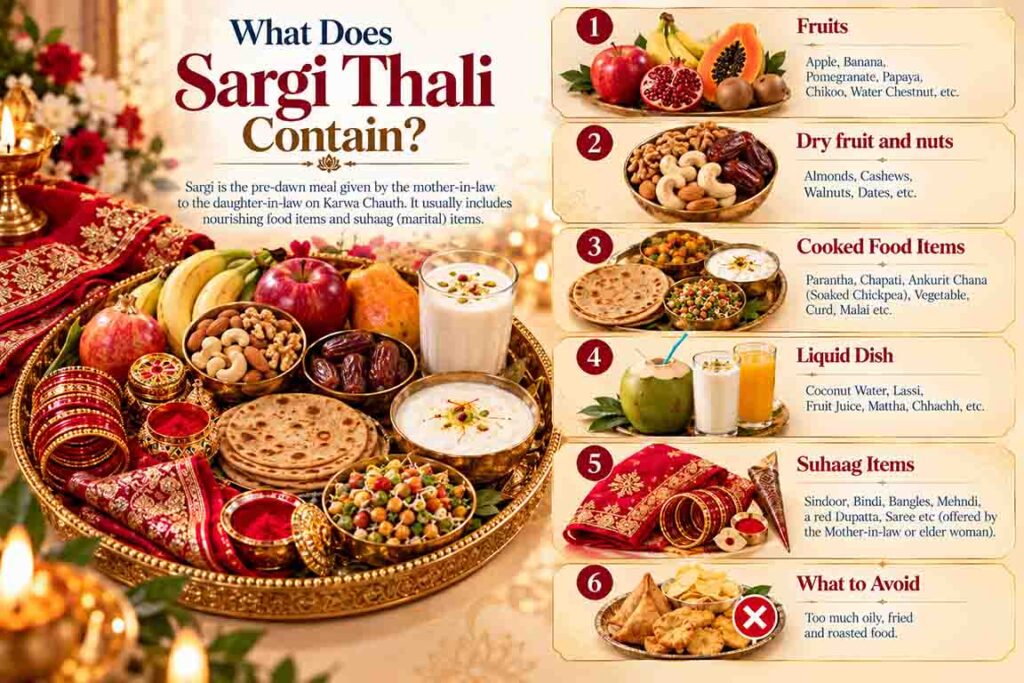 The following is a list of food and other items that a Karwa Chauth Sargi Thali contains:
|
Sargi Thali Menu |
Items |
| Fruits | Apple, Banana, Pomegranate, Papaya, Chikoo, Water Chestnut, etc |
| Dry fruit and nuts | Almonds, Cashews, Walnuts, Dates, etc |
| Cooked Food Items | Parantha, Chapati, Ankurit Chana (Soaked Chickpea), Vegetable, Curd, Malai etc |
| Liquid Dish | Coconut Water, Lassi, Fruit Juice, Mattha, Chhachh, etc |
| Suhaag Items | Sindoor, Bindi, Bangles, Mehndi, a red Dupatta, Saree etc (offered by the Mother-in-law or elder woman) |
| What to Avoid | Too much oily, fried and roasted food. |
Karwa Chauth Puja Vidhi (Step-by-Step): Karwa Chauth Fast Rules
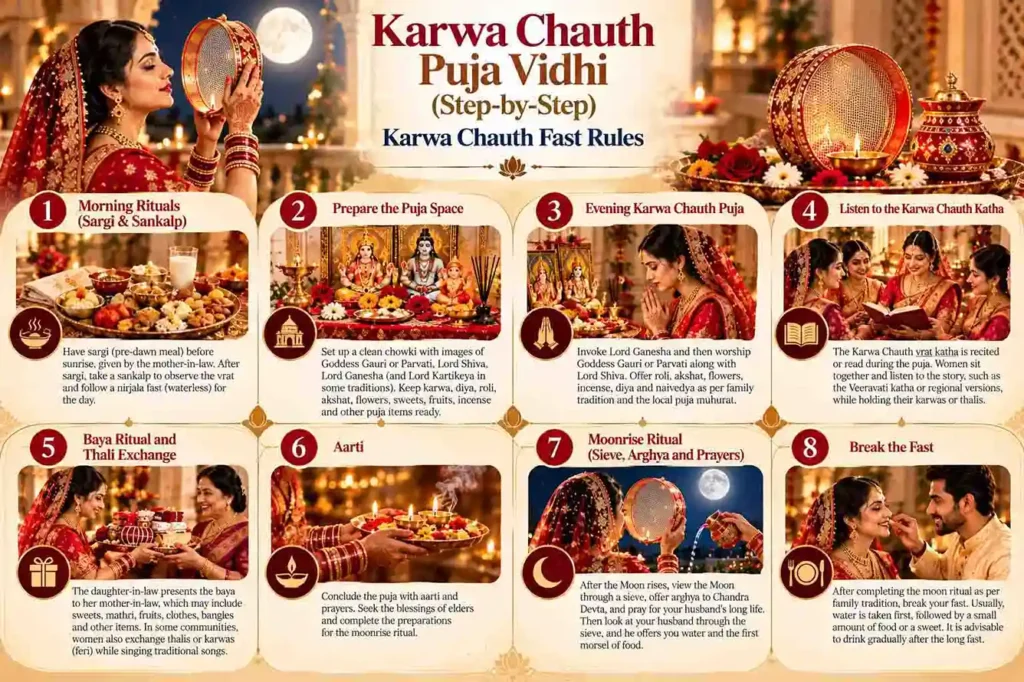 Karwa Chauth is traditionally observed as a day-long vrat that begins after the pre-dawn meal (Sargi) and ends after the moon is sighted in the evening. The main worship is associated with Goddess Parvati or Gauri, along with Lord Shiva, Lord Ganesha and, in some traditions, Lord Kartikeya. The exact sequence varies between regions and families, so the following steps describe a commonly followed North Indian form of the puja.
Step1. Morning Rituals
The day begins before sunrise. After bathing and getting ready, the woman traditionally has her sargi, the pre-dawn meal associated particularly with Punjab, Haryana and neighbouring North Indian communities. The sargi is traditionally given by the mother-in-law and may include fruits, dry fruits, sweets, mathri, seviyan or other family-specific foods. The meal should be completed by the woman (who observes the Karwa Chauth fast) before sunrise, after which the traditional nirjala vrat begins.After sargi, the woman may offer a short prayer and take sankalp, or a personal resolve to observe the vrat. During the day, she prepares for the evening puja, applies mehndi if it has not already been done and gets ready in festive clothing. In many families, red, pink, maroon or other traditional colours are preferred, although there is no single compulsory dress code.
Step 2. Prepare the Puja Space
In the afternoon, prepare a clean place for the evening puja. A chowki covered with a clean cloth may be used. Families commonly place an image of Goddess Gauri or Parvati, sometimes represented as Chauth Mata or Gaura Mata, along with images of Lord Shiva and Lord Ganesha. Some traditions also include Lord Kartikeya.Keep the karwa, diya, roli or kumkum, akshat, flowers, incense, sweets, fruits and other puja items ready. A sieve (channi) and a vessel for offering water to the Moon should also be kept aside for the later moon ritual.
Step 3. Evening Karwa Chauth Puja
The main puja is performed in the evening. The exact auspicious period is location-specific, so the local panchang should be followed rather than using one fixed time for the whole country. A prominent Hindu Panchang gives different 2026 puja windows for Delhi, Gurgaon, Kolkata, Mumbai, Bengaluru and other cities.Evening puja begins by invoking Lord Ganesha and then worshipping Goddess Gauri or Parvati along with lord Shiva. Offer roli or kumkum, akshat, flowers, fragrance, diya and naivedya according to the family’s practice. In some traditions, Chauth Mata or Gaura Mata is the central form of worship.
Step 4. Listen to the Karwa Chauth Katha
The Karwa Chauth vrat katha is traditionally recited or read during the puja. Women may sit together and listen to the story while holding their karwas or thalis. The Veeravati story is one of the best-known narratives associated with the festival, although regional versions of the katha differ.Step 5. Baya Ritual and Thali Exchange
Baya, also called bayna or vayana in different families, is a gift traditionally given by the daughter-in-law to her mother-in-law. It may contain sweets, mathri, fruits, clothes, bangles, money or other customary items. After the puja, the daughter-in-law presents the baya and seeks the elder woman’s blessings.This should not be confused with the feri or thali-exchange ritual. In some communities, women sit together and pass their decorated thalis or exchange karwas in a circle while singing traditional Karwa Chauth songs. The number of rounds and the exact method vary by region and family, so there is no single procedure that applies everywhere.
Step 6. Aarti
The puja concludes with aarti and prayers. Women who observe the vrat of Karwa Chauth seek the blessings of the elders and complete the remaining preparations for the moonrise ritual.Step 7. Moonrise Ritual
After the Moon rises, the fasting woman takes her thali and karwa outside or to a place from where the Moon can be seen.Traditionally, she views the Moon through a sieve (channi), offers arghya to Chandra Devta, and prays for her husband’s goodwill and long life. She then looks at her husband through the sieve, and then her husband offers her water and the first morsel of food (first bite of food generally fruit or sweets), after which the day’s fast is considered complete.
Step 8. Break the Fast
Once the moon ritual has been completed according to the family’s tradition, the woman breaks her fast. Water is usually taken first, followed by a small amount of food or a sweet. After a long waterless fast, it is sensible to drink gradually rather than consuming a large amount at once.Baya Ritual (Thali Exchange) in Karwa Chauth
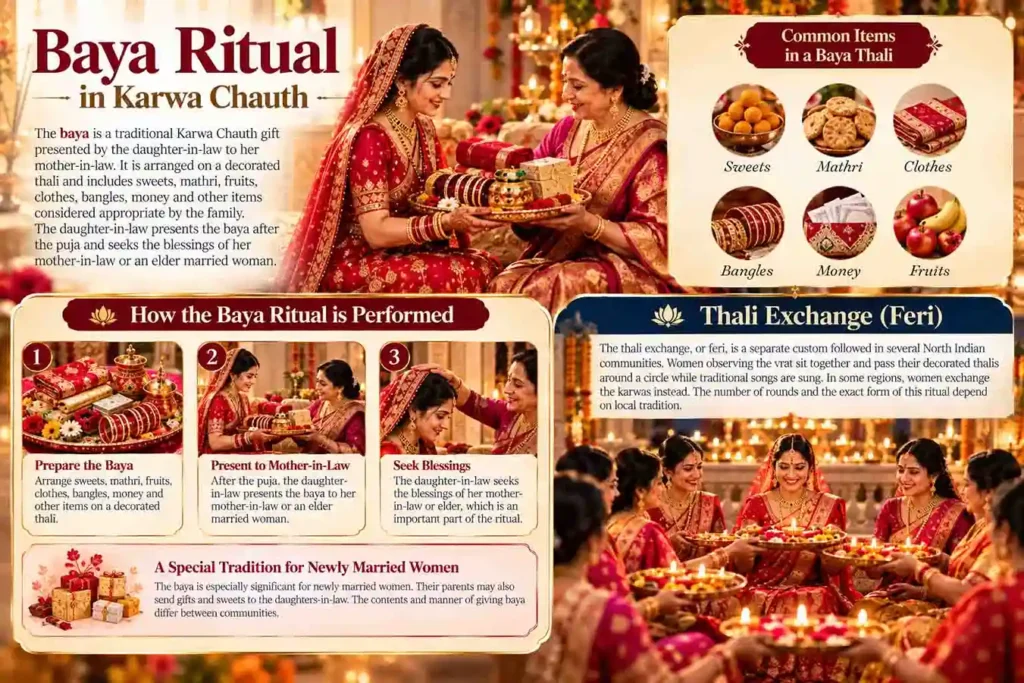 The baya is a traditional Karwa Chauth gift presented by the daughter-in-law to her mother-in-law. It is generally arranged on a decorated thali and includes sweets, mathri, fruits, clothes, bangles, money and other items considered appropriate by the family. The daughter-in-law presents the baya after the puja and seeks the blessings of her mother-in-law or an elder married woman.
The baya is particularly significant for newly married women, whose parents may also send gifts and sweets to the daughters-in-law. However, the contents and manner of giving baya differ considerably between communities.
The thali exchange, or feri, is a separate custom followed in several North Indian communities. Women observing the vrat sit together and pass their decorated thalis around a circle while traditional songs are sung. In some regions, women exchange the karwas instead. The number of rounds and the exact form of this ritual depend on local tradition. Therefore, it is better to follow the practice observed in the family rather than treat one version as the universal Karwa Chauth ritual.
Evening Puja Process
The main Karwa Chauth puja takes place in the evening, with the exact puja period determined by the local panchang. Women traditionally gather with their decorated thalis and karwas, either at home or with other women in the family or neighbourhood.
A simple household sequence is:
- Prepare the puja place: Keep the image of Goddess Gauri or Parvati on a clean chowki. Lord Shiva alongside her. Some families worship Chauth Mata or Gaura Mata.
- Prepare the karwa: Keep the water-filled karwa ready for the puja and later Moon offering. Its decoration and contents vary between communities.
- Arrange the thali: Keep roli or kumkum, akshat, flowers, diya, incense, sweets, fruits and other family-specific puja items.
- Begin the worship: Invoke Lord Ganesha and then worship Goddess Gauri or Parvati, followed by Shiva and other deities according to the family’s tradition.
- Offer puja items: Offer flowers, akshat, kumkum, diya, incense and naivedya.
- Listen to the vrat katha: The Karwa Chauth story is traditionally read or narrated during the gathering.
- Perform the feri or thali exchange: Where this custom is followed, women pass their thalis or exchange karwas while singing traditional songs.
- Offer aarti: Complete the evening worship with aarti and prayers.
- Present the baya: The daughter-in-law presents the baya to her mother-in-law and seeks her blessings, where this custom is followed.
- Wait for moonrise: The fast is not broken during the evening puja. Women wait for the Moon and then perform the Moon-sighting ritual before breaking the fast.
Moonrise Ritual: Sieve, Arghya and Breaking the Fast
The Moon ritual marks the final stage of the traditional Karwa Chauth vrat. The fast is generally completed after the Moon is sighted and the prescribed offering is made.When the Moon becomes visible, the fasting woman takes her thali, karwa and sieve. She looks at the Moon through the sieve (channi) and offers arghya, usually water, to Chandra. A diya may also be held beside or behind the sieve as part of the household ritual.
After offering arghya, she traditionally looks at her husband through the sieve. In many families, the husband then gives her water and the first morsel of food, marking the end of the fast. The couple may then seek the blessings of elders before having their meal.
The sieve is a familiar part of the modern Karwa Chauth ritual, but its symbolic meaning varies across traditions. The important ritual sequence is the sighting of the Moon, offering arghya and completing the vrat before eating.
What if the Moon is not immediately visible?
Clouds, buildings, haze and the local horizon can make the Moon difficult to see even after the moonrise time. Families follow different practices in such circumstances. Because the exact procedure is not uniform, it is better not to present the use of a mobile-phone image, reflection or another city’s Moon as a universal religious rule. If this situation arises, follow the guidance of the family’s priest or the panchang tradition being followed.Karwa Chauth Fast Rules: Dos, Don’ts and Health Considerations
The traditional Karwa Chauth vrat is nirjala, meaning that no food or water is taken after sunrise until the Moon is sighted in the evening. The pre-dawn sargi is therefore eaten before sunrise. Panchang describes the traditional observance as a strict fast without food or water and records the fast as ending after the Moon sighting and the associated offering.However, fasting practices vary between families, and a waterless fast is not appropriate for everyone.
Traditional practices to follow
- Have the sargi and drink water before sunrise, if following the traditional nirjala form.
- Take a bath and prepare for the day’s vrat and evening puja.
- Take sankalp according to your family’s tradition.
- Keep the puja items, karwa and thali ready in advance.
- Participate in the evening puja and listen to the vrat katha.
- Wait for the Moon and complete the Moon ritual before breaking the traditional fast.
- Follow your family’s custom for the sieve, arghya, thali exchange, baya and other rituals.
- Do not eat or drink after sunrise if you have chosen to observe the traditional nirjala form.
- Avoid treating one regional custom as compulsory for every Karwa Chauth observance.
- Do not continue a waterless fast if you become unwell.
- Do not assume that everyone must follow the same fasting method simply because nirjala is the traditional form.
Who may need to modify the fast?
A strict waterless fast can be unsuitable for people with certain medical conditions or nutritional needs. Pregnant women, breastfeeding women, people with diabetes, people taking medicines that require food or regular hydration, older adults, and anyone who is unwell or recovering from illness should discuss fasting with a healthcare professional before attempting a nirjala vrat. For example, medical guidance advises against fasting while actively breastfeeding because it can affect energy intake and milk supply.Depending on the person’s health and medical advice, a family may choose a modified observance that includes water, fruit, milk or regular meals while still participating in the puja and other devotional aspects of the day. This is a health decision rather than a universal religious rule.
Listen to your body
A person who develops significant dizziness, fainting, confusion, severe weakness or other concerning symptoms should stop the fast and seek appropriate medical help. Religious observance should not take priority over an immediate health concern.Solah Shringar in Karwa Chauth
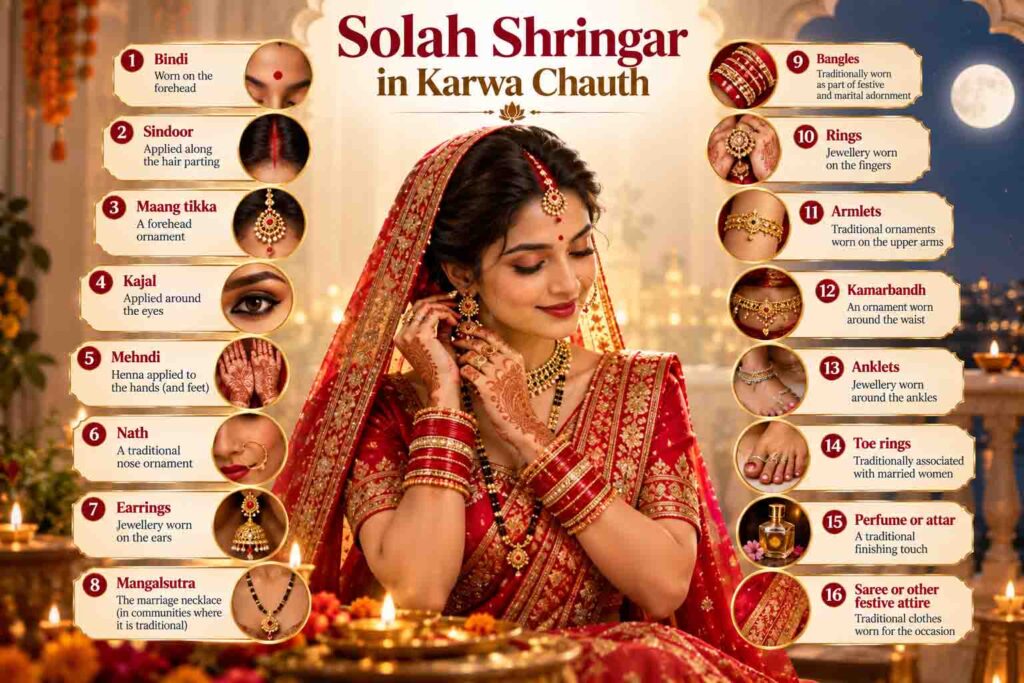 Solah Shringar refers to the traditional sixteen forms of adornment associated with a woman, particularly in the context of marriage and festive occasions. On Karwa Chauth, many married women dress in traditional clothes, apply mehndi and wear jewellery and other adornments associated with the married state.
The exact list of sixteen adornments is not identical across every region or community. A commonly cited list includes:
- Bindi – worn on the forehead.
- Sindoor – traditionally applied along the hair parting by married women.
- Maang tikka – a forehead ornament worn along the hair parting.
- Kajal – applied around the eyes.
- Mehndi – henna applied to the hands and, in some traditions, the feet.
- Nath – a traditional nose ornament.
- Earrings – jewellery worn on the ears.
- Mangalsutra – the marriage necklace in communities where it is part of the tradition.
- Bangles – traditionally worn as part of festive and marital adornment.
- Rings – jewellery worn on the fingers.
- Armlets – traditional ornaments worn on the upper arms.
- Kamarbandh – an ornament worn around the waist.
- Anklets – jewellery worn around the ankles.
- Toe rings – traditionally associated with married women in many communities.
- Perfume or attar – a traditional finishing touch in some lists.
- Saree or other festive attire – included in some modern lists as the final element of the overall adornment.
Can Unmarried Women Keep Karwa Chauth?
Yes, some unmarried and engaged women also observe Karwa Chauth, particularly in North Indian families. However, this is not the same as saying that unmarried women are universally required or traditionally expected to keep the vrat.The traditional form of Karwa Chauth is primarily associated with married women praying for the well-being and long life of their husbands. At the same time, contemporary and family traditions in parts of North India have extended the observance to unmarried women who keep the vrat with the hope of a happy married life or for the well-being of a future or intended partner. Recent reporting also documents unmarried women observing the fast for this purpose.
For unmarried women, there is no single universally prescribed version of the ritual. Some may observe a full fast, while others keep a modified fast with water or fruit. Some participate in the evening puja and katha but escape the husband-specific part of the Moon ritual. The exact practice generally depends on the family’s tradition.
An engaged woman may also choose to observe the day for her fiancé, particularly where this is already a custom in her family. Others may participate in the puja without keeping the full fast.
Therefore, if an unmarried woman wishes to observe Karwa Chauth, the most accurate approach is to follow the custom of her family or community rather than assuming that there is one mandatory procedure for all unmarried women.