+91 9990176000
 +91 9999097600
 CALENDAR 2026


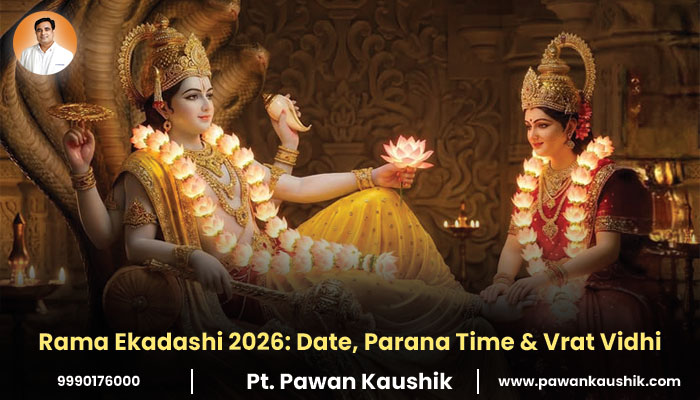 Rama Ekadashi is a festival dedicated to the worship of Lord Vishnu, his consort, Mata Lakshmi, Shree Krishna and Damodara (a name and form of Lord Vishnu). The festival is observed to seek the blessings of Narayana, who is the sustainer of the Universe. The term Rama (रमा) is the title of the deity Lakshmi, who governs wealth and prosperity.
Rama Ekadashi has a vast spiritual significance, and the vrat bestows the blessings of Lord Vishnu and Maa Lakshmi for material and spiritual gain. The blog contains all the important highlights of the festival, including Rama Ekadashi 2026 dates, vrat vidhi, significance, story, etc.
Rama Ekadashi 2026 Dates and Muhurat:
Follow these dates and timings for correct observation of the festival on the correct muhurat- Rama Ekadashi on Thursday, November 5, 2026
- On 6th Nov, Parana Time – 06:37 AM to 08:48 AM
- On Parana Day Dwadashi End Moment – 10:30 AM
- Ekadashi Tithi Begins – 11:03 AM on Nov 04, 2026
- Ekadashi Tithi Ends – 10:35 AM on Nov 05, 2026
Rama Ekadashi Paran Time: When to End the Fast?
Those who observe the Rama Kartik Ekadashi (Rama Ekadashi) fast should keep the fast from the morning (begins at sunrise) of the Ekadashi tithi and break it on the paran tithi when the sun rises.Important note: The fast should not be broken during Hari Vasara, which is the one-fourth (¼) duration of the Dwadashi tithi. Doing this is considered the incompletion of the vrat, and the devotees observing the fast will not receive the merits of the Ekadashi. The best time to break the Rama Ekadashi fast is in the morning (pratha kaal) on parana from 06:37 am to 08:48 am. A devotee can check their city’s local sunrise time on 6th of November and then conclude their vrat.
What is Rama Ekadashi
Rama Ekadashi is a sacred Hindu festival that falls on the 11th lunar tithi in Kartik month. It marks the spiritual preparation for Diwali and begins 4 days before that. Damodara- Lord Krishna, the 8th incarnation (avatar), is the presiding deity of the Rama Ekadashi festival.The term Damodar is a composite of two words: Dam means rope or cord, and udara means belly. Lord Krishna in his childhood was notorious, and he was often tied by her mother, Mata Yasodah, to a rope or pillar. Damodaar is Lord Krishna, who is himself Vishnu.
Known as the Kartik Krishna Ekadashi and Rambha Ekadasha, the festival of Rama Ekadashi marks an important spiritual observance in the days leading up to Diwali, when devotees practise purification, deepen their devotion, and prepare spiritually for the festival. From this onward, the worship of Goddess Lakshmi starts and continues through Diwali.
Rama Ekadashi has vast spiritual significance, where the devotees, by observing the vrat, receive the blessings of Lord Vishnu and Mata Lakshmi. As per the scriptures, the observance of the festival clears the past sins in life and blesses with wealth, prosperity and a good life. On this day, people worship lord- Krishna and Damodara. People also worship Tulsi and the Shaligram stone, which is considered propitious.
Significance of Rama Ekadashi
Ekadashis are considered the most auspicious days in the Hindu calendar for spiritual practices. On the ekadashi tithis, it is beneficial to engage in spiritual activities like worship, fasting, and charity, as the mind easily gets inclined towards spirituality.Observing the Rama Ekadashi fast is believed to please Damodara, a form of the deity Vishnu/Krishna. Observing the sacred vrat is also believed to attract the blessings of the goddess of wealth, Lakshmi Mata.
It is believed that sincere observance and devotion dissolve sin. It also helps remove and overcome the Pitru dosh in the birth chart, which causes unending obstacles in life. Therefore, observing this Ekadashi is considered one way to seek the blessings of ancestors.
Observing the Rama fast or vrat is also believed to grant moksha (worldly liberation) and offer a place at the feet of Lord Vishnu.
Rama Ekadashi Vrat Katha
Once, a king in Machkunda was a great devotee of Lord Vishnu. He observed Ekadashi with full devotion and set the rule that all Machkunda natives observe Ekadashi vrat with devotion. He also had a daughter named Chandrabhagya who was married to the prince Shobana, the son of King Chandrasena.When Shobana visited his in-laws’ family and kingdom after marriage, it was during the 11th lunar tithi of the Kartik month (during Rama Ekadashi). Chandrabhanga advised him to go to another city, as everyone in the kingdom strictly observes the Rama Ekadashi fast, and it was not possible for his husband to observe it because he was weak.
However, Shobana decided to observe the fast and remain in the in-laws’ house. Meanwhile, he could not bear the hunger and thirst and died. As he died observing the Ekadashi vrat of Rama, Shobana was given a heavenly place and the kingdom of Mandrachal Mountain.
Although his kingdom was temporary, as the vrat was not intentional, and he was forced to observe it due to the rule set by his father-in-law. A Brahmin from Machkunda’s kingdom, during the spiritual journey, got the chance to meet Shobana in Mandrachal.
King Shobana extended warm hospitality to him and inquired about her wife and in-law’s kingdom. The Brahmin replied that everything is well, and in return he also asked how he got this kingdom. Shobana shared the story of how, even after his death, he was merited for the vrat, and as it was unintentional, the kingdom is temporary. He also asked the Brahmin to convey this to his wife.
The Brahmin did the same. After hearing this, Chandrabhaga (the wife of Shobana) decided to visit the Mandrachal kingdom and also give all the merits of the Rama Ekadashi vrat to his husband (she had been observing since childhood) to make his husband’s kingdom permanent.
She, along with the Brahmin, set out on the Journey to visit his husband in Mandrachal. In their journey, they met Vamadeva, who offered siddhis and spiritual power to Chandrabhaga so that she could easily reach her husband and succeed in her mission. Chandrabhaga then met Shobana and offered all her accumulated virtue and merits of the ekadashi vrat to her husband and made his kingdom permanent, and they both happily lived together.
The lesson of the story: Our righteous conduct and karma go along with us even after death, and spiritual merits earned in the previous life or in the present life can even move our destiny.
Rama Ekadashi Vrat Vidhi: How to Observe the Fast Correctly?
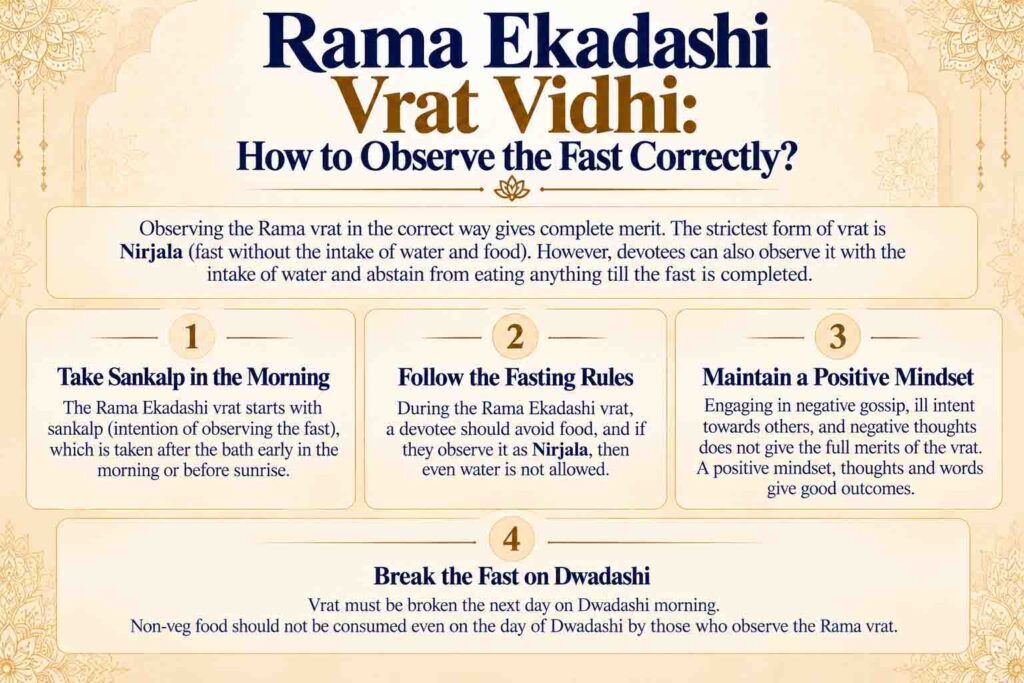 Observing the Rama vrat in the correct way gives complete merit. The strictest form of vrat is Nirjala (fast without the intake of water and food). However, devotees can also observe it with the intake of water and abstain from eating anything till the fast is completed.
The Rama Ekadashi vrat starts with sankalp (intention of observing the fast), which is taken after the bath early in the morning or before sunrise.
During the Rama Ekadashi vrat, a devotee should avoid food, and if they observe it as Nirjala, then even water is not allowed.
Engaging in negative gossip, ill intent towards others, and negative thoughts does not give the full merits of the vrat. A positive mindset, thoughts and words give good outcomes.
Vrat must be broken the next day on Dwadashi morning. Non-veg food should not be consumed even on the day of Dwadashi by those who observe the Rama vrat.
Rama Ekadashi Puja Vidhi (Step-by-Step Worship Procedure)
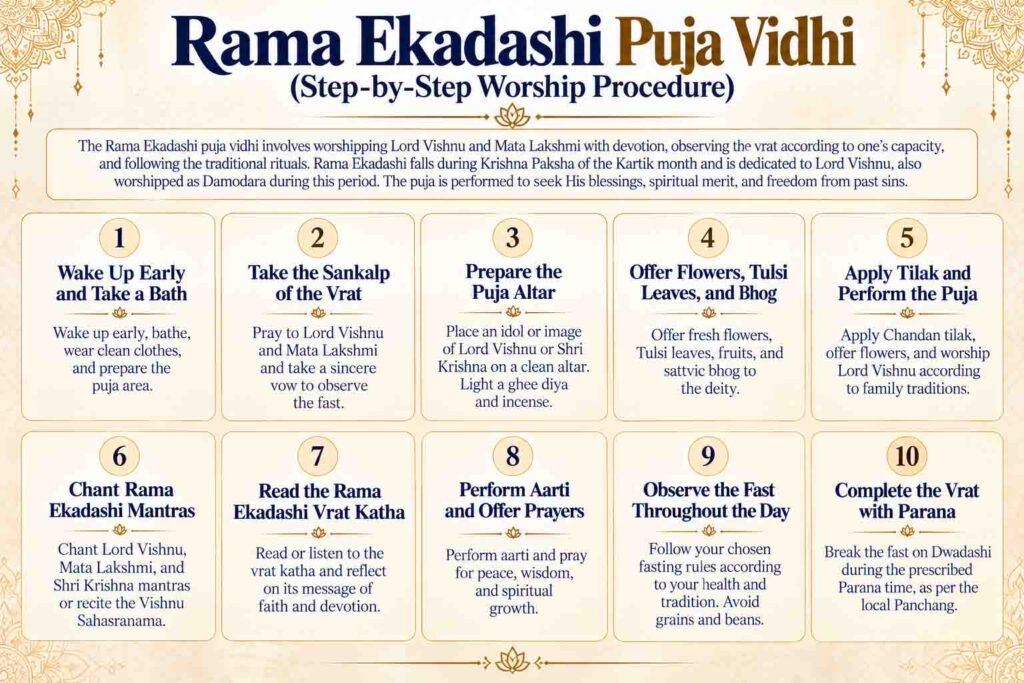 The Rama Ekadashi puja vidhi involves worshipping Lord Vishnu and Mata Lakshmi with devotion, observing the vrat according to one’s capacity, and following the traditional rituals. Rama Ekadashi falls during Krishna Paksha of the Kartik month and is dedicated to Lord Vishnu, also worshipped as Damodara during this period. The puja is performed to seek His blessings, spiritual merit, and freedom from past sins.
Step-by-Step Rama Ekadashi Puja Vidhi
Step 1: Wake up early and take a bathWake up early in the morning, take a bath, and wear clean clothes. Clean the place of worship and prepare for the day’s vrat with a sincere intention to observe it with devotion.
Step 2: Take the sankalp of the vrat
Sit before the altar, remember Lord Vishnu and the deity Lakshmi, and take a sankalp to observe the Rama Ekadashi vrat. Pray for the strength to complete the fast and follow the day’s observances with a pure mind and good intentions.
Step 3: Prepare the puja altar
Place an image or idol of Lord Vishnu or Shri Krishna on a clean altar. You may also worship Lord Damodara or a Shaligram Shila if it is already part of your household tradition. Light a ghee diya and incense sticks.
Step 4: Offer flowers, Tulsi leaves, and bhog
Offer fresh flowers, Tulsi leaves, fruits, and suitable sattvic bhog to the deity. Tulsi holds special importance in the worship of Lord Vishnu. Some devotees also offer makhan and mishri to Shri Krishna according to their family traditions.
Step 5: Apply tilak and perform the puja
Apply Chandan tilak to the deity, offer flowers, and pray to Lord Vishnu with devotion. The specific offerings may vary between families, so follow the customs traditionally observed in your home.
Step 6: Chant Rama Ekadashi Mantra
Lord Vishnu’s mantras, Deity Lakshmi’s mantras, Shree Krishna mantras, and Jaap.
Chant the following mantras while remembering Lord Vishnu, Deity Lakshmi and lord Krishna:
Lord Vishnu Mantras
- Om Namo Narayanaya
- Om Namo Bhagavate Vasudevaya Namaha
- Om Shreem Mahalakshmiyei Namaha
- Om Shreem Hreem Shreem Kamale Kamalalaye Praseed Praseed Om Shreem Hreem Shreem Mahalakshmaye Namah
- Om Kleem Krishnaya Namah
- Hare Krishna Hare Krishna, Krishna Krishna Hare Hare, Hare Rama Hare Rama, Rama Rama Hare Hare
Step 7: Read the Rama Ekadashi vrat katha
Read or listen to the Rama Ekadashi vrat katha, which explains the spiritual merit associated with observing this fast. Reflect on its message of devotion, faith, and the importance of sincere worship.
Step 8: Perform aarti and offer prayers
Perform aarti before Lord Vishnu and pray for peace, wisdom, and spiritual growth. You may also worship Tulsi Ji as part of your household’s Ekadashi traditions.
Step 9: Observe the fast throughout the day
Follow the fasting rules you have chosen according to your health, capacity, and family tradition. Some devotees observe a Nirjala fast, while others consume water, fruits, or permitted vrat food. Avoid grains and beans as prescribed by the traditional Ekadashi fasting rules.
Step 10: Complete the vrat with Parana
Break the fast on Dwadashi, the following lunar day, during the prescribed Parana time. Check the local Panchang for the correct time and follow the customary procedure for completing the vrat.
Rama Ekadashi Worship: Important Things to Remember
The Rama Ekadashi importance lies in devotion to Lord Vishnu, self-discipline, and the spiritual merit traditionally associated with the vrat. The correct way to observe the rituals is to follow the established customs with sincerity rather than treating the observance as a set of formal steps alone.While the puja offerings and fasting practices may differ between households, prayer, remembrance of Lord Vishnu, and sincere observance remain central to the vrat.