+91 9990176000
 +91 9999097600
 CALENDAR 2026


 The year 2026 will witness two lunar eclipses, and the second one is scheduled to occur in August 2026. Lunar eclipses are fascinating astronomical events that attract attention from both sky observers and astrology enthusiasts. They occur when the Earth comes between the Sun and the Moon, casting its shadow on the Moon.
The second lunar eclipse of 2026 will take place on 28 August 2026, coinciding with Shravan Purnima, the day when the festival of Raksha Bandhan is celebrated in India. This eclipse will be an almost complete partial lunar eclipse, creating an impressive celestial view in many parts of the world.
In this article, we explain the date, exact timings, duration, visibility, type of eclipse, and its general astrological significance in a simple and meaningful way.
Second Lunar Eclipse 2026: Date and Timing
According to astronomical calculations and hindu Panchang, the second lunar eclipse of 2026 will occur on:Date: 28 August 2026
Day: Friday
Lunar Eclipse Timings (IST)
- Penumbral Eclipse Begins: 06:55 AM
- Partial Eclipse Begins: 08:04 AM
- Maximum Eclipse: 09:43 AM
- Partial Eclipse Ends: 11:21 AM
- Penumbral Eclipse Ends: 12:30 PM
Duration of the Eclipse
- Duration of Partial Eclipse: 3 hours 16 minutes 37 seconds
- Total Penumbral Duration: 5 hours 35 minutes 44 seconds
Eclipse Magnitude
- Partial Lunar Eclipse Magnitude: 0.92
- Penumbral Magnitude: 1.95
Sutak Period During the Second Lunar Eclipse 2026
According to the Hindu Panchang, the Sutak period will not be applicable in India for this lunar eclipse because the eclipse will not be visible in the country. The details are as follows:- Sutak Start Time: Not applicable
- Sutak End Time: Not applicable
- Sutak Start for Children, the Elderly, and Sick Individuals: Not applicable
- Sutak End for Children, Elderly, and Sick Individuals: Not applicable
Type of Lunar Eclipse
The August 2026 eclipse will be a deep partial lunar eclipse.In a partial lunar eclipse, only a portion of the Moon passes through Earth’s dark shadow (umbra). During this event, a significant part of the Moon will appear darkened.
Astronomical calculations indicate that around 93–96% of the Moon’s surface will be covered by Earth’s shadow at the peak of the eclipse. Because of this high coverage, the Moon may appear copper-red or dark orange, which makes the event visually impressive.
Will the Lunar Eclipse Be Visible in India?
One of the most common questions about this eclipse is whether it will be visible in India.The second lunar eclipse of 2026 will NOT be visible in India because the event will occur during daytime hours according to Indian Standard Time.
Since the Moon will be below the horizon during the eclipse period, observers in India will not be able to see it.
Regions Where the Eclipse Will Be Visible
Although the eclipse will not be visible in India, it will be observable in several other parts of the world.The eclipse will be visible in regions such as:
- North America
- South America
- Europe
- Africa
- Parts of the Pacific Ocean
- Some regions of Asia
Why Lunar Eclipses Occur
A lunar eclipse occurs when three celestial bodies align in a straight line: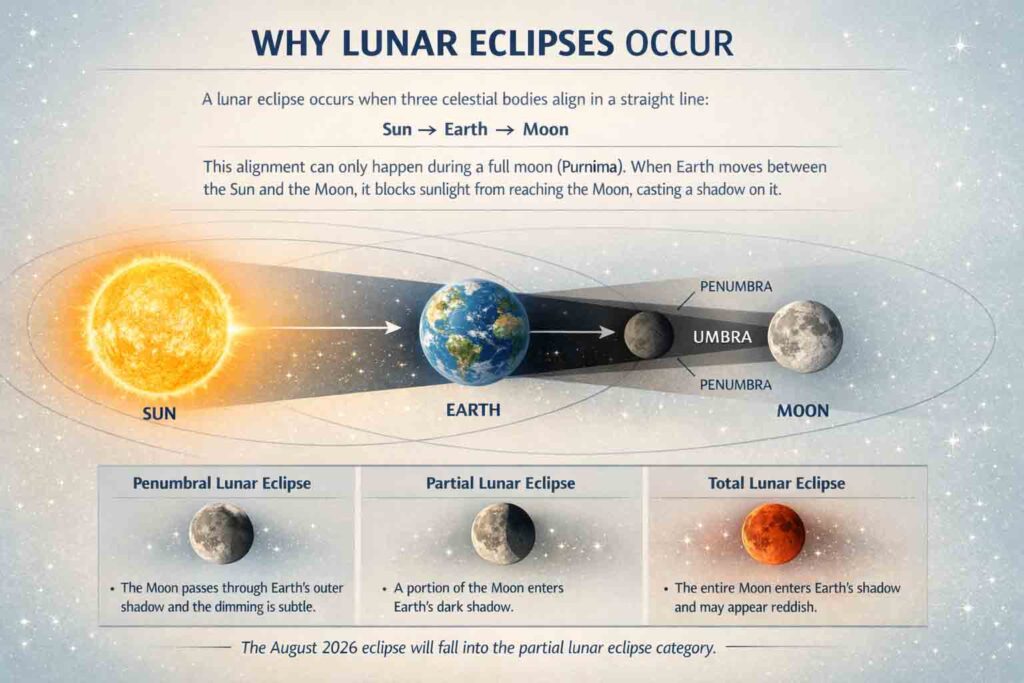
This alignment can only happen during a full moon (Purnima). When Earth moves between the Sun and the Moon, it blocks sunlight from reaching the Moon, casting a shadow on it.
There are three types of lunar eclipses:
- Penumbral Lunar Eclipse – The Moon passes through Earth’s outer shadow and the dimming is subtle.
- Partial Lunar Eclipse – A portion of the Moon enters Earth’s dark shadow.
- Total Lunar Eclipse – The entire Moon enters Earth’s shadow and may appear reddish.
Astrological Significance of Lunar Eclipse
In astrology, lunar eclipses are believed to influence emotional energy, mental clarity, and subconscious patterns because the Moon represents the mind, emotions, and intuition.However, the astrological impact of an eclipse depends on:
- The zodiac sign where the eclipse occurs
- Planetary positions at that time
- An individual’s birth chart
Cultural Significance of the Date
Interestingly, the lunar eclipse occurs on Shravan Purnima, which is celebrated in India as:- Raksha Bandhan
- Shravani Purnima
Also check out our thoughts on Solar Eclipse

Conclusion
The second lunar eclipse of 2026 will occur on 28 August 2026 and will be a deep partial lunar eclipse lasting nearly 5 hours and 35 minutes. Although a large portion of the Moon will be covered by Earth’s shadow, the eclipse will not be visible in India, meaning there will be no Sutak restrictions or temple closures in the country.For observers in other parts of the world, such as Europe, Africa, and the Americas, the eclipse will present a remarkable astronomical event. Whether viewed scientifically or culturally, lunar eclipses continue to remind us of the fascinating alignment of celestial bodies in our solar system.
You may also find this related article useful: Lunar Eclipse Rituals to Prevent Yourself from Its Effects