+91 9990176000
 +91 9999097600

 CALENDAR 2026


 A sister is worried, her brother lives far away for studies and she wants to know when Bhai Dooj falls this year. Many questions arise in her mind “ should I do tilak before lunch or after?” or “When is the right time to celebrate?”. Fair enough. But it becomes trickier this year as it falls on two days (Dwitiya Tithi) which start from one afternoon and end on the other. So, to give picture clarity, here’s the right guidance about the tithi, muhurat, vidhi and its story.
Quick Answer: When is Bhai Dooj? Wednesday, 11 November, with Dwitiya Tithi running from 2:00 PM on 10 November to 3:53 PM on 11 November. The auspicious time for tilak is in the afternoon (Aparahna): about 1:10-3:20 PM in Delhi and 1:29-3:45 PM in Mumbai.
Bhai Dooj 2026 Date and Time
Bhai Dooj falls on Kartik Shukla Dwitiya, the final day of Diwali festival.| Detail | 2026 |
| Diwali | Sunday, 8 November |
| Govardhan Puja | Tuesday, 10 November |
| Bhai Dooj
Hindu Month Paksha Tithi |
Wednesday, 11 November
Kartik Shukla Paksha Dwitiya Tithi |
| Dwitiya tithi begins | 2:00 PM, 10 November |
| Dwitiya tithi ends | 3:53 PM, 11 November |
| Aparahna tilak muhurat, Delhi NCR | 1:10 PM – 3:20 PM |
| Aparahna tilak muhurat, Mumbai | 1:30 PM – 3:46 PM |
Bhai Dooj Timing: Why 11 November and Not 10
Dwitiya tithi starts at 2:00 PM on 10 November and ends at 3:53 PM on 11 November. On 10 November it starts partway through the afternoon, so it doesn’t fully cover that day’s Aparahna tilak muhurat. On 11 November it covers the whole afternoon (Aparahna muhurat). So, this is the most suitable and auspicious time to do Tilak. A few calendars still show 10 November. In Foreign countries such as the USA, Canada and the UK, it shows the date is 10 November.Madhyahna Kaal and Aparahna: Which Is Correct?
Starting from the beginning, understand the base first. According to our ancient text, the auspicious muhurat (time) is calculated on the basis of panchang. Panchang works on the movement of the sun and moon and their astronomical positions.In simple terms, Panchang splits the day in five equal parts (from sunrise to sunrise). Pratahkala (morning), Sangava (late morning), Madhyahna (midday), Aparahna (afternoon) and Sayahna (evening). The auspicious muhurat is calculated and shows the part in which it is coming. Traditionally, used for festivals like the Ganesh Chaturthi puja.
But Bhai Dooj is an exception, the auspicious time for tilak is Aparahna (afternoon), the fourth part of the day. In Delhi, Madhyahna runs roughly 11 AM to 1:10 PM, then Aparahna takes over. So the midday hour feels right, but it isn’t the traditional slot.
Why Bhai Dooj Is Celebrated: The Yama-Yamuna Story
The festival is the symbol of bonding, care and love between siblings. A care with a sister’s prayer for her brother’s long life. Once, Goddess Yamuna invited her brother Yamaraj (god of death) to a feast at her house on this day. She welcomed him warmly with aarti, a tilak and tie thread on his wrist. To see such devotion and love Yama pleased and declared that a brother who receives a tilak from his sister on this day will be blessed with long life. Yama blessed Yamuna and promised her to protect her life long. That’s why the day becomes special and also called Yama Dwitiya and why brothers traditionally visit their sisters.Importance of Bhai Dooj
Beyond the story, the importance of Bhai Dooj lies in the trust and bond that is shared by siblings. Sisters pray for their brother’s long and happy lives. Brothers offer gifts and a promise of protection. It is like a get together where in such a busy life, work load. Chaotic life, there’s one afternoon where everyone in the family sits together and eats.Take the above example where a sister wants to celebrate Bhai Dooj with her brother who studies outside (far away from home). So, after knowing the right day and time of Bhai Dooj festival. She planned and surprised her brother. Do tilak and other vidhi. That one afternoon they both sat together and ate after a very long time, away from other worries.
Bhai Dooj Is Celebrated in Which State?
Diversity is the hallmark of India. This festival is celebrated all over the country under different names. In North India, from Delhi and Uttar Pradesh to Bihar and Rajasthan, it’s Bhai Dooj. Maharashtra calls it Bhau Beej, West Bengal Bhai Phota, and Nepal Bhai Tika. In the southern part of India it’s Yama Dwitiya.The Bhai Dooj celebration changes with the region too. In West Bengal, the Phota is applied with sandalwood as tilak, In Nepal, sisters apply a seven-coloured tika. So, there are different ways for celebration according to the region.
Bhai Dooj Thali: Samagri Checklist
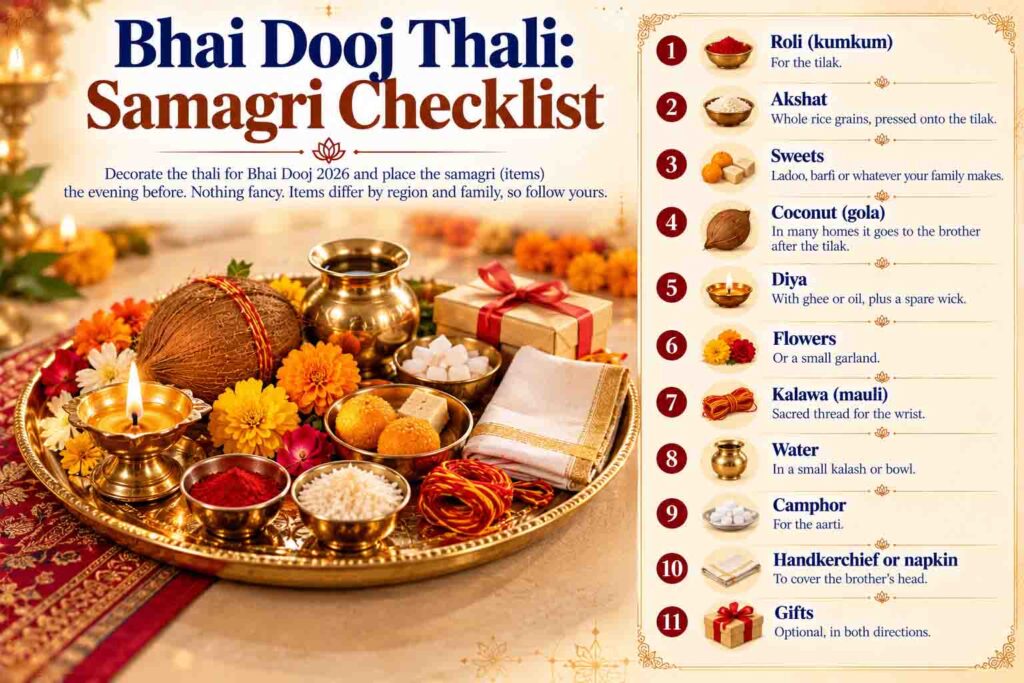
Decorate the thali for Bhai Dooj 2026 and place the samagri (items) the evening before. Nothing fancy. Items differ by region and family, so follow yours.
- Roli (kumkum) for the tilak
- Akshat: whole rice grains, pressed onto the tilak
- Sweets: ladoo, barfi or whatever your family makes
- Coconut (gola): in many homes it goes to the brother after the tilak
- Diya with ghee or oil, plus a spare wick
- Flowers or a small garland
- Kalawa (mauli): sacred thread for the wrist
- Water in a small kalash or bowl
- Camphor for the aarti
- Handkerchief or napkin to cover the brother’s head
- Gifts: optional, in both directions
Bhai Dooj Rituals and Vidhi: How to Celebrate Bhai Dooj
 Ways differ region to region, so keep accordingly. Core things of rituals and vidhi that are practiced. Here’s a simple explanation.
- The sister bathes early and takes a vow to fast until the tilak.
- The brother does his morning rituals, ideally a Yamuna dip or an oil bath at home.
- In the afternoon, he goes to his sister’s house for a feast with gifts.
- She welcomed with the diya and circles the aarti thali around his face clockwise, three, five or seven times.
- She applies the roli tilak with akshat on his forehead, ties the kalawa, and offers sweets and coconut.
- The brother honours her with new clothes and money, then shares the meal she prepared with love and care.
- She prays for brother’s long life and well being and the brother promised to protect his sister for life long.
Bhai Dooj vs. Raksha Bandhan
| Bhai Dooj | Raksha Bandhan | |
| Date | Kartik Shukla Dwitiya, two days after Diwali | Shravan Purnima |
| Main ritual | Tilak and aarti | Tying a rakhi |
| Story | Yama and Yamuna | Several legends |
| Who visits | The brother traditionally visits his sister | Varies by family |
A Calm Close
Bhai Dooj 2026 asks very little: an afternoon, tilak and someone you love. Plan the tilak under the Aparahna time, keep the vidhi simple, and don’t stress if your family’s custom differs from a website’s. If you’d like a muhurat read against your own chart, or a family question has been weighing on you, you’re welcome to book a Vedic astrology consultation in Gurgaon at Pt. Pawan Kaushik.A vedic astrologer with 30+ experience and consulted lakhs of happy clients across the country, provides both online and offline consultation. The way of making you understand your chart is in a simpler manner. No pressure. Bring your questions.
Astrology and puja offer guidance and tradition. Astrology works as a guiding map that leads you towards your future goals and helps you to make the right decision.